The Federal Data Behind Your Lower Back Pain
If you work in a warehouse — pulling orders, loading trailers, operating powered industrial equipment, sorting packages — your lower back is absorbing punishment that federal occupational health data quantifies in stark terms. The Bureau of Labor Statistics tracks musculoskeletal disorders (MSDs) by occupation, and the data is unambiguous: the back is the most common body part injured across all U.S. occupations with days away from work. Warehousing and storage consistently rank among the highest-MSD sectors in that dataset. This is not anecdote. It is the federal injury surveillance record.
The downstream costs compound quickly. BLS Employer Costs for Employee Compensation data shows that industries with high MSD incidence carry workers' compensation insurance rates 3–5 times higher than low-MSD industries. That premium is not just a corporate accounting line — it reflects the aggregate biological cost of jobs that load the lumbar spine for eight to twelve hours at a stretch. And the SSA Disability Insurance program identifies musculoskeletal disorders as the largest single category of new disability claims annually, which means for a meaningful share of warehouse workers, the trajectory from chronic back pain to permanent work disability is a documented, actuarially-priced reality.
None of this is intended to be fatalistic. It is intended to be honest about the scale of the problem before recommending interventions — because the gap between what most workers do after a shift (collapse on whatever surface is available) and what federal data suggests would actually help is significant.
Why Warehouse Work Specifically Degrades the Lumbar Spine
Understanding the mechanism matters before reaching for any intervention, whether that intervention is a new exercise routine, a clinical visit, or a different sleep surface.
Compressive spinal loading during the shift. The NIOSH Lifting Equation — the federal standard for evaluating manual material-handling risk — documents that warehousing tasks routinely exceed the 3,400-Newton spinal compression limit considered safe for repetitive lifting. A typical order-picker lift, performed with even modest forward trunk flexion and load offset from the body's center of gravity, can generate compressive forces on the L4–L5 and L5–S1 discs that NIOSH classifies as high-risk for cumulative injury. This is not a single traumatic event. It is a dosing problem: hundreds of sub-maximal compression events per shift, accumulated over months and years, that progressively reduce intervertebral disc height and elasticity.
Sustained static postures. Fork-lift operators, inventory scanners, and receiving clerks often hold asymmetric trunk positions for extended periods. The paraspinal muscles — erector spinae, multifidus — fatigue under sustained isometric contraction, shifting load to passive structures (ligaments, discs, facet joint capsules) that are not designed for prolonged mechanical stress. Electromyographic research on warehouse workers consistently shows paraspinal muscle fatigue developing within the first two hours of a shift, with incomplete recovery during standard break periods.
Vibration exposure. Powered industrial truck operators and workers on loading dock equipment are exposed to whole-body vibration (WBV) at frequencies (4–8 Hz) that resonate with the natural frequency of the lumbar spine. NIOSH ergonomics guidance identifies WBV as an independent risk factor for lumbar disc degeneration, distinct from the compressive loading associated with manual handling.
Off-shift recovery deficit. Here is where sleep surfaces enter the picture, and where the data becomes directly actionable. After a shift of high-compressive lumbar loading, the intervertebral discs undergo a rehydration process during recumbency — essentially, fluid re-enters the nucleus pulposus when axial load is removed. This process requires actual horizontal time and a spine held in relative neutral alignment. CDC sleep surveillance data shows that approximately 35% of U.S. adults report sleeping fewer than 7 hours per night, the threshold associated with elevated chronic disease risk. For warehouse workers running mandatory overtime or irregular shift patterns, that number is almost certainly worse. Insufficient sleep duration compromises the disc rehydration window. Poor sleep surface mechanics — a mattress that allows the lumbar spine to sag or a sleeping position that maintains muscular tension — further erodes whatever recovery window is available.
CDC NCHS Data Brief 390 reports that approximately 20% of U.S. adults experience chronic pain, with the lower back as the most common pain location. In high-physical-demand occupations, that baseline rate is exceeded substantially. The progression from occupational acute injury to chronic pain condition is well-documented: inadequate recovery between shifts is a primary accelerant.
The financial burden is not theoretical. AHRQ HCUP data identifies back pain as one of the most expensive conditions in U.S. healthcare by total inpatient and outpatient cost, and AHRQ MEPS data shows that average annual personal healthcare expenditures for adults with chronic back conditions substantially exceed costs for adults without such conditions. CMS drug spending data identifies opioid and non-opioid pain medication spending among the most expensive Medicare drug categories — a downstream reflection of undertreated and under-prevented musculoskeletal injury. Warehouse workers who understand this trajectory have strong financial self-interest in taking recovery seriously, not just occupational.
The Cheapest Interventions Are the Ones That Cost Nothing
Before recommending any product, federal health agencies are clear that behavioral and mechanical interventions carry strong evidence and zero price tag. The principle is straightforward: the cheapest intervention is the one that does not require buying anything. Several of the most evidence-supported approaches for lumbar recovery in high-physical-demand workers fit that description exactly.
Daily walking is consistently underrated in this population. NIH NCCIH's evidence review on low-back pain finds that walking 30 minutes most days reduces chronic low-back pain as effectively as most non-drug clinical treatments. For warehouse workers who spend eight hours on their feet, the instinct is often to rest completely off-shift — but passive rest actually allows the paraspinal muscles to stiffen and reduces the fluid exchange in lumbar discs. Low-load walking maintains intervertebral disc nutrition through cyclic compression-decompression and keeps the multifidus and erector spinae conditioned for the demands of the next shift.
Sleep position is the single highest-leverage free variable in overnight recovery. NIH guidance on back pain recommends side-sleeping with a pillow between the knees, or back-sleeping with a pillow under the knees, as the positions that best maintain lumbar neutral alignment during sleep. Stomach sleeping — extremely common in the general population — torques the lumbar spine into sustained extension and lateral rotation and is directly contraindicated for workers with existing disc irritation or facet pain. Changing sleep position costs nothing and can produce measurable morning stiffness reduction within days.
Lifting and movement mechanics during the shift deserve rehearsal, not just instruction. OSHA's ergonomics guidance is explicit: hinge at the hips, not the lumbar spine; keep loads close to the body's center of gravity; avoid twisting under load. The majority of acute warehouse back episodes are mechanical — they are caused by a specific movement pattern — and movement patterns are trainable. Workers who learn to initiate lifts from a hip-hinge pattern rather than lumbar flexion substantially reduce peak disc compression per lift, which compounds favorably over a full shift.
Mattress audit before replacement. Before spending anything on a new sleep surface, CDC sleep hygiene guidance and clinical consensus point to a simple evaluation: Does your mattress have visible sag in the middle third? Do you wake stiffer than you went to bed? Is it older than 7–10 years? If the answer to any of these is yes, the mattress may be actively contributing to morning pain regardless of how good your sleep position discipline is. Even the most precisely engineered sleep surface does not undo poor sleep hygiene or sedentary off-shift hours.
Many warehouse workers reading this have already tried the free interventions, already corrected their sleep position, already replaced a saggy mattress with whatever was available at a local furniture store, and are still waking with significant lumbar stiffness. That is the population for whom sleep surface specifics matter — and where the engineering differences between mattresses translate into genuinely different morning outcomes.
When to See a Clinician Before Considering Any Product
Some back pain presentations in warehouse workers are not sleep surface problems. They are medical problems, and buying a new mattress will not address them and may delay appropriate care.
NIH National Institute of Neurological Disorders and Stroke guidance identifies specific red flags that warrant prompt clinical evaluation rather than self-treatment. Do not buy a new mattress for any of the following presentations: back pain that radiates below the knee (suggesting nerve root compression or disc herniation with radiculopathy); back pain following a traumatic event such as a fall or vehicle collision; back pain accompanied by leg weakness, numbness, or tingling; any changes in bowel or bladder function concurrent with back pain; or back pain accompanied by fever, unexplained weight loss, or pain that is worse at night in a non-positional pattern. These presentations require imaging and clinical assessment, not sleep surface optimization.
CDC Arthritis data shows approximately 25% of U.S. adults report doctor-diagnosed arthritis, with prevalence concentrated in occupations involving sustained physical demand — warehouse workers included. Inflammatory arthropathies affecting the lumbar spine (ankylosing spondylitis, for example) present with morning stiffness lasting more than 45 minutes and pain that actually improves with activity rather than rest — the opposite pattern from mechanical low-back pain. If your stiffness is worst in the first hour of the morning regardless of sleep surface and improves significantly once you get moving, that pattern warrants rheumatological evaluation, not a mattress upgrade.
Sleep Surface Considerations for Workers With High Spinal Load Exposure
For warehouse workers who have passed the red-flag screen and are dealing with mechanical low-back pain driven by cumulative occupational loading, sleep surface selection becomes a legitimate clinical-adjacent decision. The key variables are support (the mattress's ability to maintain lumbar neutral alignment across body weight and position), pressure relief (particularly at the hips and shoulders for side-sleepers), and durability under higher body weights — a factor that becomes particularly important for workers who are above average body weight, which is common in manual material-handling occupations.
Memory foam versus hybrid construction. Pure foam mattresses distribute weight broadly and eliminate motion transfer, but they can run warm and retain heat — a significant comfort issue for workers returning from physical exertion with elevated core temperatures. Hybrid mattresses combine a foam or latex comfort layer with a pocketed coil support core, which improves airflow while preserving pressure relief. For workers with significant lumbar disc irritation, medium-firm to firm support is generally recommended in clinical literature — the spine should not drop into a valley in the mattress.
Weight-specific engineering matters. A mattress built to a standard weight assumption (roughly 180–200 lbs) will perform differently under a 240- or 270-pound warehouse worker than its specifications suggest. Coil gauge, foam density, and edge support design all change the effective feel and support profile under heavier loads. Workers who have bought a "firm" mattress and found it still bottoms out are usually experiencing a weight-load mismatch, not an incorrect firmness preference.
The Saatva Loom & Leaf Memory Foam Mattress is the premium memory foam pick for warehouse workers dealing with serious back pain in the average-to-above-average weight range. Saatva uses a multi-layer organic cotton cover, a spinal zone quilting pattern targeting lumbar support, and layered adaptive memory foam that responds to pressure without the heat-retention problems of lower-density foams. The Loom & Leaf comes in Relaxed Firm and Firm options — for most warehouse workers with chronic lumbar complaints, the Relaxed Firm provides the pressure relief needed at the hips without sacrificing the mid-section support that keeps the lumbar spine from flexing into the mattress. Saatva also offers white-glove delivery and free removal of the old mattress, which matters if you are replacing a unit with visible sag.
The Saatva HD Mattress is engineered specifically for heavier users — it is rated to 500 pounds and built with a higher-gauge support coil system than standard mattresses. For warehouse workers above 250 pounds who have tried standard mattresses and found them insufficiently supportive after several months of use, the Saatva HD addresses the weight-load mismatch directly. The HD uses a dual-coil system (micro coils over standard coils) that provides zoned support, with a firmer zone under the lumbar region and softer zones under the shoulder and hip contact points. This matters specifically for side-sleeping warehouse workers who need lumbar support without hip pressure.
The Purple Hybrid Premier Mattress uses Purple's proprietary GelFlex Grid — a hyper-elastic polymer grid that behaves differently from both foam and latex. The grid collapses under concentrated pressure points (hips, shoulders) to allow them to sink to neutral, while maintaining support under the lumbar region, which exerts more distributed, lower pressure. For warehouse workers with significant hip and shoulder pressure pain overlapping their lumbar complaints — a common pattern in workers who are forced into side sleeping by lumbar pain but develop secondary hip bursitis — the Purple Hybrid Premier's pressure map is distinctly different from standard foam. The pocketed coil base also provides the airflow that workers running hot after physical exertion need.
Mattresses Built for Warehouse Worker Lumbar Recovery
These three sleep surfaces were selected specifically for workers with high-compressive lumbar load exposure: one premium memory foam pick for serious back pain, one heavy-duty hybrid for workers above 250 lbs, and one grid-technology pick for workers with overlapping hip and shoulder pressure pain.

Saatva Loom & Leaf Memory Foam Mattress
$1,695-$3,295
See Price at Saatva →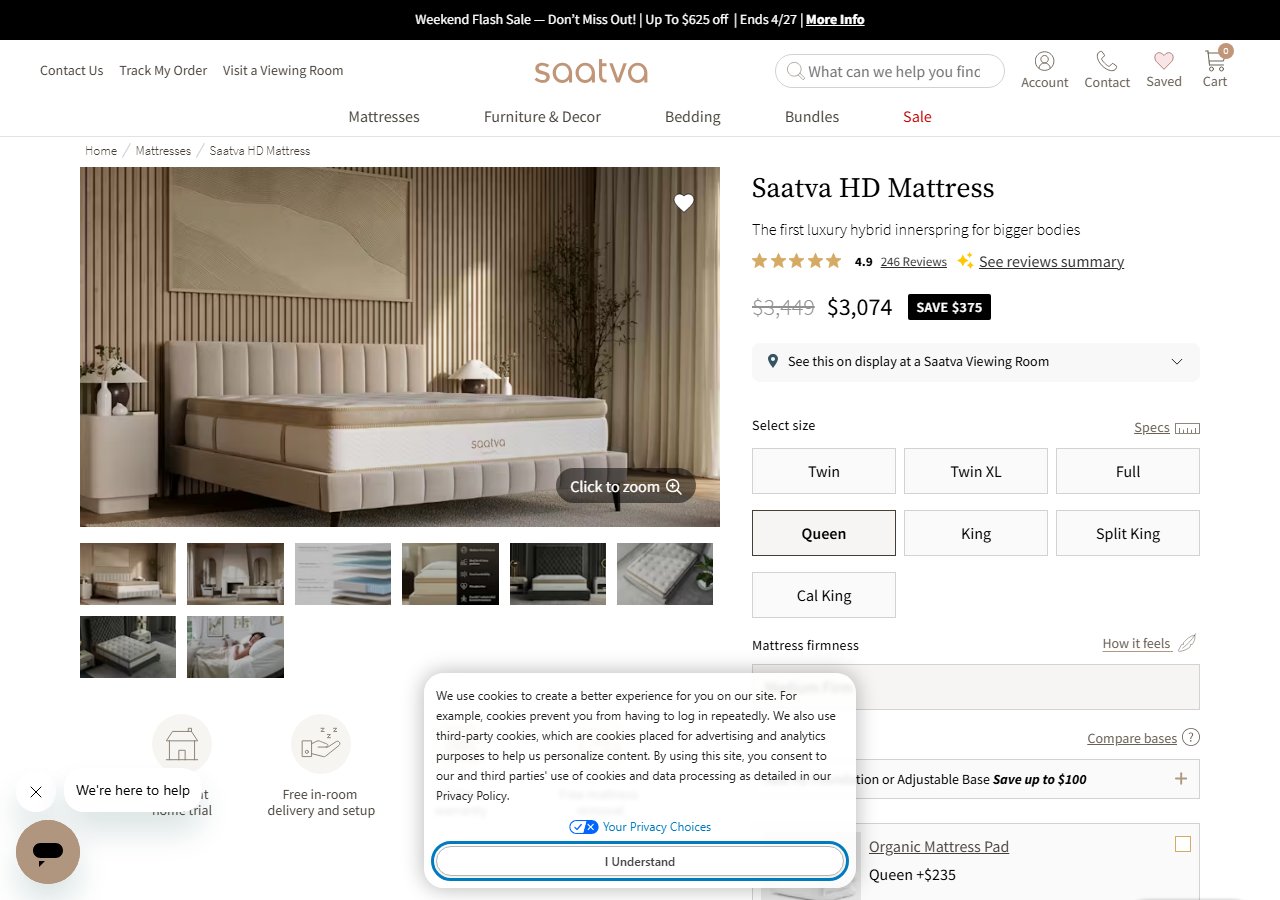
Saatva HD Mattress (Heavy-Duty)
$2,395-$3,995
See Price at Saatva →
Purple Hybrid Premier Mattress
$2,499-$4,799
See Price at Purple →The Data-to-Recovery Hierarchy in Practice
Federal occupational health data does not recommend mattresses. What it recommends — through NIOSH, OSHA, NIH, and CDC — is a hierarchy: understand the mechanism, modify the exposures where possible, apply behavioral interventions first, seek clinical care for red-flag presentations, and then consider equipment and sleep surface optimization as adjuncts to the primary interventions.
For warehouse workers, that hierarchy is specific. The NIOSH data on spinal loading during manual material handling argues for mechanics correction on the job. The NIH evidence on walking argues for active recovery off the job. The CDC sleep data argues for protecting sleep duration and position. And for workers whose occupational exposure is genuinely high — who are lifting above the NIOSH action limit repeatedly, who are running overnight shifts with disrupted circadian rhythms, who weigh more than the average mattress is engineered to support — the sleep surface becomes a legitimate part of the recovery stack.
The AHRQ MEPS data on chronic back condition costs provides the financial frame: adults with chronic back conditions spend substantially more on personal healthcare annually than those without. A sleep surface investment — particularly in a mattress engineered for heavier bodies or zoned lumbar support — is a prevention expenditure measured against a chronic-care cost trajectory. That framing does not make every expensive mattress worth buying. It makes the selection decision worth doing carefully, with the biomechanical specifics of your occupation in mind.
The most important variable is not brand. It is whether the surface you sleep on allows your lumbar spine to spend 7–8 hours in neutral alignment, rehydrating the discs that absorbed compressive load across your shift. Everything else — foam type, coil gauge, cover material — is in service of that single mechanical goal.