The federal data on warehouse back injury is not subtle
If you work in a warehouse — pick-and-pack, receiving, palletizing, order fulfillment — your lower back is the most statistically at-risk part of your body on the clock. According to BLS Musculoskeletal Disorders by Occupation tracking, the back is the single most injured body part across all U.S. occupations resulting in days away from work. Warehousing is not an outlier in that dataset — it anchors the high end. When the Bureau of Labor Statistics publishes its Survey of Occupational Injuries and Illnesses each year, material movers, hand laborers, and freight workers consistently appear among the occupations with the highest incidence rates for MSD events involving the trunk and spine.
The downstream costs of that reality are staggering. AHRQ HCUP data identifies back pain as one of the most expensive conditions in U.S. healthcare by combined inpatient and outpatient cost. SSA Disability Insurance reports show musculoskeletal disorders are the largest single category of new disability claims filed each year — claims that represent real workers who could no longer do their jobs. And BLS Employer Costs data shows that industries with high MSD incidence carry workers' compensation insurance rates 3 to 5 times higher than low-MSD industries, a cost that ultimately circulates back to wages and benefits.
This article is not about selling you a mattress. It is about what the federal data actually says about why warehouse workers' backs fail, what the evidence-based interventions look like in order of cost and effectiveness, when to stop self-treating and see a clinician, and — after all of that — what sleep surfaces the research supports for the specific biomechanical profile of a shift worker recovering from repetitive manual handling.
Why warehouse work specifically destroys the lumbar spine
Understanding why requires a brief detour into biomechanics. The lumbar spine — L1 through L5 and the sacrum — is engineered for load-bearing in a neutral, upright posture. The intervertebral discs act as hydraulic shock absorbers, and the surrounding musculature provides stabilization. That system works reasonably well for walking, standing, and carrying loads held close to the body. It does not work well for what warehouse workers actually do across a 10-hour shift.
The NIOSH Lifting Equation — the federal standard for evaluating manual material-handling tasks — documents that routine warehouse activities including repetitive lifting, lateral reaching, floor-to-shelf stacking, and pallet loading consistently generate Lifting Index values above 1.0, the threshold at which spinal compressive and shear forces exceed what is considered safe for the working population. A Lifting Index above 3.0, which NIOSH considers high risk, is not unusual in high-volume fulfillment environments where workers lift 300 to 600 individual items per shift.
The mechanism of injury is cumulative. Each lift that exceeds neutral-spine mechanics applies asymmetric compressive load to the annulus fibrosus — the outer ring of the intervertebral disc. Over months and years, that repetitive microtrauma creates radial fissures in the annulus, reducing the disc's capacity to absorb compressive force. This is the anatomical precursor to the disc bulge and herniation patterns that BLS injury records capture as "back strains" and "disc disorders." The acute "I threw my back out lifting a box" narrative is usually the final event in a long subclinical deterioration process, not a random accident.
Shift timing compounds this. Many warehouse environments run rotating shifts — days to nights and back — which CDC sleep data identifies as a direct driver of the 35% of U.S. adults who sleep fewer than 7 hours per night. Shift workers, particularly rotating-shift workers, report significantly higher rates of insufficient sleep than day workers. Sleep is when the intervertebral discs rehydrate: in a supine or side-lying position with spinal pressure removed, the disc nucleus pulposus reabsorbs fluid lost during the day's compression cycles. A warehouse worker who sleeps 5 to 6 hours on a sagging mattress, on a poor sleep surface, or in a spine-torquing position is literally sending their discs into the next shift under-recovered.
CDC NHANES survey data shows approximately 20% of U.S. adults experience chronic pain, with the lower back as the most common location. For warehouse workers, that number almost certainly underestimates prevalence, since occupational cohort data consistently shows higher chronic pain rates among manual material handlers than among sedentary workers. CDC Arthritis data adds another layer: approximately 25% of U.S. adults report doctor-diagnosed arthritis, with prevalence concentrated in physically demanding occupations — the facet joints of the lumbar spine are among the joints most affected in heavy-lifting workers.
The treatment burden is real. AHRQ Medical Expenditure Panel Survey data shows that annual personal healthcare expenditures for adults with chronic back conditions substantially exceed costs for those without — and CMS Drug Spending data identifies opioid and non-opioid pain medication among the most expensive Medicare drug categories, a direct reflection of how undertreated and undertreated-with-wrong-tools chronic spinal pain actually is across the working-age population.
The biomechanics of sleep surface pressure for manual handlers
Before discussing specific products, it is worth establishing what the research says a sleep surface actually needs to do for a warehouse worker's lumbar spine — because it differs meaningfully from what a sedentary office worker needs.
A manual handler's lumbar spine arrives at the mattress in a state of compressive fatigue. The paraspinal musculature — the erector spinae, multifidus, and quadratus lumborum — has been contracting isometrically and dynamically for 8 to 12 hours. The intervertebral discs are slightly thinner than they were at shift start, having lost intradiscal fluid pressure under load. The sacroiliac joints and lumbar facets may be mildly inflamed from repeated asymmetric loading during picking, reaching, and twisting.
What that spine needs from a sleep surface is: (1) sufficient support to maintain a neutral lumbar curve in side-lying and supine positions, preventing the pelvis from sinking into a "hammock" that flexes the lumbar spine past neutral; (2) sufficient pressure relief at the shoulder and hip girdle — the bony prominences that bear contact pressure in side-lying — to prevent the sleeper from unconsciously shifting into a pain-generating position; and (3) enough thermal neutrality that night sweats don't disrupt the restorative sleep stages where growth hormone release and tissue repair are concentrated.
The "medium-firm" consensus in sleep medicine research is a reasonable starting point, but it is imprecise for large-bodied or heavy workers. A person who weighs 220 to 280 pounds — common in a physically demanding workforce — will compress into a "medium-firm" foam layer that would feel adequately supportive to a 160-pound sleeper, effectively sleeping on a softer surface than the firmness rating implies. This is one reason that mattresses engineered specifically for higher body weights matter for a meaningful fraction of the warehouse worker population.
Try these first — the cheapest interventions cost nothing
The cheapest intervention is the one that does not require buying anything. Federal data and clinical evidence both support a clear hierarchy: behavioral and movement-based interventions first, sleep surface optimization second, and medical consultation when red flags appear. Products are adjuncts, not primary treatments.
Lifting and bending mechanics remain the single highest-leverage intervention for warehouse workers because they address the source of the injury, not the downstream effects. OSHA's ergonomics guidance is explicit: hinge at the hips rather than the lumbar spine, keep loads as close to the body's center of mass as possible, and avoid combined trunk flexion and rotation under load — the movement pattern responsible for the largest share of acute disc injury events. Most warehouse workers have received a version of this training but apply it inconsistently under production-rate pressure. Deliberate rehearsal of neutral-spine lifting mechanics, even mid-shift, demonstrably reduces injury rates in intervention studies.
Daily walking is frequently underestimated as a back-pain intervention. An NIH NCCIH evidence review finds that walking 30 minutes most days reduces chronic low back pain as effectively as most non-drug clinical treatments. For warehouse workers who are on their feet all day, the counterintuitive prescription of more walking during off-hours addresses a different mechanism: structured low-intensity ambulation maintains lumbar disc nutrition (which depends on the hydraulic pumping action of gentle spinal loading and unloading), reduces paraspinal muscle hypertonicity, and improves sleep quality — all three directly relevant to the shift-recovery deficit.
Sleep position is the single biggest free variable most back-pain sufferers fail to actively manage. NIH back pain guidance from NIAMS recommends side-sleeping with a pillow placed between the knees — this prevents the pelvis from internally rotating and dragging the lumbar spine into torsion — or back-sleeping with a pillow under the knees to reduce the lumbar extension load. Stomach-sleeping forces the lumbar spine into sustained hyperextension and torques the cervical spine; it is a position warehouse workers with existing lumbar pathology should actively work to exit, regardless of mattress quality.
Knowing when the mattress is actually the problem requires an honest audit. CDC sleep hygiene guidance identifies visible mattress sag, waking stiffer than you went to bed, or a mattress older than 7 to 10 years as legitimate indicators of a sleep-surface problem. If your mattress meets none of these criteria, upgrading it is unlikely to produce meaningful pain relief.
For warehouse workers who have addressed their lifting mechanics, are walking regularly, have optimized their sleep position, and are still waking with lumbar stiffness and pain — or whose mattress genuinely meets the replacement criteria above — a sleep surface upgrade is a legitimate next step. The key is matching the mattress to the specific biomechanical demands of manual material handling, not simply buying the most expensive option or the one with the most aggressive marketing.
When to see a clinician — red flags that outrank any product decision
No mattress, supplement, or stretching routine substitutes for clinical evaluation when the following signs are present. NIH National Institute of Neurological Disorders and Stroke guidance on back pain is explicit about the scenarios requiring prompt clinical attention rather than self-treatment: back pain that radiates below the knee (possible nerve root compression), pain following direct trauma, pain accompanied by leg weakness or numbness, any change in bowel or bladder function, and back pain occurring with fever (possible spinal infection or other systemic cause).
For warehouse workers specifically, the red flag list warrants expansion. Unilateral leg pain that worsens with prolonged standing but improves with sitting or lumbar flexion may indicate lumbar spinal stenosis — a structural narrowing of the spinal canal that becomes clinically significant in workers with years of compressive loading. Morning stiffness lasting more than 45 minutes that improves with movement (rather than worsening) can indicate inflammatory arthritis rather than mechanical back pain, a diagnosis that requires rheumatologic evaluation, not a new mattress. Workers over 50 with new-onset back pain and no clear mechanical cause warrant imaging to exclude vertebral insufficiency fractures or other age-related pathology. If any of these descriptions fit your presentation, the right next step is a physician or physical therapist, not a product purchase.
Where sleep surface quality enters the equation
For the warehouse worker who has worked through the intervention hierarchy — whose lifting mechanics are sound, who is walking regularly, who has corrected their sleep position, and who is sleeping on a mattress that is visibly sagged or past its service life — a targeted sleep surface upgrade can meaningfully improve lumbar recovery between shifts. The evidence base for specific firmness levels and construction types in occupational back pain populations is thinner than the mattress industry's marketing implies, but the biomechanical logic is sound and the clinical guidelines on sleep surface characteristics for back pain are consistent.
Three sleep surfaces stand out for the specific demands of manual material handling workers:
The Saatva Loom & Leaf Memory Foam Mattress is the premium memory foam pick for warehouse workers dealing with serious, persistent lumbar pain. Memory foam's viscoelastic properties allow it to conform to the lumbar lordosis in supine sleeping — supporting the natural inward curve without the pressure-point loading that a uniformly firm surface creates at the sacrum and posterior iliac crest. Loom & Leaf uses a multi-layer foam architecture with a pressure-relieving top layer over a firmer support core, which addresses both the surface compliance a fatigued paraspinal musculature needs and the foundational support necessary to prevent lumbar flexion past neutral. It is available in Relaxed Firm and Firm configurations — warehouse workers with predominantly axial lumbar pain (pain localized to the lower back without radiation) often report better outcomes on firmer configurations, while those with concomitant hip or SI joint pain may prefer the Relaxed Firm.
The Saatva HD Mattress is the most specifically engineered option for the warehouse worker population. Designed explicitly for sleepers up to 500 pounds, the HD is built around a dual coil support system — a lower layer of individually wrapped pocket coils over an enhanced base — topped with foam comfort layers rated for higher body weights. This matters for a simple reason: standard mattresses with comfort foam layers rated for average body weights compress disproportionately under higher loads, shifting the effective firmness well below the rated specification. A 260-pound warehouse worker sleeping on a standard medium-firm mattress may effectively be sleeping on a soft mattress, with the attendant lumbar hammocking that positions the spine in sustained flexion overnight. The Saatva HD's construction is calibrated to maintain support geometry at body weights where standard mattresses begin to fail — making it the most functionally appropriate option for larger-bodied workers in physically demanding occupations.
The Purple Hybrid Premier Mattress takes a structurally different approach via its GelFlex Grid top layer — a hyper-elastic polymer grid that collapses under bony prominences (shoulders, hips) to relieve pressure while remaining rigid under softer tissue areas (the lumbar waist) to provide support. This dual-response behavior is biomechanically interesting for warehouse workers because it addresses the pressure-versus-support tradeoff that memory foam manages through firmness selection. The Hybrid Premier's coil support layer adds edge support and airflow, addressing the thermal neutrality concern relevant to physically active workers who tend to sleep hot. For warehouse workers whose dominant complaint is pressure-point pain at the hips or shoulders disrupting sleep continuity, the Purple Hybrid Premier's pressure-mapping performance is the strongest among this set.
Sleep Surfaces Built for Warehouse Worker Lumbar Recovery
These three mattresses were selected specifically for the biomechanical profile of manual material-handling workers — higher body weights, compressive spinal fatigue, shift-disrupted sleep, and the need for genuine lumbar support geometry rather than marketing-copy firmness ratings.

Saatva Loom & Leaf Memory Foam Mattress
$1,695-$3,295
See Price at Saatva →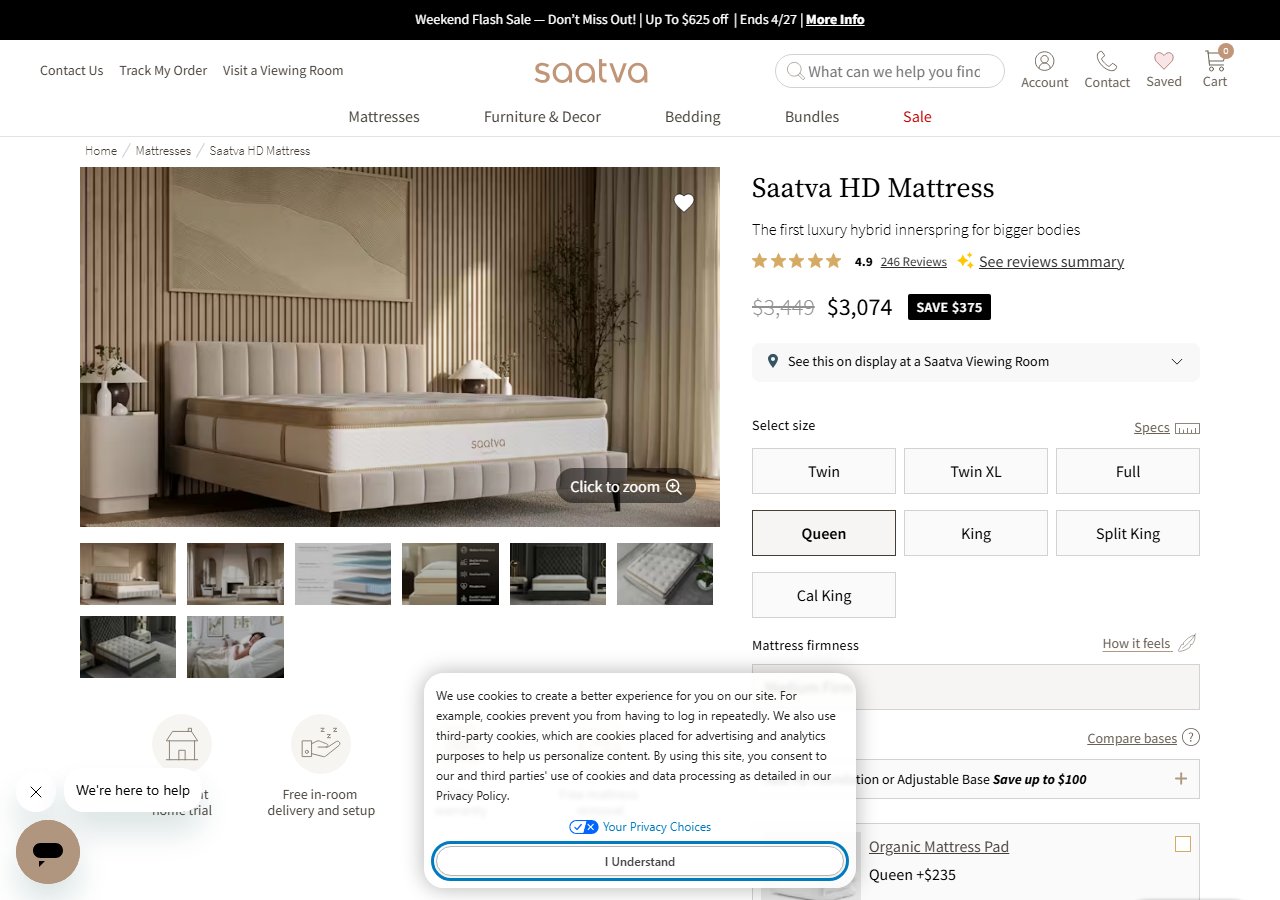
Saatva HD Mattress (Heavy-Duty)
$2,395-$3,995
See Price at Saatva →
Purple Hybrid Premier Mattress
$2,499-$4,799
See Price at Purple →Making the decision: a data-driven hierarchy
The federal data tells a coherent story that the mattress industry rarely presents honestly. BLS SOII data documents the injury. NIOSH identifies the mechanism. CDC quantifies the sleep deficit. AHRQ prices the downstream cost. The through-line is this: warehouse work systematically loads the lumbar spine beyond safe thresholds, the off-shift recovery window is compressed by shift timing and insufficient sleep duration, and sleep surface quality is a legitimate but downstream variable in the recovery equation.
Start with the interventions that cost nothing: refine your lifting mechanics, add daily walking, correct your sleep position, and honestly assess whether your current mattress meets the replacement criteria. If it does — visible sag, progressive morning stiffness, age over 7 to 10 years — then a sleep surface matched to your body weight and pain pattern is a defensible investment. If your back pain includes any of the clinical red flags identified by NIH, a clinician is the right next call, not a product decision.
For the warehouse worker who reaches the product decision point, the Saatva HD is the most mechanically specific recommendation for larger-bodied manual handlers. The Saatva Loom & Leaf is the strongest option for workers whose primary complaint is axial lumbar pain with preserved sleep continuity. And the Purple Hybrid Premier is the pressure-mapping pick for workers whose sleep disruption is driven more by hip and shoulder pressure than by lumbar pain specifically. None of these are miracle remedies for a cumulative occupational injury. But the right sleep surface, deployed as part of a complete recovery strategy, is a legitimate tool — and the federal data tells you exactly why warehouse workers need it more than most.