The federal data on your back pain is not subtle
If you work in a warehouse — picking orders, moving pallets, loading trailers, running a reach truck — your back is being asked to absorb forces that federal ergonomics researchers have spent decades documenting. According to BLS Musculoskeletal Disorders by Occupation tracking, the back is the single most common body part injured across all U.S. occupations that result in days away from work. Not just in warehousing. Across every sector the BLS measures. That is how dominant the lumbar spine is as a site of occupational injury.
The cost of ignoring this is substantial. AHRQ HCUP data identifies back pain as one of the most expensive conditions in U.S. healthcare by total inpatient and outpatient cost. AHRQ MEPS data shows that adults with chronic back conditions spend significantly more out of pocket annually than adults without them. And CMS drug spending data identifies opioid and non-opioid pain medications among the most expensive Medicare drug categories — a direct downstream signal of how many working Americans are managing chronic spinal pain with pharmaceuticals because earlier interventions did not hold.
The most consequential intervention point — the one that costs nothing and happens every night — is sleep. And most warehouse workers are short on both sleep quality and quantity.
Why warehousing breaks lumbar spines at a structural level
Understanding why your back hurts requires a brief visit to the biomechanics. The NIOSH Lifting Equation, the federal government's primary tool for evaluating manual material-handling risk, was designed precisely because researchers found that real-world lifting tasks in sectors like warehousing routinely exceed safe spinal loading limits. The equation accounts for load weight, horizontal reach, vertical height of the lift, asymmetry (twisting), frequency, and grip quality. In a typical warehouse shift, workers routinely score poorly on multiple variables simultaneously: they lift heavy loads at awkward reaches, twist at the waist, and do it repetitively over 8–10-hour shifts with only short breaks.
The cumulative effect is a phenomenon occupational health researchers call spinal load accumulation. Each lift that exceeds your safe lifting limit compresses the intervertebral discs, strains the paraspinal muscles, and stresses the facet joints. Over the course of a shift, micro-trauma accumulates in the posterior ligamentous system and disc annulus. The muscles that stabilize the spine — the multifidus, the erector spinae group, the quadratus lumborum — are fatigued by the end of a shift. They need recovery time to regenerate the glycogen stores and protein structures that keep them functional.
Sleep is when that repair happens. Growth hormone secretion peaks during slow-wave sleep. Inflammatory cytokines associated with muscle damage are cleared during overnight rest. Intervertebral disc hydration partially recovers during periods of spinal unloading — i.e., lying down. For a warehouse worker, the 6–8 hours they spend horizontal is not just rest; it is the only window in the 24-hour cycle when their spine is genuinely unloaded.
This is why CDC NHANES survey data finding that approximately 20% of U.S. adults experience chronic pain — with lower back as the most common location — is not surprising in a country where millions of workers handle materials manually every day. The mechanism from occupational exposure to chronic pain is well-documented, and it runs directly through inadequate recovery.
CDC sleep data shows that approximately 35% of U.S. adults already sleep fewer than 7 hours per night — the threshold below which chronic disease risk increases measurably. For shift workers running rotating or overnight schedules, that number is almost certainly higher. A warehouse worker who clocks out at 2 a.m. and needs to return at 10 a.m. is operating in a window where adequate sleep is structurally difficult to achieve, and the quality of that compressed sleep window matters enormously.
The occupational economics are not abstract
BLS Employer Costs for Employee Compensation data shows that industries with high musculoskeletal disorder incidence carry workers' compensation insurance rates 3–5x higher than low-MSD industries. The SSA Disability Insurance program identifies musculoskeletal disorders as the single largest category of new disability claims filed annually. These are not abstract statistics. They represent warehouse workers whose injuries progressed from the acute to the chronic to the disabling — and whose transition to disability happened in part because the recovery window was never adequately supported.
The CDC Arthritis Data shows approximately 25% of U.S. adults report doctor-diagnosed arthritis, with prevalence concentrated in occupations involving sustained physical demand. Warehouse work is exactly that kind of occupation. The combination of spinal load accumulation during the workday and inadequate overnight recovery is a documented pathway to structural joint degeneration — the kind that eventually shows up on imaging and shows up on a disability claim.
This is not meant to be alarmist. Plenty of warehouse workers manage decades of physically demanding work without disabling injury. What separates them, in most cases, is a combination of good lifting mechanics, adequate recovery time, and — critically — sleep quality that allows the musculoskeletal system to repair itself nightly.
Try these first — free interventions before any purchase
The cheapest intervention is the one that does not require buying anything. Before evaluating any sleep surface, every warehouse worker with back pain should work through the following evidence-based behavioral and ergonomic interventions. These are not filler. Federal health research supports each of them as meaningfully effective for musculoskeletal recovery.
Sleep position is the biggest free variable. NIH guidance on back pain is specific: side-sleeping with a pillow between the knees maintains spinal alignment by preventing the upper leg from pulling the lumbar spine into rotation. Back-sleeping with a pillow under the knees reduces the lumbar lordosis load. Stomach-sleeping — common in physically exhausted workers who collapse into whatever position they land in — torques the lumbar spine into extension and rotation simultaneously, which is exactly the kind of positional loading that aggravates disc pathology and facet joint irritation. Changing sleep position costs nothing and can produce measurable pain reduction within days.
Walking outperforms most passive interventions. This is the finding that surprises most people with back pain, because intuition says rest is the antidote to physical work. It is not. NIH NCCIH evidence review finds that walking 30 minutes most days reduces chronic low back pain as effectively as most non-drug clinical treatments. Walking on your off days — not rest, not couch recovery — is the single highest-return non-clinical intervention available to warehouse workers. A new mattress helps. Movement is the lever.
Lifting mechanics are rehearsable. OSHA ergonomics guidance specifies what the NIOSH Lifting Equation implies: hinge at the hips, not the lumbar spine; keep loads close to the body; avoid twisting under load; use mechanical assists whenever available. Most acute back episodes in warehousing are mechanical — they result from a single lift with degraded mechanics, usually at the end of a shift when the stabilizing muscles are fatigued. Deliberately rehearsing correct mechanics when you are fresh makes them more automatic when you are exhausted.
Know when your mattress is the actual problem. CDC sleep hygiene guidance identifies sleep surface quality as a real variable — but with specific indicators. If your mattress has visible sag, if you wake consistently stiffer than you went to bed, or if it is older than 7–10 years, the surface itself may be undermining recovery. A worn mattress cannot maintain the spinal alignment that recovery requires. But even the most sophisticated sleep surface does not compensate for poor sleep hygiene, irregular schedules, or a sedentary recovery day.
For readers who have addressed sleep position, are walking regularly, are using correct lifting mechanics, and are still waking stiff and underrecovered — or whose mattress shows visible wear — a sleep surface upgrade becomes a legitimate recovery investment. The research on mattress firmness and back pain is more specific than mattress marketing suggests: medium-firm surfaces consistently outperform both soft and very firm options for lumbar pain reduction in adults who side- or back-sleep. What that means in practice depends on your body weight, sleep position, and the specific injury pattern you are managing.
When to see a clinician — red flags for warehouse workers
Not every back pain condition is addressable through behavioral changes and sleep surface optimization. NIH Neurological Disorders guidance on back pain is explicit about conditions that require prompt clinical evaluation rather than self-management. If you are a warehouse worker experiencing any of the following, the correct next step is a clinician — not a mattress review.
- Pain that radiates below the knee, particularly with numbness or tingling in the foot or toes, suggests nerve root compression — commonly from a herniated disc at L4-L5 or L5-S1, the segments most loaded by repetitive lifting. NIH NINDS identifies radiculopathy as a red flag requiring evaluation, not conservative management alone.
- Back pain following direct trauma — a fall from height, a forklift incident, a heavy drop — requires imaging to rule out fracture. Do not assume musculoskeletal strain after significant trauma.
- Leg weakness, foot drop, or difficulty walking associated with back pain suggests possible spinal cord or cauda equina involvement, which is a medical emergency.
- Bowel or bladder dysfunction accompanying back pain is a cauda equina syndrome red flag — seek emergency care immediately. NIH NINDS lists this as requiring urgent intervention.
- Back pain with unexplained fever, night sweats, or unintentional weight loss may indicate a systemic cause — infection, inflammatory arthritis, or malignancy — rather than mechanical low back pain.
The distinction matters for this audience specifically because warehouse workers are accustomed to pushing through physical discomfort. The cultural norm in physically demanding work is tolerance, not complaint. That tolerance is adaptive for minor soreness but dangerous when it delays diagnosis of conditions that worsen with continued loading.
Where sleep surfaces enter the equation
For the warehouse worker who has optimized sleep position, is moving on off days, has reviewed lifting mechanics, and whose mattress shows the indicators of wear described above — a purpose-built sleep surface is a legitimate recovery tool. The evidence base for mattress selection in back pain is not as robust as the evidence base for exercise, but medium-firm mattresses consistently outperform alternatives in controlled studies of adults with non-specific low back pain. For heavier workers — which describes a meaningful portion of the warehouse workforce — standard consumer mattresses are often designed for body weights below what the NIOSH Lifting Equation would classify as a high-force handler.
Three surfaces are worth examining for this specific reader.
The Saatva Loom & Leaf Memory Foam Mattress is the premium memory foam option for warehouse workers managing serious, recurrent back pain. Its multi-layer gel-infused memory foam construction is engineered to provide zoned lumbar support — meaning the foam is formulated to be firmer beneath the lumbar region and more conforming at the shoulders. For a side-sleeping warehouse worker dealing with disc-related pain, this zoned approach keeps the spine in lateral alignment without creating pressure point loading at the hip or shoulder. The Loom & Leaf comes in Relaxed Firm and Firm variants; for most back pain presentations in physically demanding workers, Relaxed Firm delivers the medium-firm feel the research supports. At $1,695–$3,295 depending on size, it is a serious purchase — but it is priced for durability and support engineering that mass-market foam mattresses do not match.
For warehouse workers who are larger-framed — which is occupationally relevant given that body weight scales the compressive forces documented in the NIOSH Lifting Equation — the Saatva HD Mattress is the direct engineering answer. Saatva designed the HD explicitly for higher body weights, with a dual-coil system — individually wrapped support coils beneath a tempered steel base coil layer — that maintains consistent lumbar support across body weights that compress standard consumer mattresses beyond their rated performance range. The support system is rated for durability well above the 250-pound threshold where most consumer innerspring mattresses begin to sag prematurely. Priced at $2,395–$3,995, it is the most expensive option in this list, but for the heavier warehouse worker whose current mattress shows premature sag, it addresses the structural cause of the problem rather than managing its symptoms.
The Purple Hybrid Premier Mattress takes a different engineering approach that is worth understanding for warehouse workers with hip or shoulder pressure point issues secondary to their back pain. Purple's GelFlex Grid — a polymer grid rather than foam or coil — redistributes pressure across a larger surface area than either foam or spring systems. For a warehouse worker who is managing back pain and has hip bursitis or shoulder irritation from years of awkward carries, the Grid's pressure-neutral surface prevents the localized loading that aggravates these secondary sites. The Hybrid Premier pairs the Grid with a pocketed-coil support base, providing edge support and motion isolation alongside the pressure distribution. At $2,499–$4,799, it is the broadest-range option in this list and works particularly well for combination sleepers who shift between side and back positions during the night.
Sleep Surfaces Engineered for Warehouse Worker Lumbar Recovery
These three mattresses were selected for their structural support, pressure distribution, and durability engineering specifically relevant to workers managing cumulative spinal load from manual material-handling shifts.

Saatva Loom & Leaf Memory Foam Mattress
$1,695-$3,295
See Price at Saatva →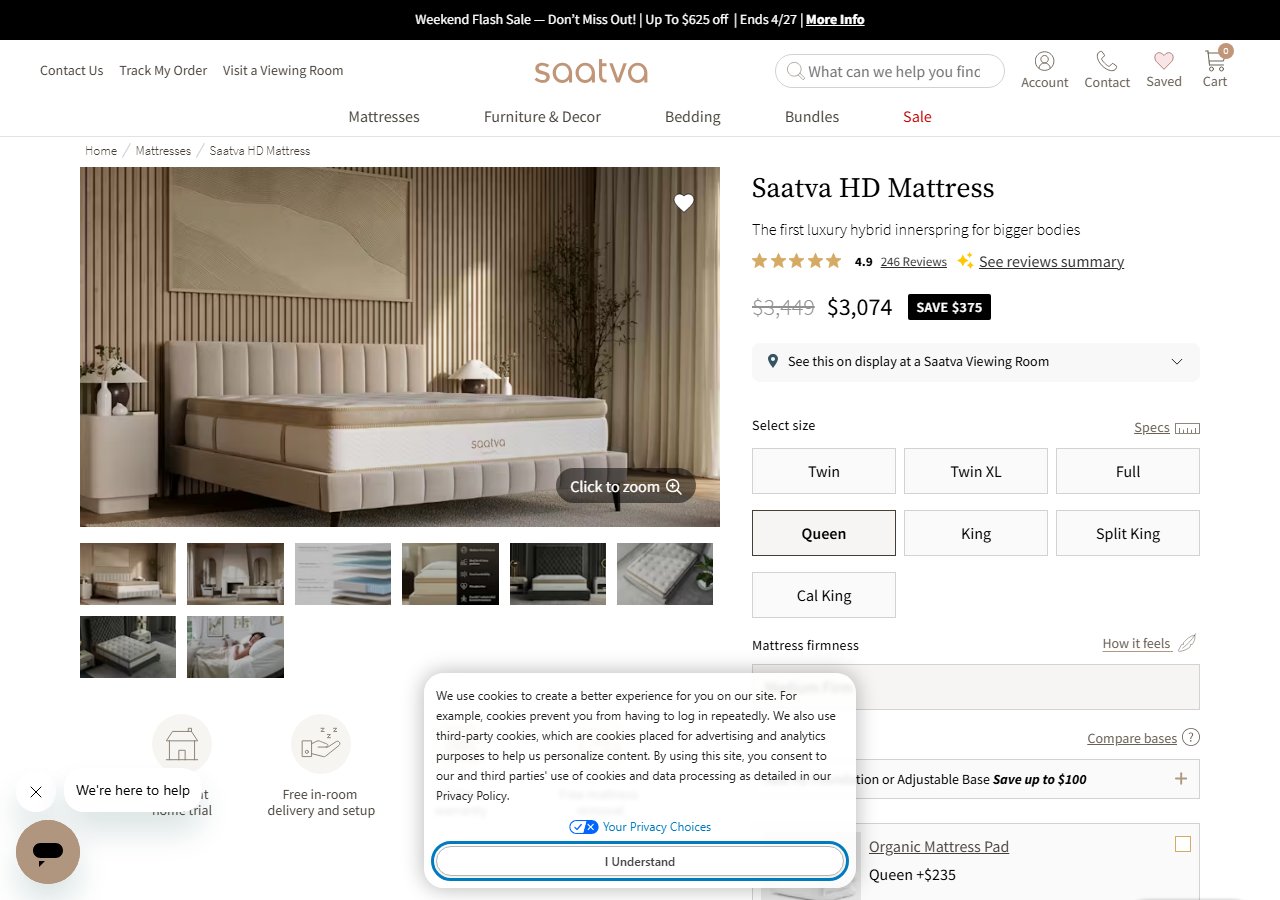
Saatva HD Mattress (Heavy-Duty)
$2,395-$3,995
See Price at Saatva →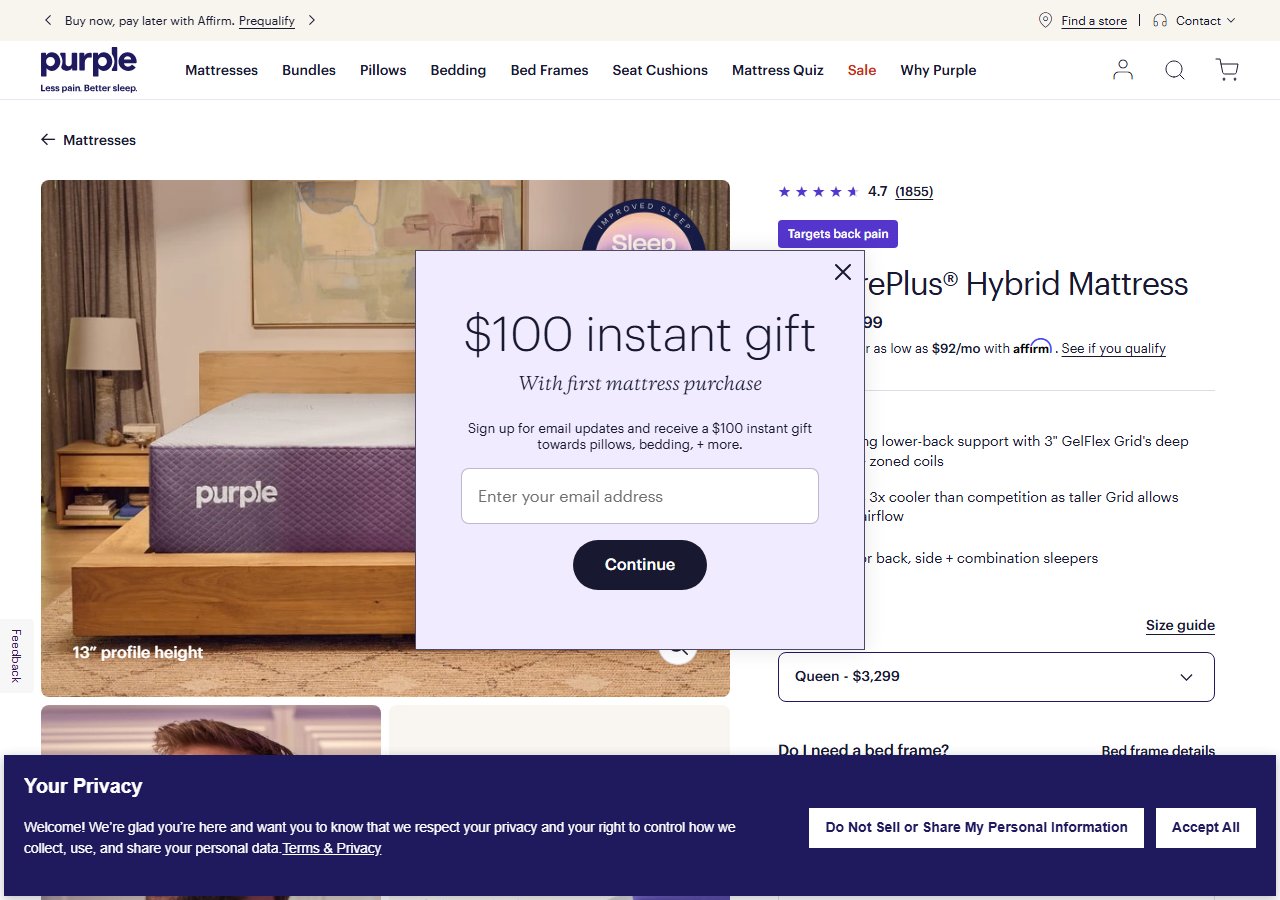
Purple Hybrid Premier Mattress
$2,499-$4,799
See Price at Purple →How to choose between these options
The selection framework for this specific reader group breaks down along three variables: body weight, primary pain location, and sleep position.
If you are an average-framed warehouse worker (under 250 pounds) dealing primarily with lumbar disc pain and sleeping predominantly on your side or back, the Loom & Leaf Relaxed Firm is the logical choice. Its zoned support targets the lumbar region specifically, and its foam construction provides the conforming lateral alignment that side-sleepers need.
If you are a larger-framed worker — over 250 pounds, or someone whose current mattress shows the premature center sag that indicates the surface was not engineered for your weight — the Saatva HD is the purpose-built answer. Do not assume that buying a firmer standard mattress solves this; firmness and structural integrity under sustained load are different engineering problems.
If your back pain presentation involves secondary pressure-point issues — hip pain, shoulder pain, or a documented history of pressure-related discomfort — the Purple Hybrid Premier's Grid technology addresses a mechanism that foam and coil alone do not.
All three options should be evaluated in the context of the behavioral interventions above. A warehouse worker sleeping on the Saatva HD but still stomach-sleeping with no pillow support, and skipping movement on off days, will not extract the recovery value the surface is engineered to provide. The surface is an enabler of good sleep biomechanics — not a substitute for them.
The bottom line
Federal data paints a consistent picture: warehouse workers carry some of the highest spinal loading in the U.S. labor force, the downstream costs of unmanaged back pain are enormous by every federal measurement available, and the nightly recovery window is the primary modifiable variable outside of work itself. BLS injury data, NIOSH lifting research, CDC chronic pain prevalence data, and SSA disability claim patterns all converge on the same mechanism: repeated spinal loading without adequate recovery produces progressive injury.
The intervention hierarchy is: fix sleep position first (free), add daily walking (free), rehearse lifting mechanics (free), replace a worn mattress when the physical indicators warrant it. When the mattress replacement is warranted, choose a surface engineered for the actual load profile — which for most warehouse workers means medium-firm zoned support, structural integrity under higher body weights, and pressure distribution adequate for whatever secondary joint issues have accumulated alongside the back pain.
The three surfaces covered here — the Saatva Loom & Leaf, the Saatva HD, and the Purple Hybrid Premier — represent different engineering approaches to the same core problem. Match the engineering to your specific presentation, implement the behavioral interventions concurrently, and follow the clinical red flags guidance if your symptoms cross into territory that requires imaging or referral. That is the complete picture the federal data supports.