The federal data behind your back pain is blunt
If you work in a warehouse — pulling orders, stacking pallets, loading conveyors, or driving a forklift for 8 to 12 hours — federal injury data describes your body with unusual precision. According to BLS Musculoskeletal Disorders by Occupation tracking, the back is the most common body part injured across all U.S. occupations that result in days away from work. That is not a statistical artifact of sample size. It is a consistent finding year over year, and warehousing and storage workers sit at or near the top of the industries driving that number.
The downstream cost of this injury pattern is enormous. AHRQ HCUP data identifies back pain as one of the most expensive conditions in U.S. healthcare by total inpatient and outpatient cost. AHRQ's Medical Expenditure Panel Survey quantifies the individual burden: adults with chronic back conditions spend substantially more on personal healthcare annually than adults without such conditions. And CMS drug spending data places opioid and non-opioid pain medications among the most expensive Medicare drug categories — a downstream consequence of the chronic-pain treatment pipeline that begins, for many workers, on a warehouse floor.
The societal consequence is even starker. SSA Disability Insurance data identifies musculoskeletal disorders as the largest single category of new disability claims annually in the United States. Warehousing and logistics workers are not immune to this trajectory. They are, statistically, overrepresented in it.
This article is not about scaring you. It is about understanding the mechanism, identifying the interventions that are free or low-cost, knowing when to see a clinician, and — only after all of that — understanding what features in a sleep surface actually matter for lumbar recovery after a demanding shift.
Why warehouse work breaks the lumbar spine: the biomechanical mechanism
The lumbar spine — the five vertebrae between your rib cage and pelvis — is designed to bear axial load in a neutral, slightly curved position. It is not designed to flex forward under heavy external load repeatedly across an 8-hour shift. But that is exactly what warehouse work demands.
The NIOSH Lifting Equation is the federal standard for evaluating manual material-handling risk. It defines a Recommended Weight Limit (RWL) for lifting tasks based on load weight, lifting frequency, horizontal distance of the load from the spine, vertical travel distance, asymmetry (twisting), and coupling (how well you can grip the object). When a task's Lifting Index — the ratio of the actual load to the RWL — exceeds 1.0, spinal loading is in a potentially harmful range. NIOSH documents that routine warehouse tasks routinely exceed safe spinal loading limits. Order picking from low shelves, moving boxes from conveyor to pallet, and unloading trailers are among the highest Lifting Index tasks in U.S. industry.
What does repeated excessive spinal loading actually do? At the tissue level, it compresses intervertebral discs — the fluid-filled shock absorbers between vertebrae — and fatigues the posterior spinal musculature. Over a full shift, disc hydration decreases (workers are measurably shorter at the end of a shift than the beginning), the erector spinae and multifidus muscles accumulate metabolic waste products, and the thoracolumbar fascia becomes sensitized. This is not an injury in the acute sense on most days. It is cumulative mechanical stress that, over months and years, accelerates disc degeneration, facet joint arthritis, and the development of chronic low-back pain.
CDC NCHS Data Brief 390 reports that approximately 20% of U.S. adults experience chronic pain, with the lower back as the most common pain location. For warehouse workers, the occupational mechanism is well-established: high-frequency, high-load lumbar flexion under time pressure creates exactly the exposure profile that produces chronic low-back pain. CDC Arthritis data further documents that approximately 25% of U.S. adults report doctor-diagnosed arthritis, with prevalence concentrated in occupations involving sustained physical demand — a category that squarely includes warehousing.
Now consider what happens during sleep. Disc rehydration — the process by which the nucleus pulposus of each intervertebral disc re-absorbs fluid — is gravity-dependent. It happens most effectively during recumbent rest. If sleep is insufficient, interrupted, or spent in a position that does not allow the lumbar spine to maintain a neutral curve, disc rehydration is incomplete. The worker wakes with a spine that has not fully recovered from the previous shift and begins the next shift in a compromised state. Multiply that across weeks and months, and the cumulative deficit accelerates the injury trajectory that federal data documents so clearly.
CDC Sleep and Sleep Disorders data shows that approximately 35% of U.S. adults report sleeping fewer than 7 hours per night, the threshold associated with elevated chronic disease risk. Warehouse workers, who disproportionately work overnight, rotating, or split shifts, likely exceed that 35% figure in their occupational category. The sleep deficit is not just about fatigue. It is about incomplete recovery from the specific physiological damage that a warehousing shift inflicts.
The BLS Employer Costs for Employee Compensation data adds the economic dimension: industries with high MSD incidence carry workers' compensation insurance rates 3-5x higher than low-MSD industries. The cost of this injury pattern is ultimately borne by workers through benefit structures, by employers through premiums, and by the healthcare system through the chronic-pain treatment pipeline.
The cheapest intervention is the one that does not require buying anything
Before we discuss any product, it is worth stating plainly: most of the evidence-based interventions for occupational low-back pain do not require spending money. Federal health agencies have published clear, actionable guidance. If you have not tried these interventions consistently, a new mattress will not save you.
Sleep position is the biggest free variable in lumbar recovery. NIH guidance on back pain specifically recommends side-sleeping with a pillow between the knees, or back-sleeping with a pillow under the knees, as positions that maintain spinal neutrality during rest. Stomach-sleeping torques the lumbar spine and exacerbates chronic pain — it forces the neck into rotation, increases lumbar lordosis, and compresses posterior spinal structures across the entire night. If you are a stomach sleeper with back pain, position change is the single highest-leverage free intervention available to you.
Daily walking outperforms most passive interventions. A systematic evidence review by NIH's National Center for Complementary and Integrative Health concludes that walking 30 minutes most days reduces chronic low-back pain as effectively as most non-drug clinical treatments. This is not a minor finding. It means a consistent walking habit — free, accessible, requiring only shoes — competes with physical therapy, chiropractic manipulation, and pharmacological management on outcome measures. For warehouse workers, this is both encouraging and sobering: the movement you do off the clock matters enormously.
Lifting mechanics are rehearsable. OSHA's Ergonomics Solutions guidance outlines the core principles: hinge at the hips rather than the lumbar spine, keep loads close to the body, and avoid twisting under load. Most acute low-back episodes in warehouse work are mechanical and preventable through motor pattern change. If your employer has not provided formal lifting training, OSHA's materials are publicly available.
Know when the mattress is genuinely the problem. CDC Sleep Hygiene guidance supports replacing a mattress if it shows visible sag, if you consistently wake stiffer than you went to bed, or if it is older than 7 to 10 years. Those are legitimate triggers. But no mattress — at any price point — compensates for inadequate sleep duration, sedentary days, or unaddressed lifting mechanics.
For warehouse workers who have already worked through the free interventions — who sleep in a neutral position consistently, who walk daily, who have corrected their lifting mechanics — and who are still waking with a stiff, aching lumbar spine, the sleep surface becomes a legitimate next variable to examine. The evidence base for specific mattress firmness and construction in back pain is more limited than mattress marketing suggests, but there are structural features that are biomechanically rational for this population.
When to see a clinician before anything else
Certain back pain presentations require medical evaluation before any self-management strategy — including sleep surface changes. NIH's National Institute of Neurological Disorders and Stroke is explicit about the red flags that warrant prompt clinical attention. These are not rare edge cases; they are presentations that warehouse workers, who are at elevated injury risk, may encounter.
If your back pain radiates below the knee — into the calf, foot, or between the buttock and knee — that is a nerve compression presentation, likely involving a disc herniation impinging on a lumbar nerve root. Changing your mattress does not decompress a nerve root. If your back pain is accompanied by leg weakness, difficulty walking, or loss of bowel or bladder control, that is a neurological emergency requiring same-day evaluation. If your back pain follows a traumatic event at work — a fall, a vehicle accident, being struck by equipment — imaging is appropriate before attributing it to a soft-tissue strain. If back pain is accompanied by fever, unexplained weight loss, or occurs in a person with a cancer history, it requires urgent evaluation for non-mechanical causes.
For warehouse workers specifically, the cumulative nature of the exposure can mask an escalating injury. A pain pattern that was manageable six months ago and is now worsening, spreading, or waking you from sleep at night (rather than merely being present when you wake up in the morning) is a reason to see a physician, not a reason to order a new mattress.
Where sleep surface features actually matter for warehouse workers
Assuming you have cleared the clinical threshold above — your pain is mechanical, positional, and concentrated in the lumbar region — a sleep surface can meaningfully affect the quality of overnight lumbar recovery. The relevant features are not luxury metrics. They are structural properties with biomechanical rationale for a population that loads the lumbar spine heavily all day.
Zoned support — where the mattress provides more resistance under the hips and lumbar spine and softer pressure relief at the shoulders — keeps the spine horizontal for side sleepers rather than allowing the heavy pelvic girdle to sag the lumbar region into lateral flexion. For a warehouse worker who may weigh 180 to 250 lbs or more after years of physical labor, unzoned mattresses often fail to maintain spinal alignment.
Load-rated coil systems — individually wrapped coils with higher gauge wire or higher coil count — provide consistent support across the full body weight distribution rather than compressing uniformly under high-load areas. Standard innerspring or lower-coil hybrid mattresses often have a weight threshold beyond which they no longer maintain the surface geometry that keeps the spine neutral.
Pressure-relieving comfort layers — memory foam, latex, or gel-infused foam between the body and the support core — allow the shoulder and hip to sink slightly into the surface while the lumbar region is supported. Without this, a very firm mattress creates a pressure concentration at the greater trochanter (outer hip) and acromion (outer shoulder) in side sleepers, which causes position shifts throughout the night and interrupts the deep sleep stages when growth hormone — which drives soft tissue repair — is predominantly secreted.
The Saatva Loom & Leaf: premium memory foam with lumbar zoning
For warehouse workers whose primary complaint is morning lumbar stiffness and who prefer the conforming feel of memory foam, the Saatva Loom & Leaf Memory Foam Mattress is the most biomechanically relevant premium foam option in this category. The Loom & Leaf uses a layered gel-infused memory foam construction over a tempered steel coil support system, with a lumbar zone of enhanced support built into the foam architecture. This is not a marketing claim about lumbar support — it is a structural zone of higher-density foam under the region of the spine that bears the highest cumulative load in a warehouse worker's day. At a price range of $1,695 to $3,295 depending on size and firmness selection, it sits at the premium end, but for a worker dealing with chronic lumbar pain, the cost per night over a 7- to 10-year mattress lifespan is measurably lower than a single urgent care visit.
The Saatva HD: engineered for heavier body weights and higher mechanical loads
Warehouse work physically changes the body over time. Workers who spend years in physically demanding roles often carry more muscle mass and body weight than sedentary office workers. Standard mattresses — including most premium mattresses — are designed for a weight distribution centered around 130 to 180 lbs. For workers above that range, many mattresses fail to maintain surface geometry under load, allowing the heaviest body regions to sag through the comfort layers and eliminating the spinal alignment benefit entirely.
The Saatva HD Mattress is specifically engineered for this loading scenario. It features a dual-coil system — a layer of individually wrapped coils over a reinforced base of tempered steel Bonnell coils — that provides the progressive resistance needed to support heavier body weights without bottoming out. The HD is rated for higher weight capacities than standard mattress constructions and maintains its support geometry longer under sustained high-load use. For warehouse workers above 250 lbs, or workers who share a bed and create an asymmetric load, the HD is the most structurally rational choice in this article. Prices range from $2,395 to $3,995 depending on size.
The Purple Hybrid Premier: pressure relief for workers who cannot tolerate firm surfaces
Some warehouse workers — particularly those with diagnosed facet joint arthritis, hip bursitis, or sensitized posterior spinal structures — find that firm mattresses, despite their alignment benefits, create intolerable pressure at bony prominences. For these workers, the Purple Hybrid Premier Mattress offers an alternative engineering approach. Purple's GelFlex Grid — a hyper-elastic polymer grid that collapses under concentrated pressure points while remaining rigid under distributed load — is designed to eliminate pressure concentration at the hip and shoulder while maintaining support under the lumbar region. The Hybrid Premier pairs a thicker grid (3 or 4 inches depending on variant) with a responsive coil support system, producing a mattress that is simultaneously pressure-relieving and supportive in a way that traditional foam layering struggles to achieve. At $2,499 to $4,799, it is the highest-priced option in this roundup, but for workers with neuropathic or arthritic pain components, the pressure-relief engineering is meaningfully different from standard foam or coil constructions.
Sleep Surfaces Engineered for Warehouse Worker Lumbar Recovery
These three mattresses were selected for their structural features — zoned lumbar support, load-rated coil systems, and pressure-relief engineering — that are biomechanically relevant to workers who load their lumbar spine heavily during every shift.

Saatva Loom & Leaf Memory Foam Mattress
$1,695-$3,295
See Price at Saatva →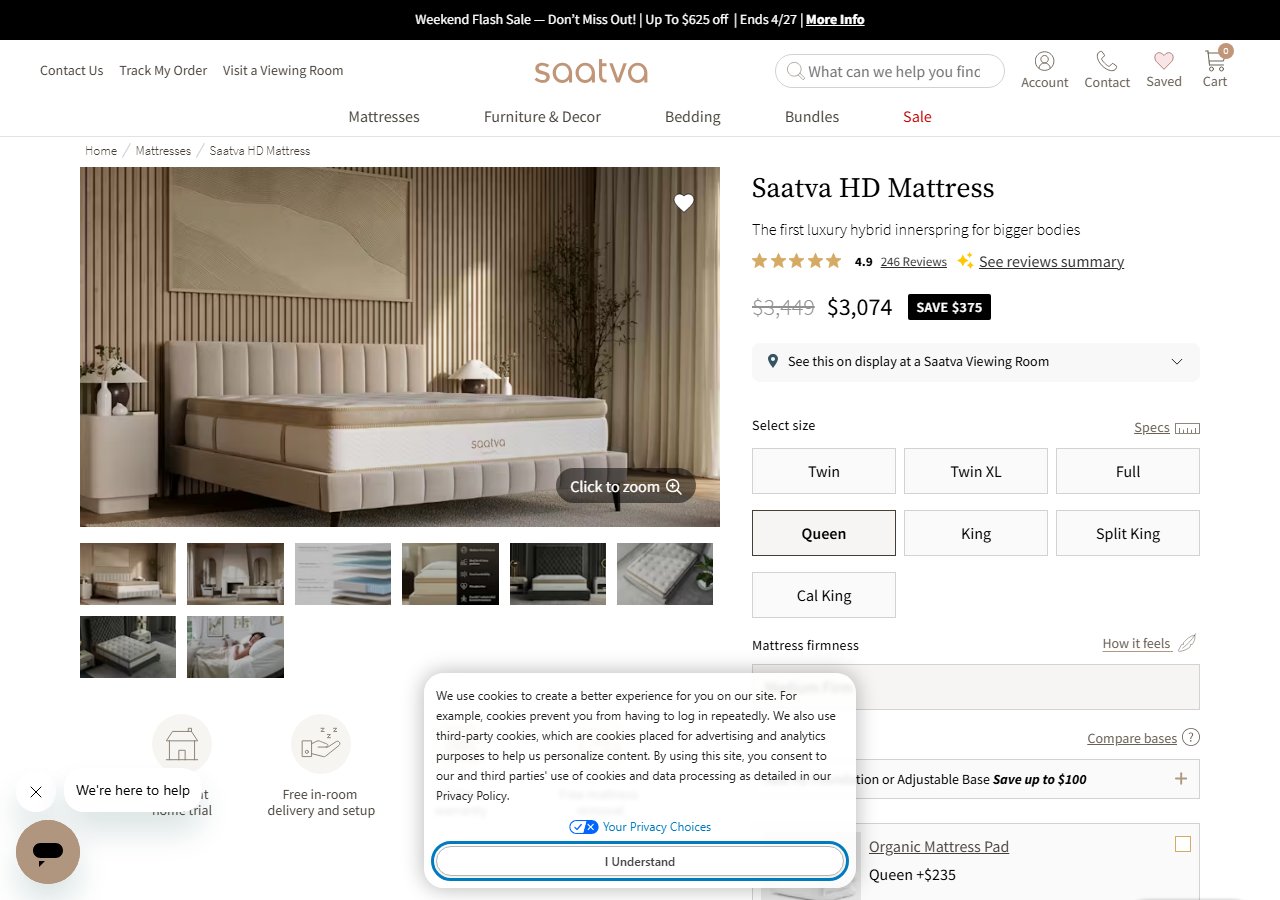
Saatva HD Mattress (Heavy-Duty)
$2,395-$3,995
See Price at Saatva →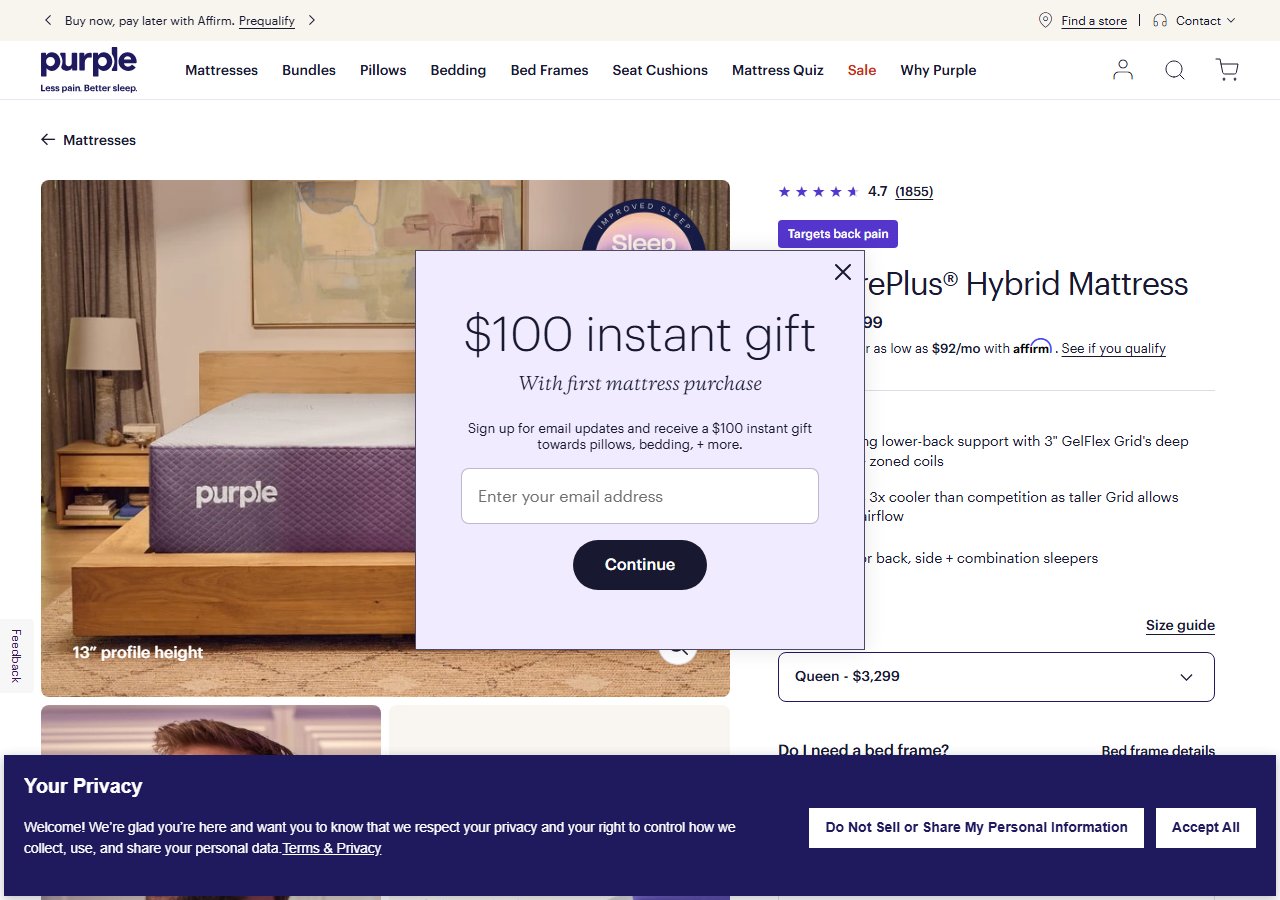
Purple Hybrid Premier Mattress
$2,499-$4,799
See Price at Purple →Putting it all together: a hierarchy of lumbar recovery for warehouse workers
Federal data is clear about where warehouse workers sit in the national back-pain landscape: at the top of the injury incidence tables, with the biomechanical exposure to match. The NIOSH Lifting Equation documents that the work itself routinely exceeds safe spinal loading limits. The BLS data documents that back injuries produce more days away from work than any other body region across all U.S. occupations. The SSA disability data documents where this trajectory can lead if cumulative exposure is not managed.
But the same federal evidence base — NIH, NCCIH, NIOSH — also points clearly to the intervention hierarchy. Sleep position and walking habits are the highest-leverage interventions, and they are free. Lifting mechanics are correctable with training. Clinical red flags require a physician, not a product. And for workers who have cleared those thresholds, a sleep surface with the right structural features — zoned support, load-rated coil systems, appropriate pressure relief — is a legitimate tool for improving the quality of overnight lumbar recovery.
For most warehouse workers, the sequence is: fix sleep position first, establish a walking habit, verify lifting mechanics, rule out clinical red flags, and then — if the mattress is visibly sagging, more than 7-10 years old, or genuinely disrupting sleep quality — consider an upgrade. The three options profiled here represent different engineering approaches to the same problem. The Saatva Loom & Leaf offers memory foam conforming with lumbar zoning for standard body weights. The Saatva HD offers load-rated structural support for heavier workers or those who have found standard mattresses inadequate. The Purple Hybrid Premier offers pressure-relief engineering for workers with sensitized or arthritic spinal structures.
None of them will undo 10 years of cumulative spinal loading. But paired with the behavioral interventions that federal health agencies recommend, the right sleep surface can meaningfully improve the recovery quality that determines how you walk into the next shift.