The federal data paints a brutal picture for high-bodyweight adults with back pain
Start with a number that rarely makes the wellness headlines: approximately 20% of U.S. adults live with chronic pain, and the lower back is the single most common pain location, according to CDC NCHS Data Brief 390. That statistic is drawn from the National Health and Nutrition Examination Survey — one of the most rigorous ongoing federal health assessments in existence. It is not a pharmaceutical company's survey. It is not a mattress brand's self-commissioned study. It is the federal government counting pain in Americans' bodies.
Now layer in body weight. Adults who weigh 250 pounds or more apply substantially greater compressive and shear forces to lumbar vertebrae, intervertebral discs, and the posterior facet joints than a 160-pound reference individual does — and the entire architecture of the U.S. mattress industry was calibrated around that lighter reference body. Standard spring counts, foam densities, and edge-support engineering were not developed with higher body weight in mind. The result: a large and underserved population of Americans who buy sleep surfaces that feel adequate in the showroom and then sag, conduct heat, and fail to maintain spinal alignment within 12 to 18 months.
That failure matters more than it sounds. The BLS Musculoskeletal Disorders by Occupation tracking confirms that the back is the most frequently injured body part across all U.S. occupations with days away from work. Workers who carry higher body weight — disproportionately represented in warehousing, construction, long-haul trucking, and direct patient care — enter sleep each night with spinal tissues already stressed from eight to twelve hours of occupational loading. If their sleep surface cannot maintain lumbar alignment under their body weight, those tissues get no true decompression window overnight. The chronic pain cycle deepens.
Why this happens: the biomechanics of bodyweight and spinal loading
The physics are unambiguous. When you lie on a sleep surface, your body's mass distributes across that surface according to contact area and surface firmness. A firmer surface distributes load more evenly but can create high-pressure points at bony prominences — the hips and shoulders — that push the sleeper into compensatory positions, rotating the pelvis and torquing the lumbar spine. A softer surface eliminates those pressure points but allows the heaviest body segments (hips and torso) to sink disproportionately deep, creating a hammock-like sag that hyperextends the lumbar spine all night.
For adults over 250 pounds, this Goldilocks problem is structurally harder to solve. A foam density that holds alignment for a 175-pound side sleeper will compress and bottom out within months under 280 pounds. The same spring system that provides responsive support for a 190-pound back sleeper will feel too firm at the hips for a 260-pound person and may bottom out the springs near the center third of the mattress — where the torso rests — for anyone over 300 pounds. This is not an opinion. It is a consequence of material science and compressive yield points.
The occupational dimension compounds the problem. The NIOSH Lifting Equation documents that manual material-handling tasks in warehousing, construction, and healthcare routinely exceed safe spinal loading limits. Workers in those sectors are already presenting to their sleep surface with inflamed facet joints, compressed disc tissue, and fatigued paraspinal musculature. Their recovery window is the 7 to 8 hours of sleep — and CDC sleep data shows approximately 35% of U.S. adults are already sleeping fewer than 7 hours per night, the threshold at which chronic disease risk elevates measurably. A sleep surface that fails to maintain alignment is not a comfort inconvenience. It is a physiological problem with downstream healthcare costs.
Those costs are not theoretical. AHRQ HCUP data identifies back pain as one of the most expensive conditions in U.S. healthcare by combined inpatient and outpatient expenditure. AHRQ MEPS data further confirms that adults with chronic back conditions incur substantially higher annual personal healthcare expenditures than those without. And SSA Disability Insurance data shows musculoskeletal disorders are the single largest category of new disability claims filed each year — a federal data point that puts a hard number on what happens when back pain progresses to the point of ending careers. CMS drug spending data identifies opioid and non-opioid pain medications among the most expensive Medicare drug categories, reflecting how deep the treatment burden runs when structural interventions fail upstream.
None of this means buying a better mattress solves a systemic injury problem. It means that for a population whose spines are already under occupational siege, sleep surface integrity is a legitimate and underappreciated variable in the chronic-pain equation — one that federal data indirectly quantifies through its downstream cost and disability signals.
Try these first — the interventions that do not require a credit card
The cheapest intervention is the one that does not require buying anything. Before this article discusses sleep surfaces, it is obligated to state clearly: the free interventions below have stronger evidence bases than any mattress recommendation, and some of them will eliminate your pain problem entirely without a purchase.
The most evidence-backed free intervention is also the most consistently skipped. NIH NCCIH's evidence review of low back pain treatments finds that walking 30 minutes most days reduces chronic low back pain as effectively as most non-drug clinical treatments. Not yoga. Not dry needling. Not a new mattress. Walking — specifically, sustained aerobic walking — is among the most rigorously supported interventions for chronic lower back pain in the peer-reviewed literature, and it costs nothing but time. For adults over 250 pounds whose back pain is already driven by muscle weakness and postural fatigue, walking also builds the paraspinal and hip extensor strength that no mattress can replicate.
The second free intervention is mechanical: lift and bend correctly, consistently. OSHA's lifting guidance specifies hinging at the hip joint rather than rounding the lumbar spine, keeping loads close to the body's center of mass, and never twisting the torso under load. Most acute back episodes in physically demanding work are mechanical — they result from a single moment of poor load mechanics, not from chronic structural degeneration. Rehearsing proper mechanics until they become automatic eliminates a large fraction of acute episodes before they cascade into chronic pain cycles.
Sleep position is the most underestimated free variable available to any back pain sufferer. NIH NIAMS back pain guidance recommends side-sleeping with a pillow placed between the knees, which keeps the lumbar spine and pelvis in a neutral stack and prevents the hip from internally rotating and pulling the lower spine into lateral flexion overnight. Back-sleeping with a pillow or rolled towel under the knees accomplishes the same neutral spine goal from a supine position. Stomach-sleeping does neither — it forces the lumbar spine into extension and simultaneously rotates the cervical spine to one side, compounding both lumbar and cervical stress over hours. Changing sleep position is entirely free and for some readers will resolve morning stiffness before any other intervention is needed.
Finally: examine the mattress you already own before buying a new one. CDC sleep hygiene guidance recommends replacing a mattress that has visible sag, is older than 7 to 10 years, or consistently leaves you stiffer upon waking than you were when you went to bed. But even if all three conditions apply, a new mattress does not undo poor sleep hygiene, sedentary waking hours, or occupational mechanics that are loading your spine to failure every shift. The mattress is one variable in a multi-variable system.
For readers who have genuinely worked through the above — who walk consistently, have corrected their lifting mechanics, optimized their sleep position, and are sleeping on a mattress that is within its serviceable life — and who are still waking up with lumbar pain that worsens over the first hour of the day, the conversation about sleep surface engineering becomes legitimate. Adults over 250 pounds are not simply "heavy" — they are applying mechanical forces to sleep surfaces that were not engineered for their load. The next section addresses what purpose-built engineering actually looks like, and why the specifications matter.
When to see a clinician — red flags that a mattress cannot fix
Before any sleep surface discussion, a direct word on clinical red flags. NIH NINDS back pain guidance is explicit: certain presentations of back pain are medical emergencies or require urgent specialist evaluation, and no consumer product intervention is appropriate for them. Do not buy a new mattress — or try any other self-directed intervention — if your back pain is accompanied by any of the following presentations. See a clinician promptly.
CDC Arthritis Data notes that approximately 25% of U.S. adults carry a doctor-diagnosed arthritis condition, with prevalence concentrated in occupational groups involving sustained physical demand — the same workers most at risk for compounded spinal loading. Arthritis-driven back pain has specific treatment pathways that differ materially from mechanical back pain, and higher-bodyweight adults with occupational arthritis need clinician-guided care, not a consumer product substitution.
BLS workers' compensation cost data shows that industries with high MSD incidence carry workers' compensation insurance rates 3 to 5 times higher than low-MSD industries — a signal that serious musculoskeletal injury in physical-demand occupations is both common and expensive to treat. If your back pain is work-related and accompanied by any of the red-flag presentations below, your employer's occupational health resources and your state's workers' compensation system are the first call, not a mattress retailer.
Where purpose-built sleep surfaces fit into the recovery equation
For the reader who has cleared the clinical threshold, worked through the free interventions, and established that their sleep surface is a genuine variable in their pain equation, three purpose-built options merit serious consideration. Each is discussed here on its engineering merits relative to the specific load and pressure demands of adults over 250 pounds — not as ranked by price or brand preference.
The Saatva HD Mattress is the most architecturally specific option available for this reader. Saatva explicitly engineered the HD for body weights up to 500 pounds — a specification you will not find on the standard consumer mattress market. Its construction uses a dual coil system: a perimeter-reinforced base layer of recycled steel coils topped by a secondary layer of individually wrapped micro-coils, with a high-density foam foundation below. This layered spring architecture is designed specifically to prevent the center-third sag that defeats standard spring systems under sustained higher body weight. For a warehouse worker or construction laborer who carries 280 to 350 pounds and needs genuine overnight spinal decompression after a day of NIOSH-limit-exceeding lifts, the HD's load-rated coil system is not a marketing claim — it is a structural specification. The lumbar zone enhancement built into the center third of the mattress directly targets the region where disc compression from daily loading concentrates. The HD carries a 365-night trial and is delivered white-glove with old mattress removal, which matters when you are trying to evaluate whether a sleep surface is genuinely improving your waking pain pattern over a meaningful trial window.
For readers whose primary complaint is morning pressure-point pain — the hip and shoulder soreness that results from a surface that is too firm for their body's bony prominences — the Purple Hybrid Premier Mattress addresses a different dimension of the problem. Purple's GelFlex Grid is a polymer grid structure that behaves differently from both foam and coil: it collapses vertically under pressure points (hips, shoulders) while remaining firm in adjacent low-pressure zones (lumbar region, legs). For a higher-bodyweight side sleeper, this means the hip sinks into the grid material without the lumbar region following it into a sag — a property that foam achieves poorly at higher body weights because foam's pressure relief and support trade-off is fixed by density. The Purple Hybrid Premier pairs the GelFlex Grid with a pocketed coil base, adding the responsive bounce and edge support that pure foam mattresses cannot provide for heavier sleepers. The grid also sleeps dramatically cooler than memory foam, which matters for higher-bodyweight adults who generate more metabolic heat during sleep.
For readers who want the contouring and pressure relief of memory foam but whose primary pain pattern is lumbar rather than hip or shoulder, the Saatva Loom & Leaf Memory Foam Mattress represents the premium memory foam option in this comparison. Loom & Leaf is constructed from 5-pound-density and 4-pound-density memory foam layers — density specifications that are meaningfully above the 2- to 3-pound density foam used in mass-market memory foam mattresses. Higher foam density directly translates to slower compression, slower recovery, and longer durability under sustained weight — all specifications that matter for the 250-plus-pound reader who has watched standard memory foam flatten into a body-shaped depression within 18 months. The Loom & Leaf also features a lumbar zone enhancement in the center-third panel, targeting the region where disc compression and facet joint stress concentrates after a physically demanding workday. Its organic cotton cover and phase-change cooling gel address the heat retention that has historically been memory foam's biggest weakness for higher-bodyweight users.
Sleep Surfaces Engineered for High-Bodyweight Spinal Support
Each of these three mattresses was selected specifically for adults over 250 pounds whose spines absorb occupational loading during work hours and need a sleep surface built to maintain lumbar alignment under real-world body weight overnight.

Saatva Loom & Leaf Memory Foam Mattress
$1,695-$3,295
See Price at Saatva →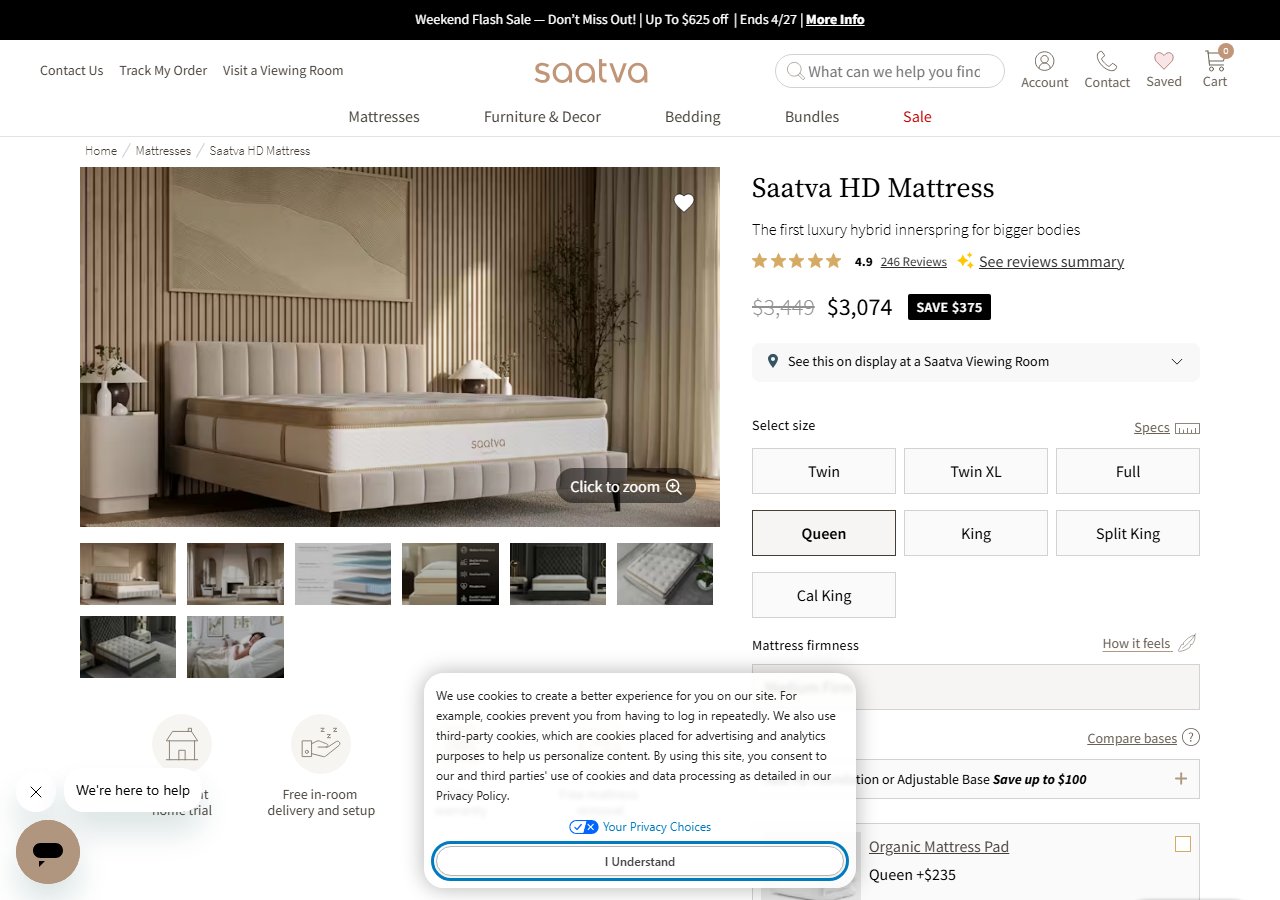
Saatva HD Mattress (Heavy-Duty)
$2,395-$3,995
See Price at Saatva →
Purple Hybrid Premier Mattress
$2,499-$4,799
See Price at Purple →Putting the federal evidence into a usable framework
The data this article has drawn on tells a consistent story. The back is the most commonly injured body part in U.S. occupations. Workers in high-physical-demand jobs — warehousing, construction, healthcare, trucking — already exceed NIOSH's safe spinal loading limits regularly. Chronic back pain is among the most expensive conditions in U.S. healthcare and the leading driver of new disability claims. A third of U.S. adults are already sleep-deprived. And musculoskeletal disorders are bankrupting workers' compensation systems in high-MSD industries at rates 3 to 5 times higher than comparable low-MSD sectors.
For adults over 250 pounds who also work in physically demanding occupations, these risks compound rather than simply add. The spine that absorbs occupational loading during the workday needs a sleep surface that can genuinely maintain alignment under higher body weight overnight — not as a luxury, but as a basic recovery requirement. Standard mattress engineering was not built for that requirement.
The hierarchy of intervention remains clear: move daily, lift correctly, optimize sleep position, and evaluate whether your current mattress has exceeded its serviceable life. See a clinician if red flags are present. When those steps are genuinely in place and morning lumbar pain persists, a purpose-built sleep surface becomes a rational and evidence-anchored investment — one of several tools in a toolkit that federal data strongly suggests this population needs more than most.