Healthcare Shift Workers and the Back-Pain Epidemic Hidden in Federal Data
Nurses, surgical technicians, patient-care aides, and emergency responders already know what the federal numbers confirm: their backs take a beating that most desk workers cannot fathom. BLS Musculoskeletal Disorders by Occupation data identifies the back as the single most common body part injured with days away from work across all U.S. industries — and healthcare consistently ranks among the sectors with the highest absolute counts of musculoskeletal disorder (MSD) events. This is not a soft finding. It is a durable pattern in federal occupational injury surveillance that has persisted across decades of reporting.
The lived experience behind that data looks like this: a 12-hour overnight nursing shift involves anywhere from 20 to 40 patient repositioning events, extended periods of standing on hard floors, repeated trunk flexion over beds and procedure tables, and the kind of sustained muscular loading that leaves lumbar discs compressed and paraspinal muscles in low-grade protective spasm by the end of the shift. Then the worker drives home, tries to sleep in a six-hour window before the next rotation, and wakes up stiffer than when they went down. Repeat for three or four consecutive days. Repeat for a career.
What follows is not a product pitch. It is a structured analysis of the mechanism behind healthcare MSD, the interventions that federal agencies recommend before anyone reaches for a credit card, the clinical red flags that require a provider rather than a consumer product, and finally the sleep-surface options that can support recovery when all the other variables are already being managed correctly.
Why Healthcare Workers' Backs Break Down: The Biomechanical and Occupational Mechanism
The spinal loading problem in healthcare is well-documented at the federal level. The NIOSH Lifting Equation — the gold-standard federal tool for evaluating manual material-handling risk — documents that patient-handling tasks routinely exceed safe spinal compression limits, even when workers use textbook lifting mechanics. Repositioning a 180-pound patient from a bed to a wheelchair generates lumbar compressive forces that can surpass 3,400 Newtons, the NIOSH threshold above which disc injury risk rises substantially. No amount of "lift with your legs" coaching changes the physics when the load itself is a human being who cannot always cooperate with the transfer.
Beyond acute lifting events, the sustained postural demands of healthcare work create a cumulative loading pattern that erodes spinal tissue resilience over time. Prolonged standing on hard hospital floors creates constant low-level compressive loading on lumbar vertebrae and intervertebral discs. Trunk flexion over patient beds — repeated dozens of times per shift — stresses posterior disc annulus in ways that accumulate across years. Carrying supply loads, pushing medication carts, and working in constrained procedural spaces all add to the biomechanical debt that healthcare workers carry into their off-duty hours.
That debt does not simply discharge during sleep. Sleep is the primary window during which intervertebral discs rehydrate (they are largely avascular and depend on osmotic pressure changes during unloaded rest to absorb fluid and nutrients). When a healthcare worker sleeps on a surface that does not maintain spinal alignment — a mattress with visible sag, one that is too firm to allow natural lumbar curvature, or one that forces the spine into a twisted position — that rehydration process is compromised. The disc that did not fully recover overnight is the disc that faces the next 12-hour shift at a structural disadvantage.
CDC NCHS Data Brief 390 reports that approximately 20% of U.S. adults experience chronic pain, with lower back as the most common pain location. Among healthcare workers specifically, the intersection of occupational loading and inadequate recovery creates a trajectory toward chronicity that the AHRQ HCUP data makes financially concrete: back pain is one of the most expensive conditions in U.S. healthcare by total inpatient and outpatient cost. The irony of healthcare workers becoming major consumers of the very healthcare system they staff is not lost on occupational health researchers.
The financial dimension extends beyond hospital bills. AHRQ MEPS data shows that average annual personal healthcare expenditures for adults with chronic back conditions substantially exceed those for adults without such conditions. CMS drug spending data identifies opioid and non-opioid pain medication spending among the most expensive Medicare drug categories — a reflection of the chronic-pain treatment burden that often begins with occupational injury. And at the population level, SSA Disability Insurance data identifies musculoskeletal disorders as the largest single category of new disability claims annually. Healthcare workers are not immune to that trajectory; they are disproportionately contributors to it.
The sleep deprivation dimension compounds everything. CDC sleep and sleep disorders data shows approximately 35% of U.S. adults report sleeping fewer than 7 hours per night. For shift workers cycling between overnight and day rotations, circadian disruption means that even when sleep opportunity exists, sleep quality and architecture are degraded. Slow-wave sleep — the restorative stage during which growth hormone is secreted and musculoskeletal tissue repair is most active — is the stage most suppressed by circadian misalignment. A healthcare worker sleeping at 10 a.m. after a night shift is not getting the same physiological repair yield as a worker sleeping at 10 p.m. on a normal schedule. That gap in recovery efficiency means the sleep surface they use matters more, not less, than it does for a worker with a standard schedule.
Try These First: Free and Low-Cost Interventions That Federal Data Actually Supports
The cheapest intervention is the one that does not require buying anything. Before evaluating any mattress, healthcare workers dealing with chronic back pain should audit the non-product variables that federal health agencies identify as having the strongest evidence base. These interventions are not filler content inserted to seem balanced — they are, in many cases, more effective than any sleep surface at reducing chronic pain and improving functional recovery. A mattress on a sedentary, sleep-deprived, mechanically stressed body is a diminishing-returns purchase. A mattress on a body that is also moving daily, sleeping in a spine-neutral position, and not ignoring clinical red flags is a meaningful upgrade.
The interventions below are drawn directly from federal agency guidance. Each has a cited source. None requires a purchase.
For readers who have already addressed sleep position, are walking regularly, are using proper lifting mechanics at work, and have verified their mattress is not visibly sagging or more than a decade old — and who are still waking up with back pain and morning stiffness that disrupts their ability to recover between shifts — the evidence does support evaluating their sleep surface as a contributing factor. The next section addresses when to involve a clinician first. After that, the product options.
When to See a Clinician Before Buying Anything
Some back pain presentations in healthcare workers are not sleep-surface problems and are not amenable to any consumer product. NIH National Institute of Neurological Disorders and Stroke guidance on back pain is explicit: certain symptom patterns require prompt clinical evaluation, not self-management. Buying a new mattress for a herniated disc with active nerve root compression, an undiagnosed fracture, or a systemic illness presenting as back pain is not just unhelpful — it delays care that could prevent permanent neurological damage.
Healthcare workers in particular sometimes normalize pain that would send a civilian patient to an urgent care visit. The occupational culture of pushing through discomfort, combined with the insider knowledge that emergency departments are overcrowded, can produce a dangerous delay in seeking evaluation for symptoms that warrant imaging or specialist referral. Federal clinical guidance is clear that the following symptoms should not be managed with pillows, mattresses, or over-the-counter analgesics alone:
- Pain that radiates below the knee, especially with numbness, tingling, or burning quality — this pattern suggests nerve root involvement and warrants clinical assessment rather than sleep-surface adjustment. (NIH NINDS Back Pain)
- Back pain following trauma — a fall, a patient-handling incident, or a vehicle accident. Spinal fracture must be ruled out before any physical intervention, including changes in sleep position. (NIH NINDS Back Pain)
- Progressive leg weakness accompanying back pain — this is a neurological red flag that may indicate cord compression and constitutes a time-sensitive clinical emergency. (NIH NINDS Back Pain)
- Bowel or bladder dysfunction combined with back pain — cauda equina syndrome is a surgical emergency. Any healthcare worker who has cared for a cauda equina patient understands why this symptom combination requires immediate evaluation, not a mattress trial. (NIH NINDS Back Pain)
- Back pain accompanied by unexplained fever, night sweats, or unintentional weight loss — these constitutional symptoms raise concern for infection, malignancy, or inflammatory arthropathy, all of which require systemic evaluation. (CDC Arthritis Data)
If none of these red flags are present, the back pain is of the mechanical, positional, or fatigue-driven variety that occupational health research suggests is meaningfully influenced by sleep surface quality and recovery behavior. That is the context in which the following product analysis applies.
Where Sleep Surfaces Actually Fit: Product Analysis for Shift-Worker Recovery
For healthcare workers whose back pain is mechanical in origin, whose red flags have been ruled out, and who have already optimized the free variables — sleep position, daily movement, and lifting mechanics — the sleep surface is a legitimate recovery variable worth serious investment. The logic is straightforward: a healthcare worker sleeping six interrupted hours on a mattress that creates pressure points and does not support lumbar lordosis is leaving physiological recovery capacity on the table every single off-duty day.
The three products below were selected for this specific reader profile: workers experiencing lumbar fatigue and diffuse paraspinal soreness from sustained occupational loading, who need pressure distribution across hips and shoulders, consistent lumbar support regardless of sleep position, and a surface that does not trap heat (hospital work already means spending 12 hours in a warm environment — sleeping hot adds to the cortisol load that disrupts restorative sleep stages).
For the healthcare worker dealing with persistent lumbar soreness and pressure sensitivity across hips and shoulders, the Saatva Loom & Leaf Memory Foam Mattress is the premium memory foam recommendation in this analysis. Loom & Leaf uses a multi-layer organic cotton and spinal gel foam construction that distributes body weight more evenly than traditional spring systems — reducing the pressure-point loading that exacerbates already-inflamed paraspinal tissue. It is available in Relaxed Firm and Firm densities; for most healthcare workers with acute lumbar sensitivity, Relaxed Firm is the appropriate starting point. The memory foam construction also means the surface conforms to natural lumbar curvature rather than forcing the spine into a flat plane, which matters considerably for side-sleepers following the NIH-recommended pillow-between-the-knees protocol.
For healthcare workers who are larger-framed, have heavier occupational body composition, or who simply need a surface engineered to maintain support under higher sustained loads, the Saatva HD Mattress is purpose-built for that requirement. Saatva HD uses a reinforced lumbar zone with additional coil rows and a higher-density foam perimeter that prevents the edge-loading sag that undermines spinal alignment in standard consumer mattresses. Healthcare workers who do patient repositioning work are often carrying significant musculature — the HD's construction is engineered to maintain alignment for body types that standard mattresses begin to fail for relatively quickly.
For healthcare workers whose dominant complaint is pressure-point pain at hips and shoulders — common in side-sleepers and in workers with hip bursitis or rotator cuff irritation from sustained procedural positioning — the Purple Hybrid Premier Mattress represents a materially different engineering approach. Purple's GelFlex Grid is a hyper-elastic polymer grid that collapses under concentrated pressure points while remaining rigid under distributed weight — meaning it cradles the hip and shoulder without allowing lumbar sag. The open grid structure also has documented temperature-neutrality advantages over traditional memory foam, which matters for the body-temperature regulation issues that compound shift-worker sleep disruption. Purple Hybrid Premier is available in multiple grid heights; the 3-inch and 4-inch grid versions offer meaningfully more pressure relief than the base tier.
Sleep Surfaces Built for Healthcare Shift-Worker Recovery
These three mattresses were selected specifically for healthcare workers managing mechanical back pain from sustained occupational loading — prioritizing lumbar support, pressure-point distribution, and temperature neutrality for truncated off-duty sleep windows.

Saatva Loom & Leaf Memory Foam Mattress
$1,695-$3,295
See Price at Saatva →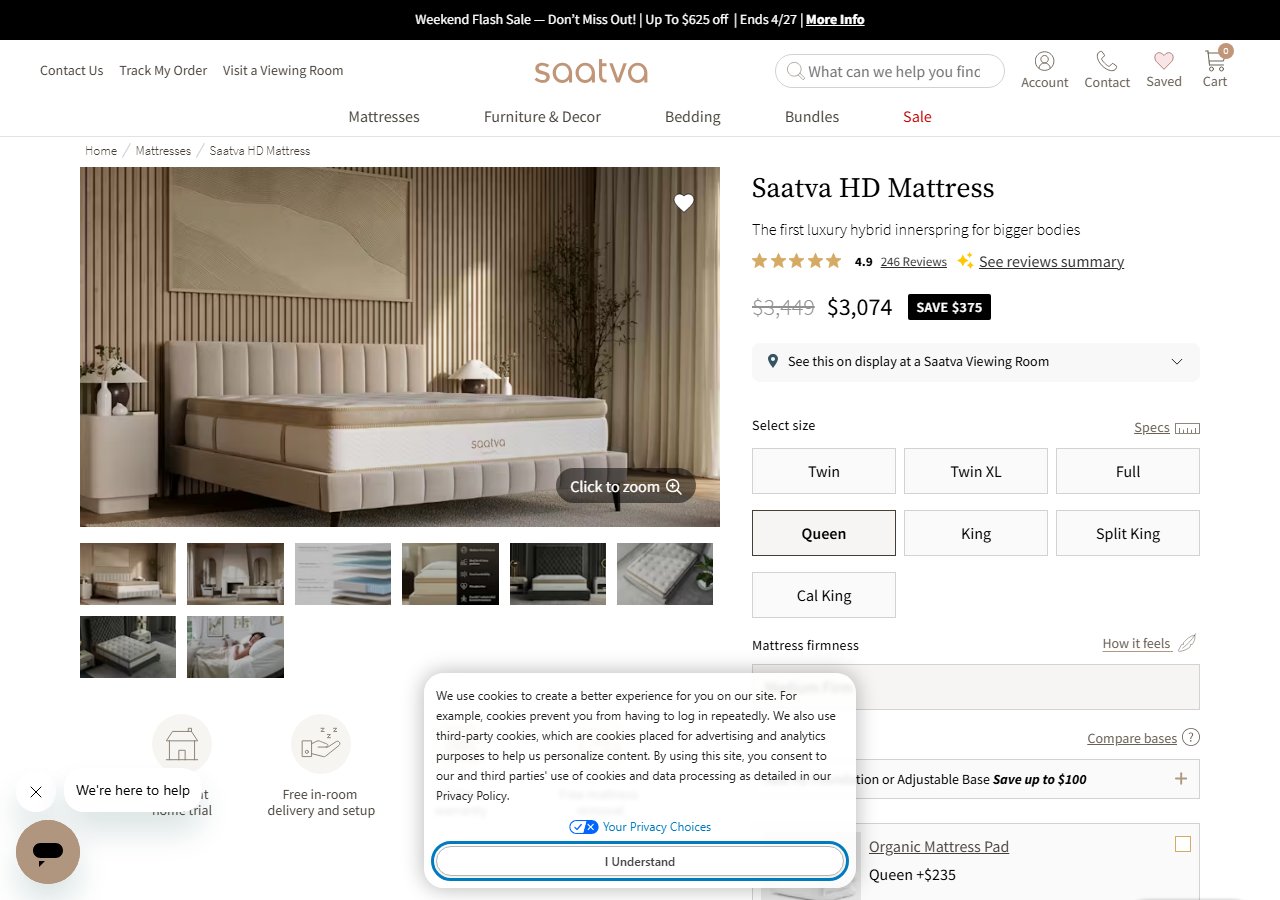
Saatva HD Mattress (Heavy-Duty)
$2,395-$3,995
See Price at Saatva →
Purple Hybrid Premier Mattress
$2,499-$4,799
See Price at Purple →The Data-to-Recovery Hierarchy: What Federal Evidence Actually Tells Healthcare Workers to Do
The federal data on healthcare worker musculoskeletal injury, chronic back pain prevalence, and shift-worker sleep deficit points toward a recovery hierarchy that is not primarily a purchasing decision. BLS MSD by Occupation data establishes the injury burden. NIOSH Lifting Equation analysis explains the mechanism. NIH NCCIH evidence identifies daily walking as the highest-leverage non-pharmacological intervention. NIH NIAMS guidance establishes that sleep position costs nothing to correct. And CDC Sleep and Sleep Disorders data frames the 35% population rate of short sleep as a systemic problem that a mattress alone cannot fix — but that a mattress, deployed correctly and at the right time in the recovery hierarchy, can meaningfully address at the margin.
The BLS workers' compensation data showing that high-MSD industries carry insurance rates 3-5x higher than low-MSD industries puts the financial stakes in institutional terms. But for the individual healthcare worker, the financial argument is personal: AHRQ MEPS data shows that chronic back conditions substantially elevate personal healthcare spending. A mattress that costs $2,000 and extends a nursing career by two years without a compensable back injury is a dramatically better financial outcome than a $500 mattress replaced every four years while accumulating physical therapy co-pays and prescription analgesic costs that CMS drug spending data shows are among the largest per-beneficiary drug cost categories in Medicare.
Healthcare workers deserve the same rigorous analysis applied to their recovery that they apply to patient care. Move first. Fix sleep position. Rule out red flags. Then, if the surface is the remaining variable — invest in it deliberately, with an understanding of why the construction choices matter for your specific injury pattern and sleep schedule.