The Federal Data Behind Healthcare Worker Back Pain
If you work a 12-hour nursing shift, an overnight ER rotation, or a hospital floor position that has you on your feet for the better part of a decade, the federal data already knows your spine. According to BLS Musculoskeletal Disorders by Occupation tracking, the back is the single most common body part injured across all U.S. occupations that result in days away from work. That is not a general wellness observation — it is a structural feature of shift-based healthcare labor, where patient transfers, prolonged standing, awkward reaches over hospital beds, and repetitive bending accumulate across a career. The back absorbs what the schedule demands, and it sends the invoice during the hours you are supposed to be recovering.
CDC NCHS Data Brief 390 puts the population-level number at roughly 20% of U.S. adults living with chronic pain, and lower back pain is the most common reported location. For healthcare workers specifically, that average understates the real exposure. The NIOSH Lifting Equation — the federal standard for evaluating manual material handling — documents that tasks in healthcare routinely exceed safe spinal compressive load limits. Repositioning a 200-pound patient in a hospital bed is not a safe lift by NIOSH criteria. Neither is bending over a low gurney, transferring a patient from wheelchair to exam table, or doing it again four hours later on hour ten of a twelve-hour shift.
The downstream costs are enormous. AHRQ HCUP data identifies back pain as one of the most expensive conditions in the U.S. healthcare system by combined inpatient and outpatient spending — a number that would be grimly ironic to any nurse who has treated back-pain patients while developing back pain herself. AHRQ MEPS data shows that annual personal healthcare expenditures for adults with chronic back conditions substantially exceed those for adults without. And at the far end of the spectrum, SSA Disability Insurance data identifies musculoskeletal disorders as the largest single category of new disability claims filed annually in the United States. The back-pain crisis is not a wellness trend — it is a federal actuarial fact.
Why Healthcare Shift Work Is Uniquely Damaging to the Spine
Understanding the mechanism matters before you reach for any solution. Healthcare workers do not simply experience back pain at higher rates because they lift heavy objects. The injury pattern is more complex, and three compounding factors separate healthcare MSDs from those in most other physically demanding occupations.
Factor 1: Cumulative load without adequate recovery windows. A warehouse worker lifts, but typically on a first-shift schedule with predictable rest. A nurse or surgical tech may work three 12-hour shifts in a row, rotating between day and night. Each shift adds to the cumulative spinal load without restoring the tissue — intervertebral disc rehydration, ligament recovery, and erector spinae muscle repair all require sustained horizontal rest. Short or disrupted sleep truncates that repair cycle.
Factor 2: Shift rotation and circadian disruption compound inflammation. CDC sleep data reports that approximately 35% of U.S. adults sleep fewer than 7 hours per night — the threshold associated with elevated chronic disease risk. Among rotating-shift healthcare workers, inadequate sleep is not a lifestyle choice; it is a structural feature of the schedule. Circadian misalignment elevates systemic inflammation markers, which amplifies pain sensitivity in already-stressed spinal tissue. A nurse who would rate her back pain a 4 on a full night of aligned sleep may rate it a 7 after a rotating shift.
Factor 3: Occupational arthritis exposure is underrecognized. CDC arthritis data reports that approximately 25% of U.S. adults have a doctor-diagnosed arthritis condition, with prevalence concentrated in occupations involving sustained physical demand. Healthcare workers — particularly those over 40 who have spent decades in bedside roles — develop facet joint arthritis and degenerative disc changes at rates consistent with high-demand manual occupations. Arthritis-affected joints are more sensitive to pressure and position during sleep, which is precisely why sleep-surface selection becomes a clinical variable rather than a comfort preference.
The workers' compensation signal is telling. BLS Employer Costs for Employee Compensation data shows that industries with high MSD incidence carry workers' compensation insurance rates 3 to 5 times higher than low-MSD industries. Hospitals and healthcare systems sit squarely in the high-MSD tier. This is not coincidence — it reflects the accumulated cost of an industry that asks its workers to physically handle humans all day, often on rotating schedules, often for decades.
The pain medication signal is equally concerning. CMS Drug Spending Dashboard data identifies opioid and non-opioid pain medication spending among the most expensive Medicare drug categories — a direct reflection of the chronic-pain treatment burden that accumulates when the underlying occupational exposure goes unaddressed. None of these federal data points point to a mattress as the primary solution. But they do collectively make the case that off-duty recovery quality is a legitimate occupational health variable, not a personal indulgence.
Try These First: Free and Low-Cost Interventions That Work
The cheapest intervention is the one that does not require buying anything. Before discussing any product, the federal evidence base supports several non-equipment interventions that have documented efficacy for the type of chronic low back pain healthcare workers experience. These come first in this article deliberately — because the research supports their primacy, not because products do not matter.
Sleep position before sleep surface. NIH guidance on back pain is explicit: side-sleeping with a pillow between the knees, or back-sleeping with a pillow under the knees, maintains spinal neutral alignment during sleep. Stomach-sleeping rotates the lumbar spine out of neutral and places sustained compressive stress on the facet joints — exactly the joints that are already inflamed from a shift. This is a zero-cost intervention. A standard bed pillow costs less than five dollars at any drugstore. Changing your sleep position is the single highest-leverage free variable in overnight spinal recovery.
Walking: underrated, federally supported. The NIH NCCIH evidence review on low back pain is one of the cleaner clinical evidence summaries available. Its finding: walking 30 minutes on most days reduces chronic low back pain as effectively as most non-drug clinical treatments. This is not a soft finding — NCCIH is the federal agency that evaluates complementary health approaches with the same methodological rigor it applies to pharmaceuticals. For healthcare workers who already spend shifts on their feet, the prescription to walk more may seem paradoxical. It is not. Purposeful low-impact walking loads the spine in a mechanically favorable pattern that differs significantly from the static standing, asymmetric reaching, and awkward bending of clinical work.
Lifting mechanics as a rehearsable skill. OSHA's ergonomics guidance on lifting is specific: hinge at the hips rather than the lumbar spine, keep loads close to the body's center of gravity, and avoid rotational torque under load. Most acute back episodes in healthcare are mechanical — meaning they are triggered by a specific movement pattern, often one that could have been modified. The NIOSH Lifting Equation supports this: the equation exists precisely because safe lifting is learnable, and because most acute MSD events are preventable with mechanics training rather than equipment.
Knowing when the mattress is actually the problem. CDC Sleep Hygiene guidelines offer a practical framework: replace a mattress when it has visible sag, when you consistently wake stiffer than you went to bed, or when it is more than 7 to 10 years old. Even the highest-specification sleep surface on the market does not undo poor sleep hygiene — irregular sleep schedules, blue-light exposure before bed, or excessive caffeine use late in a shift all override whatever the mattress contributes.
Some readers have already done all of this. They sleep on their side with the knee pillow. They walk. They have replaced the eight-year-old mattress that had a visible valley in the center. They have talked to an occupational therapist or physical therapist about mechanics. And they still wake up with lumbar stiffness that takes an hour to work out. That is a legitimate signal that sleep-surface engineering may be the remaining variable. For those readers, the evidence base on mattress construction — pressure relief, zoned support, and spinal alignment across different body compositions — becomes relevant.
When to See a Clinician First
Before any product discussion, a direct word about red flags. Not all back pain is the kind that sleep-surface selection addresses. NIH NINDS back pain guidance identifies specific clinical criteria that require prompt evaluation rather than equipment changes:
- Back pain that radiates below the knee, particularly with numbness or tingling, may indicate nerve compression that requires imaging and potentially procedural intervention — not a new mattress.
- Back pain following trauma (a fall, a patient-handling incident, a vehicle accident) requires imaging to rule out fracture before conservative care.
- Back pain accompanied by leg weakness, bowel or bladder changes, or fever may indicate serious pathology including cauda equina syndrome or spinal infection. These are medical emergencies.
- Back pain in a healthcare worker that is dramatically worsening rather than fluctuating, or that is worse lying down than standing, warrants oncology or infectious-disease workup.
If any of these patterns describes your situation, stop reading mattress reviews and call your physician or occupational medicine specialist. The federal data on back pain costs — AHRQ HCUP placing it among the most expensive conditions in the healthcare system — reflects in part the cost of delayed diagnoses when serious pathology is initially attributed to mechanical pain.
For healthcare workers without these red flags whose pain is the chronic, morning-stiff, position-sensitive variety typical of occupational MSD, the sleep surface is a legitimate next variable.
Where Sleep-Surface Engineering Meets Occupational Recovery Needs
Healthcare workers are not a monolithic body type or pain pattern. A 130-pound float pool nurse, a 220-pound ICU charge nurse who also does weekend warehouse work, and a 55-year-old surgical tech with documented lumbar facet arthritis all have different biomechanical needs from a sleep surface. The mattress science that matters here centers on three variables: zoned pressure relief (reducing peak pressure at the hips and shoulders without sacrificing lumbar support), foam or coil response to weight distribution (which changes the load map substantially between body types), and material durability under nightly use by a body that arrives already compressed from occupational loading.
For healthcare workers dealing with serious chronic back pain, the Saatva Loom & Leaf Memory Foam Mattress is the premium memory foam pick in this analysis. The Loom & Leaf uses a multi-layer premium foam construction with a proprietary gel-infused memory foam layer designed to reduce heat retention — a clinically relevant feature for shift workers who run warm after a high-activity overnight — while maintaining contouring pressure relief across the lumbar spine. Its dual firmness options (Relaxed Firm and Firm) give healthcare workers with different pain patterns a meaningful choice. The Relaxed Firm works well for side-sleepers with hip and shoulder pressure sensitivity; the Firm tier better serves back-sleepers and heavier-framed workers who need resistance rather than sink at the lumbar.
For larger-framed healthcare workers — specifically those over 200 pounds, or workers who do physical patient-handling at scale — the Saatva HD Mattress is the purpose-engineered option. The HD is built to handle body weights up to 500 pounds with a reinforced coil system and denser foam layers specifically designed to prevent the early sag that undermines spinal alignment in standard mattresses used by heavier individuals. The occupational relevance is direct: healthcare workers who are themselves larger-bodied face the same NIOSH-documented spinal loading on shift, but then come home to a mattress that deflects under their weight in ways that worsen rather than relieve lumbar compression. The HD's construction specifically addresses this mismatch.
For healthcare workers whose primary complaint is pressure sensitivity rather than structural alignment — particularly those with hip bursitis, shoulder tendinopathy, or the kind of all-over soreness that follows days of sustained standing and patient transfers — the Purple Hybrid Premier Mattress offers a genuinely differentiated pressure-relief mechanism. Purple's proprietary GelFlex Grid technology distributes pressure differently than either traditional memory foam or standard coil systems, creating a surface that simultaneously provides pressure relief at contact points and resistance at the lumbar without the progressive sink of foam. For healthcare workers who have tried memory foam and found it traps them in a single position all night, the Grid's responsive nature allows repositioning without resistance — which matters when you're trying not to disturb a sleep cycle that may have started at 7 a.m. after a night shift.
Sleep Surfaces Built for Healthcare Worker Spinal Recovery
These three mattresses were selected specifically for the pressure-relief, zoned support, and durability demands of shift workers who arrive home with accumulated spinal loading — not for general comfort shoppers.

Saatva Loom & Leaf Memory Foam Mattress
$1,695-$3,295
See Price at Saatva →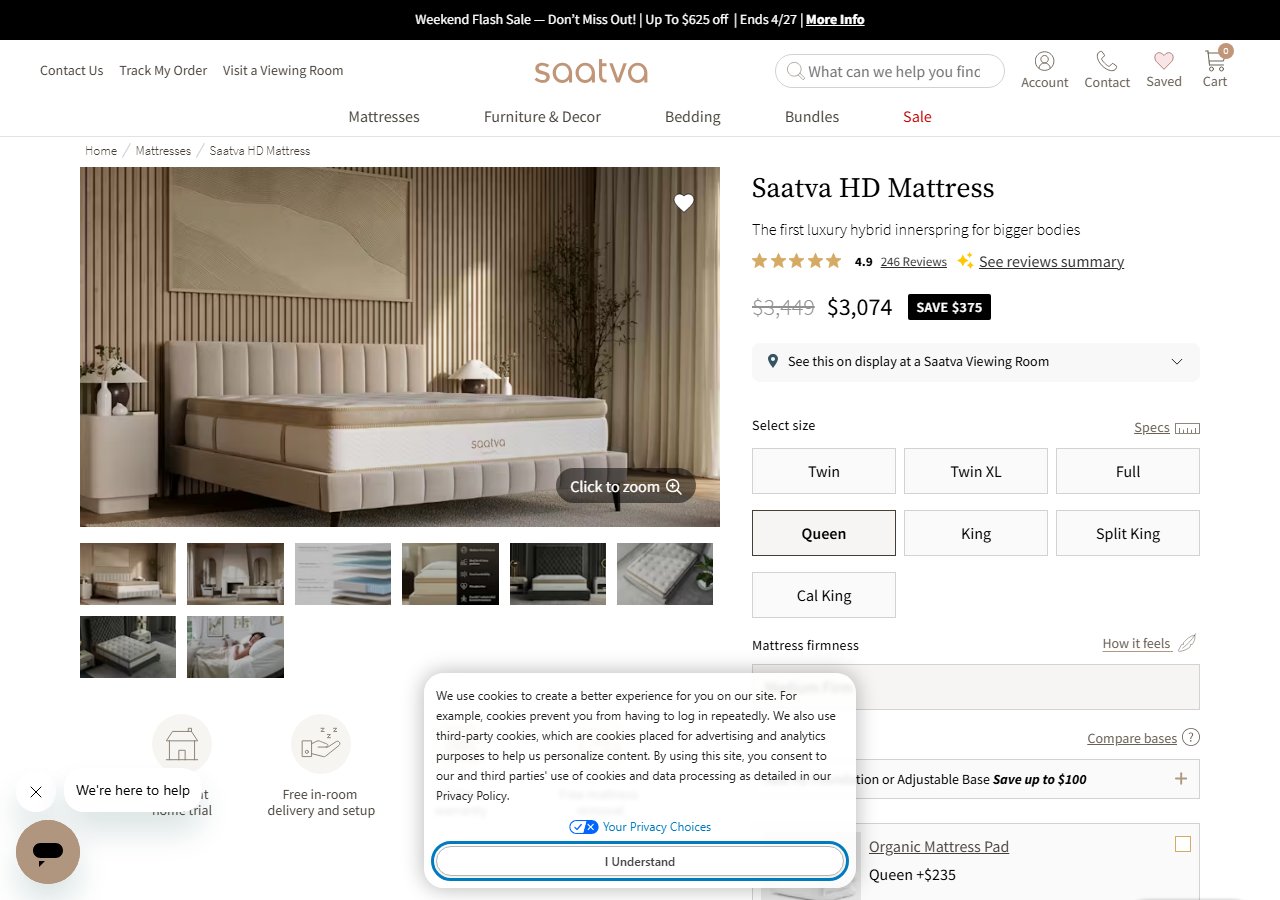
Saatva HD Mattress (Heavy-Duty)
$2,395-$3,995
See Price at Saatva →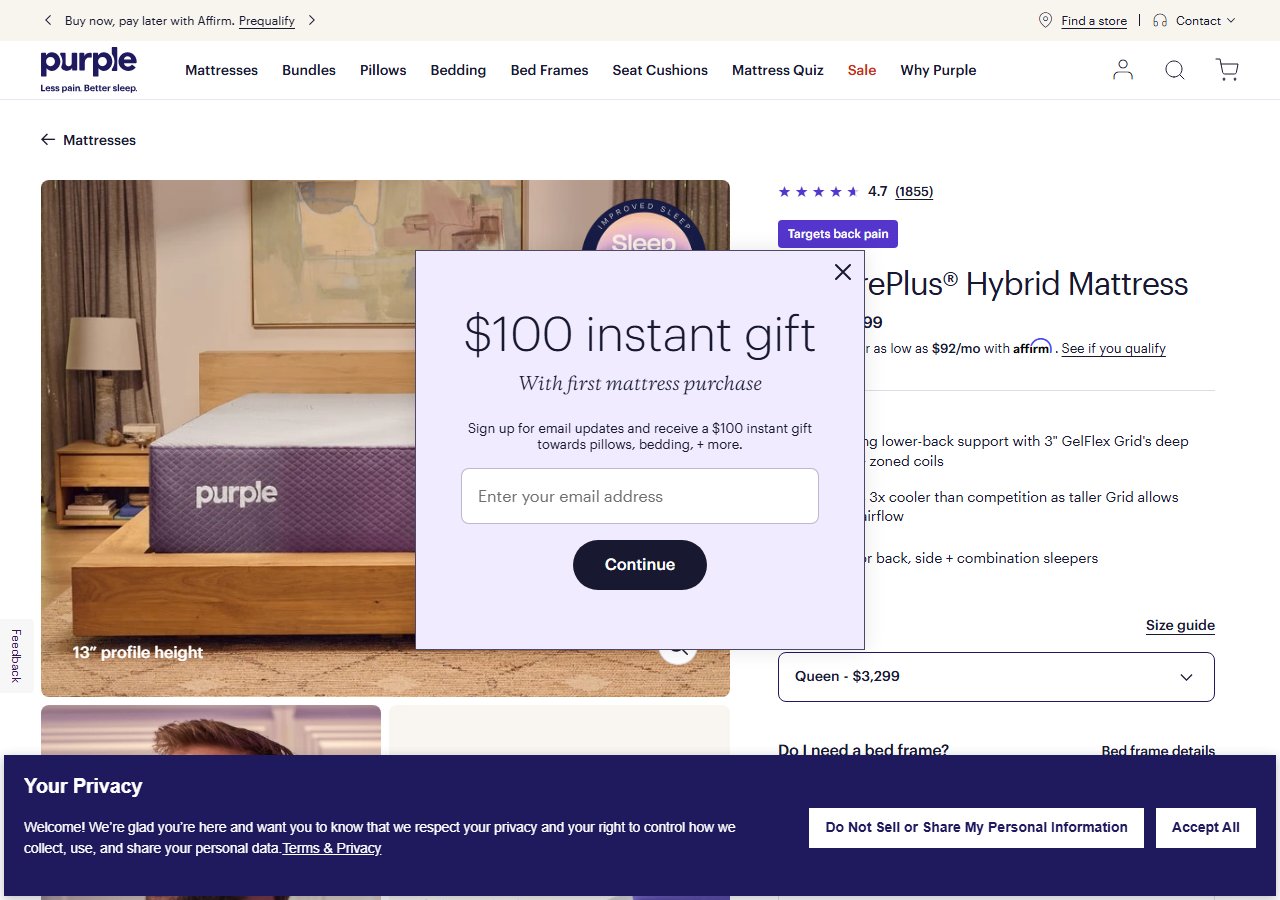
Purple Hybrid Premier Mattress
$2,499-$4,799
See Price at Purple →Putting the Evidence Hierarchy in Order
The federal data reviewed in this article tells a consistent story. Healthcare workers experience among the highest rates of occupational MSDs in the U.S. workforce. The back is the most frequently injured body part. The downstream costs — in healthcare expenditure, workers' compensation premiums, disability claims, and medication spending — are measured in billions annually. Sleep disruption from shift rotation compounds the injury pattern by elevating inflammation and truncating tissue recovery.
The intervention hierarchy the evidence supports is this: first, optimize sleep position using NIH guidance (zero cost). Second, add purposeful walking as NCCIH's evidence review recommends (zero cost). Third, audit lifting and bending mechanics using OSHA and NIOSH frameworks (zero cost, and the mechanism through which most acute episodes are preventable). Fourth, if the current sleep surface has visible degradation, is more than a decade old, or produces consistent morning stiffness, replace it — but replace it with engineering that matches your body type and pain pattern, not the cheapest available option.
For the healthcare workers who have cleared those steps and are ready to make a considered sleep-surface investment: the Saatva Loom & Leaf is the premium memory foam option for standard body types with chronic lumbar pain. The Saatva HD is the purpose-built option for larger-framed workers for whom standard mattress construction is a structural mismatch. The Purple Hybrid Premier is the pressure-relief-first option for workers whose pain pattern is predominantly surface-pressure sensitive.
None of these products reverses a decade of occupational spinal loading. The SSA Disability Insurance data and AHRQ HCUP cost data exist because musculoskeletal disorders in physically demanding occupations progress without comprehensive intervention — not because someone bought the wrong mattress. Sleep surface is one variable in a multi-variable problem. Treat it accordingly: important enough to get right, but not so important that it displaces movement, clinical care, or occupational ergonomics from their higher positions in the evidence hierarchy.