The federal data on healthcare worker back injury is unambiguous
If you are a nurse, surgical technician, respiratory therapist, or home health aide reading this between shifts, the federal data already knows your back. BLS Musculoskeletal Disorders by Occupation tracking consistently identifies the back as the single most common body part injured across all U.S. occupations resulting in days away from work — and healthcare and social assistance is one of the highest-incidence sectors in that dataset. This is not a minor workplace inconvenience. SSA Disability Insurance data identifies musculoskeletal disorders as the largest single category of new disability claims filed annually in the United States. For a significant number of healthcare workers, the injury that began with a patient transfer or a repeated bending motion at the bedside eventually becomes the condition that ends a career.
The economic footprint is equally sobering. AHRQ HCUP data identifies back pain as one of the most expensive conditions in the U.S. healthcare system by total inpatient and outpatient cost. Meanwhile, AHRQ Medical Expenditure Panel Survey data shows that adults living with chronic back conditions spend substantially more on personal healthcare annually than adults without those conditions. And downstream, CMS Drug Spending Dashboard data identifies opioid and non-opioid pain medications among the most expensive Medicare drug categories — a direct reflection of what happens when chronic pain goes unmanaged for years.
This article does not propose that a new mattress solves any of that. What it does argue — anchored in federal occupational health data — is that the eight hours a healthcare worker spends off-duty on a sleep surface represents a meaningful biomechanical variable that is almost entirely within that worker's control. Everything else in the treatment stack — the physical therapy copays, the anti-inflammatory prescriptions, the occupational health referrals — is expensive and often inaccessible between a 7 p.m. and 7 a.m. shift. The mattress is not.
Why healthcare work destroys the spine: the biomechanical mechanism
Understanding why healthcare workers are disproportionately represented in MSD data requires a brief stop at the physics of spinal loading. The NIOSH Lifting Equation — the federal standard for evaluating manual material-handling risk — documents that lifting tasks in healthcare routinely exceed safe spinal compression limits. Patient repositioning, transferring patients from bed to wheelchair, lifting supply boxes in a pharmacy stockroom, bending over a surgical table for three hours: these activities generate compressive and shear forces on lumbar discs that accumulate across a career.
The problem compounds with shift structure. A 12-hour nursing shift on a hard hospital floor means the lumbar spine is loaded — either through standing, walking, or repeated bending — for an extended block of time with minimal decompression. When that nurse goes home, the intervertebral discs that spent 12 hours under compressive load need time in a neutral, unloaded position to rehydrate and recover. This is not metaphor; it is basic disc physiology. Intervertebral discs are avascular structures that exchange fluid and nutrients through the mechanical pumping action of loading and unloading. Sustained loading without adequate decompression during sleep accelerates degenerative disc disease.
Layer on top of that the sleep deprivation problem. CDC sleep and sleep disorder data shows approximately 35% of U.S. adults report sleeping fewer than 7 hours per night — the threshold below which chronic disease risk measurably elevates. Among shift workers, that number is reliably worse. Rotating shifts disrupt circadian rhythms, fragment sleep architecture, and reduce the proportion of slow-wave sleep during which musculoskeletal tissue repair primarily occurs. A healthcare worker who sleeps five fragmented hours on a mattress that puts the spine in lateral flexion is not recovering. They are accumulating deficit.
CDC NCHS Data Brief 390 reports that approximately 20% of U.S. adults experience chronic pain, with lower back as the most prevalent site. Among the working population, occupational exposure explains a significant share of that burden. CDC arthritis data adds that roughly 25% of U.S. adults have doctor-diagnosed arthritis, with prevalence concentrated precisely in the physically demanding occupations that healthcare represents.
The mechanism, then, is this: a healthcare worker loads the lumbar spine repeatedly and asymmetrically across a long shift, goes home sleep-deprived, lies on a surface that may hold the spine in a compromised position for whatever hours of sleep they can get, and returns to work with less disc hydration and more facet joint irritation than they started with. Repeat for years. The BLS injury data is the downstream statistical result of that loop.
Free interventions come first — and they outperform products for most people
Before discussing any product, the evidence is clear: the cheapest intervention is the one that costs nothing. For most healthcare workers experiencing mechanical back pain — the kind that builds gradually through occupational exposure rather than arriving from a single traumatic event — behavioral and positional changes produce measurable improvement without requiring a purchase.
Proper lifting and bending mechanics during the shift matter more than almost anything else. OSHA's ergonomics guidance is explicit: hinge at the hips, not the lumbar spine; keep loads as close to the body as possible; never twist under load. Most acute back episodes are mechanical in origin and preventable through rehearsed movement patterns. For healthcare workers who are already doing patient transfers, this means advocating within your unit for mechanical lift equipment and never normalizing manual patient handling as a routine expectation.
Off the clock, sleep position is the highest-leverage free variable. NIH guidance on back pain is straightforward: side-sleeping with a pillow between the knees, or back-sleeping with a pillow tucked under the knees, keeps the lumbar spine in a neutral arc. Stomach-sleeping generates sustained lumbar hyperextension and cervical rotation that worsens chronic pain — the position healthcare workers who crash into bed face-down should actively un-learn.
Daily walking is one of the most evidence-supported non-pharmacological interventions for chronic low back pain. NIH NCCIH's evidence review on low back pain finds that 30 minutes of walking on most days reduces chronic low-back pain symptoms as effectively as most non-drug clinical treatments. This matters because it reframes rest as active recovery: lying still in bed for additional hours does not produce the same benefit as light aerobic movement that promotes disc fluid exchange and reduces paraspinal muscle guarding.
Finally, the mattress itself may already be part of the problem before you consider buying something new. Replacing a visibly sagging mattress is not a luxury purchase — it is correcting a dysfunctional sleep surface. CDC sleep hygiene guidance frames the sleep environment as a clinical variable. If you wake stiffer than when you went to bed, if there is a visible depression in the mattress surface, or if the mattress is older than 7-10 years, it is likely producing lateral spinal flexion throughout the night. No amount of correct sleep position technique compensates for a surface that sags under body weight.
For readers who have already addressed sleep position, movement habits, and shift mechanics, and who are still waking with lumbar pain — the mattress construction itself becomes a legitimate variable worth examining. The federal data on spinal loading, disc physiology, and sleep deprivation collectively point toward specific mattress design features: pressure relief at the lumbar curve, lateral spinal support during side-sleeping, and surface temperature regulation for shift workers whose circadian rhythms are already disrupted. Three products in this article were evaluated against those specific criteria.
When to see a clinician before buying anything
Back pain in healthcare workers is common enough that it risks being normalized. It should not be. There is a category of back pain symptoms that demands clinical evaluation before any self-management strategy — including mattress selection — is appropriate.
- Radicular pain below the knee (shooting, burning, or numbness extending past the knee into the calf or foot) suggests nerve root compression or disc herniation requiring imaging. Per NIH NINDS back pain guidance, this symptom warrants prompt evaluation, not a new mattress.
- Back pain following acute trauma — a fall, a patient-handling incident, a vehicle accident — requires rule-out of fracture before any conservative management.
- Leg weakness, bowel or bladder dysfunction, or saddle anesthesia (numbness in the groin or inner thigh) are red flags for cauda equina syndrome, a surgical emergency. Seek emergency care immediately.
- Back pain accompanied by fever, unexplained weight loss, or night sweats may signal infection or malignancy. NIH NINDS guidance identifies these as systemic red flags requiring urgent workup.
- Pain that is constant, non-mechanical, and worsening despite rest over several weeks — without any positional relief — warrants imaging and referral rather than conservative management.
For the healthcare worker whose back pain is mechanical, positional, and directly tied to shift exposure and poor sleep surface quality — the rest of this article is relevant. For anyone recognizing the red flags above: see a clinician first. AHRQ HCUP data documents the cost of delayed care for back conditions; early evaluation is categorically less expensive than late-stage intervention.
Where specific mattress constructions fit into the recovery picture
With mechanism understood, free interventions addressed, and clinical red flags acknowledged, mattress selection becomes a rational engineering question: which constructions support lumbar neutrality under the specific load profiles of a healthcare worker's body after a 12-hour shift?
The relevant variables are pressure relief (particularly at the hip and shoulder during side-sleeping, which is the recommended position for lumbar pain), zoned support (firmer under the lumbar and hips, softer at the shoulders), heat management (critical for shift workers whose disrupted circadian rhythms already impair thermoregulation), and durability under nightly load cycling.
The Saatva Loom & Leaf is the premium memory foam pick for healthcare workers dealing with serious chronic back pain. Its multi-layer memory foam construction uses a spinal zone quilting pattern — a quilted lumbar crown that provides targeted support directly under the lower back. This matters for the healthcare worker who side-sleeps: the lumbar region tends to sink into standard foam surfaces, creating lateral flexion that loads the facet joints all night. The Loom & Leaf uses high-density base foam beneath the comfort layers to prevent that sink-through effect while still providing enough surface compliance to relieve hip and shoulder pressure. At $1,695 to $3,295 depending on size, this is a considered purchase — but for a nurse or respiratory therapist who has already spent more than that on anti-inflammatory medications and physical therapy copays documented in AHRQ MEPS data, it is a one-time capital expenditure on the most uncontrolled variable in their recovery stack.
The Saatva HD addresses a specific subset of the healthcare workforce: larger-bodied workers, or those whose occupational loading has been extreme enough that standard mattress support systems have failed them. The HD uses a dual steel coil system — an individually-wrapped coil layer sitting on a tempered steel base grid — engineered to maintain consistent support at higher body weights without the progressive softening that causes standard mattresses to lose their lumbar support geometry over time. The NIOSH Lifting Equation documents that healthcare patient-handling tasks routinely exceed safe spinal loading thresholds; a worker who has been absorbing those loads for years often carries musculoskeletal adaptations — stronger thoracic musculature, altered lumbar curve — that standard mattress designs do not accommodate. The HD's engineered coil geometry is relevant here. Priced at $2,395 to $3,995, it is the highest-ticket option in this list but the most structurally differentiated for its target user.
The Purple Hybrid Premier takes a different engineering approach: its GelFlex Grid replaces conventional foam comfort layers with an open-grid polymer structure that collapses under pressure points (hips, shoulders) while remaining supportive under lighter-loaded zones (lumbar). For side-sleeping healthcare workers with hip pain layered on top of lumbar complaints — a common combination in nurses who stand primarily on one leg — this targeted pressure response is meaningful. The grid is also air-permeable, which addresses the thermoregulation problem relevant to shift workers. Priced at $2,499 to $4,799, the Purple Hybrid Premier competes with the Loom & Leaf at similar price points with a fundamentally different comfort mechanism; the right choice depends on whether the worker's primary complaint is pressure pain (Purple's strength) or lumbar support (Loom & Leaf's strength).
Mattresses Built for Healthcare Shift-Worker Spinal Recovery
Each of these mattresses was evaluated against the specific biomechanical demands documented in federal occupational health data for healthcare workers: lumbar support under shift-accumulated spinal loading, pressure relief for side-sleeping, and thermal regulation for disrupted circadian schedules.

Saatva Loom & Leaf Memory Foam Mattress
$1,695-$3,295
See Price at Saatva →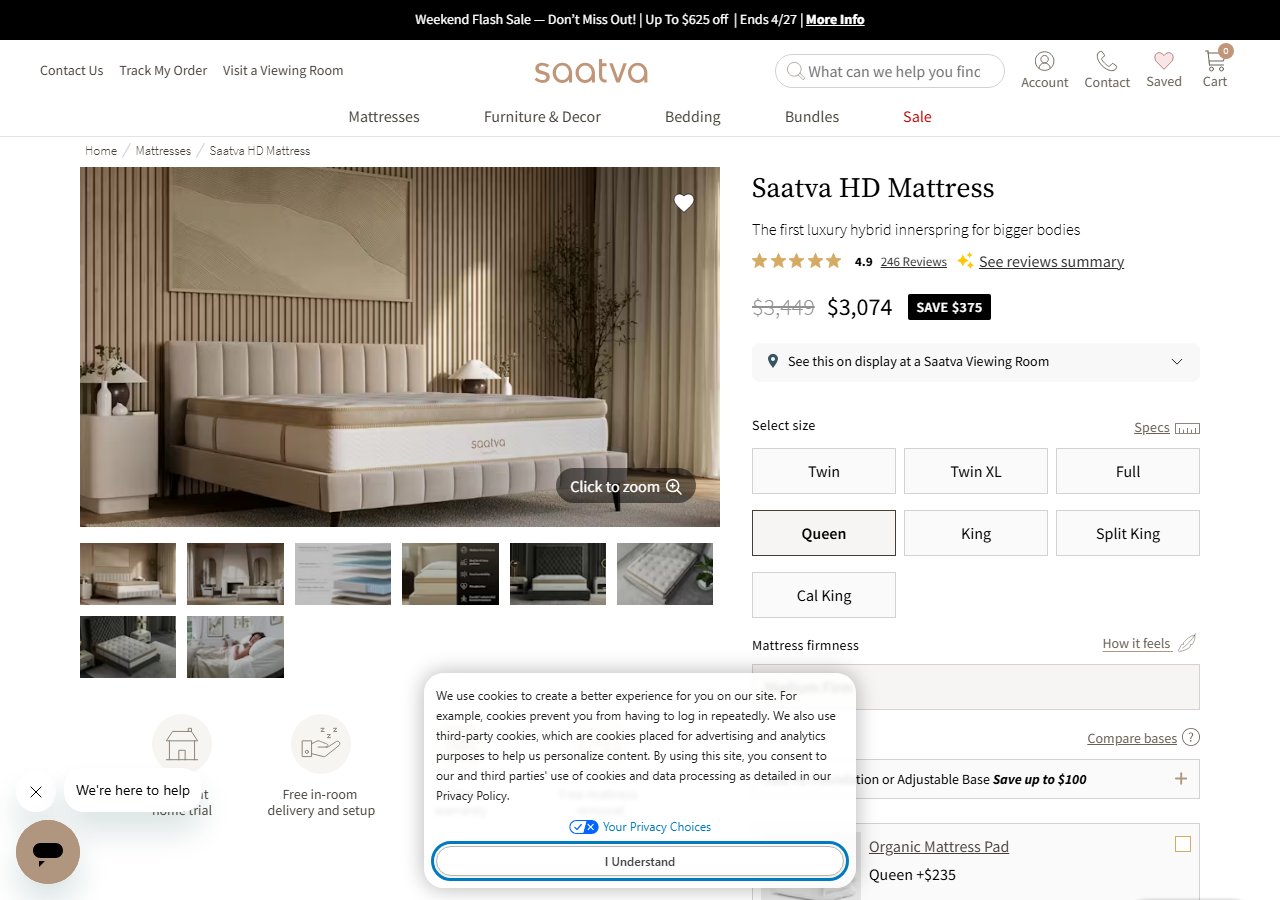
Saatva HD Mattress (Heavy-Duty)
$2,395-$3,995
See Price at Saatva →
Purple Hybrid Premier Mattress
$2,499-$4,799
See Price at Purple →Putting the federal data hierarchy to work
The through-line of every federal data source cited in this article is the same: musculoskeletal injury in healthcare is a high-frequency, high-cost, career-limiting occupational exposure. BLS MSD tracking puts healthcare workers in the highest injury-incidence tiers. SSA disability data shows where the worst cases land. AHRQ cost data quantifies what delayed management costs the system — and the individual.
A mattress sits at the bottom of that intervention hierarchy, not the top. The free interventions — corrected movement mechanics, optimized sleep position, daily walking — are the first tools. Clinical evaluation rules out the serious diagnoses that require imaging or surgery. Only then does mattress construction become a meaningful variable. But for the healthcare worker who has addressed those upstream factors and is still sleeping on a decade-old surface that sags under body weight, the mattress is no longer a luxury. It is the single remaining variable in the recovery equation that has not been optimized.
BLS workers' compensation data shows that industries with high MSD incidence carry insurance rates three to five times higher than low-MSD industries — a market price signal for the cost of not managing these exposures. The individual healthcare worker cannot change the ergonomics of a hospital built in 1987. But they can control what happens to their spine for the eight hours they are off the clock. The federal data on sleep deprivation, disc physiology, and MSD progression argues that those hours are not a passive variable. They are the recovery window. What that window is built on matters.