The Federal Data Behind Construction's Morning Pain Problem
If you work in framing, concrete, roofing, ironwork, or any other heavy trade, there is a reasonable chance you have started your morning by rolling out of bed with the kind of stiffness that takes an hour — and usually a hot shower — to work through. That experience has a federal data signature. According to BLS Musculoskeletal Disorders by Occupation tracking, the back is the single most common body part injured across all U.S. occupations resulting in days away from work, and construction trades consistently rank among the highest-incidence industries in that dataset. This is not a matter of toughness or aging — it is a biomechanical accounting problem that accumulates across career-length exposures and then presents every morning on your mattress.
The stakes are financial as well as physical. BLS Employer Costs for Employee Compensation data shows that industries with high MSD incidence carry workers' compensation insurance rates 3–5 times higher than low-MSD industries. AHRQ HCUP data identifies back pain as one of the most expensive conditions in U.S. healthcare by total inpatient and outpatient spend — not because individual episodes are catastrophic, but because chronic, undertreated spinal conditions generate a lifetime of clinical contacts, imaging studies, injections, and eventually surgical consults. SSA Disability Insurance reports identify musculoskeletal disorders as the single largest category of new disability claims filed annually. The construction worker who dismisses morning stiffness as "just part of the job" is statistically on a trajectory that federal data has already mapped.
Why This Happens: The Biomechanics of a Construction Career on Your Spine
Understanding why construction workers wake up stiff requires understanding what a shift actually does to the spine — not in soft, general terms, but mechanically. The NIOSH Lifting Equation is the federal standard for evaluating manual material-handling tasks. It calculates a Recommended Weight Limit (RWL) based on load weight, horizontal and vertical position at lift origin and destination, asymmetry, frequency, and grip coupling. Tasks that exceed the RWL generate a Lifting Index above 1.0, which NIOSH classifies as posing elevated musculoskeletal risk. NIOSH's own documentation notes that manual material-handling tasks across warehousing, construction, and healthcare routinely exceed safe spinal loading limits — meaning ordinary workday tasks, performed by trained workers following standard practice, still impose forces on the lumbar spine beyond what the equation considers safe for uninjured workers.
This matters for sleep because of what those forces do structurally. Intervertebral discs are viscoelastic: they absorb compressive load during the day and rehydrate during recumbency at night. But repeated high-load episodes — carrying bundle after bundle of roofing shingles, setting form boards, operating a jackhammer in a bent-forward posture, pouring and screeding concrete — cause microfailure in the outer annulus fibrosus over years. Paraspinal muscles chronically activated for stabilization develop myofascial trigger points that remain electrically active even at rest. Facet joint cartilage, subjected to asymmetrical compression during twisting lifts, develops early osteoarthritic changes that are painful with any sustained position change.
The result is that a construction worker's lumbar spine arrives at bedtime in a mechanically compromised state. If the sleep surface cannot maintain neutral spinal alignment — if it sags under concentrated load at the hips or allows the lumbar curve to collapse into a hammocked position — the paraspinal musculature cannot fully relax and the discs cannot fully rehydrate. Eight hours of poor spinal mechanics during sleep compounds the damage done during eight hours of occupational loading. Morning stiffness is not just "soreness" — it is the clinical signal that nocturnal recovery has failed.
Body weight compounds this substantially. Construction trades skew toward higher body-mass workers — not universally, but structurally. Framers and ironworkers carry upper-body muscle mass that pushes average weight above the population mean. CDC NCHS Data Brief 390 reports that approximately 20% of U.S. adults experience chronic pain with lower back as the most common site; the prevalence in physically demanding occupations exceeds that baseline. A 220-pound carpenter imposes roughly 40% more force per unit mattress area than a 155-pound office worker. Consumer mattresses are typically engineered for average-adult load profiles. A mattress that feels supportive at 155 pounds may sag measurably at the hip zone of a 230-pound side-sleeper within 18–24 months, creating exactly the hammock geometry that prevents spinal decompression overnight.
CDC Sleep and Sleep Disorders Data shows that approximately 35% of U.S. adults already report sleeping fewer than 7 hours per night — the threshold the CDC associates with elevated chronic disease risk. Among shift workers, and among workers with pain-disrupted sleep, that percentage is significantly higher. The bidirectional relationship between sleep deprivation and pain sensitization is well-established in clinical literature: inadequate sleep lowers pain thresholds, and increased pain disrupts sleep architecture, creating a reinforcing cycle that a construction worker's occupational exposures can accelerate rapidly.
Try These First: Free and Low-Cost Interventions Before Any Product Purchase
The cheapest intervention is the one that requires no purchase. Before discussing mattress specifications, it is worth being direct: a worker whose morning stiffness is primarily driven by poor sleep position, inadequate movement during non-work hours, or a mattress that is objectively worn out will get more relief from fixing those variables than from upgrading to a more expensive sleep surface. Federal data and clinical guidance support several non-product interventions with strong evidence bases.
Lifting mechanics are the upstream lever. OSHA's ergonomics guidance is clear: hinge at the hips rather than the lumbar spine, keep loads close to the body's center of mass, and avoid twisting under load. Most acute back episodes in construction are mechanical — they result from a specific movement pattern that exceeded tissue tolerance. Rehearsing correct hip-hinge mechanics until they are automatic is the single highest-return investment a construction worker can make in spinal longevity. No mattress can undo the damage done by 200 asymmetrical twisting lifts per shift.
Daily walking is underrated as recovery. NIH NCCIH's evidence review of low back pain interventions concludes that 30 minutes of walking most days reduces chronic low back pain as effectively as most non-drug clinical treatments. The mechanism is multifactorial: walking loads the spine rhythmically and symmetrically, promotes disc nutrient exchange, maintains gluteal and core activation patterns, and reduces the central sensitization that amplifies chronic pain signals. A construction worker who is physically exhausted after a shift may find it counterintuitive, but light walking — not rest — is what the evidence supports.
Sleep position is the biggest free variable. NIH National Institute of Arthritis and Musculoskeletal and Skin Diseases back pain guidance recommends side-sleeping with a pillow between the knees, or back-sleeping with a pillow under the knees, as the positions most consistent with lumbar neutral alignment. Stomach-sleeping places the lumbar spine in sustained extension with rotational stress on the cervical spine and should be avoided by anyone with existing lower back pathology. A pillow between the knees costs under ten dollars and changes hip-spine alignment in a way that $3,000 mattresses cannot fully compensate for if the position is wrong.
Mattress condition matters before brand or model. CDC Sleep Hygiene guidance supports replacing a mattress that shows visible sag, produces worse morning stiffness than before sleep, or exceeds 7–10 years of age. A worn-out mattress is not a support system — it is a conforming surface that maps to existing asymmetries and holds the spine in them for eight hours. The most expensive new mattress cannot compensate for chronic sleep deprivation or inadequate movement, but it also cannot help when the old one is functionally failed.
For readers who have already worked through the above — who sleep correctly positioned, walk regularly, have reasonable lifting mechanics, and are on a mattress less than eight years old that shows no visible sag — and still wake stiff and under-recovered, the issue may be that the sleep surface itself is inadequate for the specific load profile and recovery demands of construction work. That is a legitimate product question, and it is what the rest of this article addresses.
When to See a Clinician: Red Flags That a Mattress Cannot Fix
Before spending money on a new sleep surface, construction workers need to rule out back pain presentations that require clinical evaluation rather than equipment upgrades. NIH National Institute of Neurological Disorders and Stroke back pain guidance establishes clear red flags: back pain that radiates below the knee (suggesting nerve root compression or disc herniation), pain following acute trauma (falls, caught-between incidents, which are disproportionately common in construction), leg weakness or numbness, changes in bowel or bladder function, or back pain accompanied by fever. These presentations require imaging or referral — they are not sleep surface problems.
AHRQ MEPS data shows that average annual personal healthcare expenditures for adults with chronic back conditions substantially exceed costs for adults without such conditions — which means the financial case for early clinical evaluation, before conditions become chronic, is strong. CMS drug spending data identifies opioid and non-opioid pain medication spending among the most expensive Medicare drug categories, reflecting how often undertreated musculoskeletal pain escalates toward pharmacological management. A construction worker who delays evaluation for a progressing disc herniation because they are trying a new mattress first is not saving money — they are accumulating the deferred costs that federal spending data has already counted. If your pain is worsening rather than stable, seek evaluation before purchasing anything.
CDC Arthritis data shows approximately 25% of U.S. adults report doctor-diagnosed arthritis, with prevalence concentrated in occupations involving sustained physical demand — exactly the profile of heavy trades. Arthritic facet joints and early degenerative disc disease can be meaningfully managed, but management requires diagnosis. A clinician can distinguish between mechanical pain that responds to sleep surface optimization and inflammatory or structural pain that requires different interventions entirely.
Where a Sleep Surface Actually Helps: The Construction Worker's Load Profile
For workers who have cleared the clinical threshold and are genuinely evaluating sleep surfaces as a recovery tool, the relevant variables are different from what most mattress marketing addresses. The question is not whether a mattress is "medium-firm" or "memory foam" in the abstract — it is whether the support system can maintain neutral lumbar alignment under the specific combination of body weight, body composition, and dominant sleep position of a worker who arrives at the mattress in a state of accumulated spinal fatigue.
For construction workers dealing with serious back pain and chronic muscular fatigue, the Saatva Loom & Leaf Memory Foam Mattress is the first option worth examining in the premium memory foam category. Loom & Leaf is built on a 5.5-inch convoluted support foam base topped with multiple layers of gel-infused memory foam, including a lumbar zone enhancement designed to provide differential support under the lower back. Memory foam's viscoelastic properties make it particularly well-suited for workers with myofascial pain — the material conforms to asymmetrical load presentations that result from long-term postural adaptation, distributing pressure rather than creating focal high-pressure points at the hip and shoulder. The gel infusion addresses the heat retention issue that standard memory foam presents for workers with high metabolic output.
For workers at the higher end of the weight range — roughly 230 pounds and above, which is not unusual in structural trades — standard consumer mattresses, including premium ones, present a durability and support problem that the Saatva HD Mattress was specifically engineered to address. The HD is a purpose-built heavy-duty innerspring-hybrid with a 3-inch Euro pillow-top over a three-stage coil system that includes individually-wrapped micro coils and a high-density foam encasement border designed to prevent perimeter collapse under sustained high-load use. The coil system is calibrated to maintain neutral spinal alignment at body weights that cause conventional innerspring systems to bottom out or sag asymmetrically. For a 260-pound ironworker or a 240-pound concrete finisher side-sleeping eight hours per night, the HD's engineering parameters are materially different from what a standard innerspring — even an expensive one — can sustain over a five-to-seven-year product life.
The Purple Hybrid Premier Mattress approaches the pressure-relief problem differently. Purple's proprietary GelFlex Grid — a hyperelastic polymer grid rather than foam or coil — is designed to collapse under pressure points while remaining rigid under lower-load areas. For construction workers with facet joint sensitivity or hip bursitis that makes sustained side-lying painful on conventional foam, the Grid's pressure-nullification properties can reduce the number of pain-driven awakenings per night that disrupt sleep architecture. The Hybrid Premier places the Grid over a pocketed coil support system, providing the spinal alignment benefits of a responsive foundation while the Grid manages surface pressure. It runs warmer than Purple's foam-only models and cooler than standard memory foam, which matters for high-metabolic workers.
Sleep Surfaces Built for Construction Workers' Spinal Load Patterns
Each mattress below was selected for its specific engineering fit with the weight ranges, sleep positions, and cumulative spinal fatigue patterns documented in BLS and NIOSH construction-worker injury data — not for marketing claims.

Saatva Loom & Leaf Memory Foam Mattress
$1,695-$3,295
See Price at Saatva →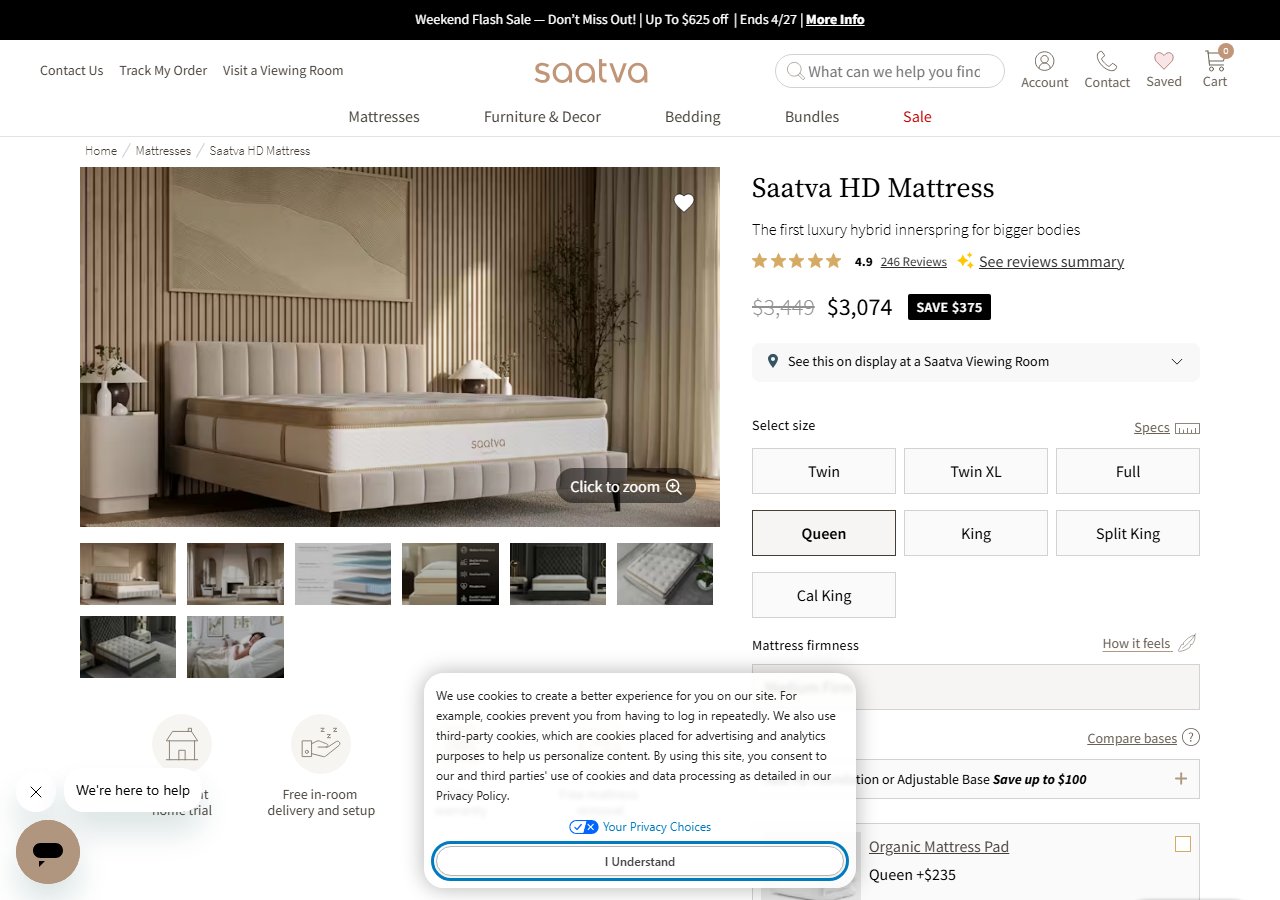
Saatva HD Mattress (Heavy-Duty)
$2,395-$3,995
See Price at Saatva →
Purple Hybrid Premier Mattress
$2,499-$4,799
See Price at Purple →Making the Decision: A Data-Driven Framework
The federal data reviewed in this article points toward a clear decision hierarchy for construction workers dealing with sleep-disrupting back pain. Start with the upstream variables: lifting mechanics, daily walking, sleep position, and mattress age and condition. These interventions are free or near-free, have strong federal evidence bases, and address root causes rather than symptoms. If back pain presents with any of the clinical red flags identified by NIH — radiation below the knee, neurological symptoms, post-trauma onset — seek evaluation before purchasing anything.
If a worker clears those steps and is evaluating sleep surfaces as a genuine recovery tool, the relevant specification question is body weight and sleep position, not marketing language about "firmness levels." Workers under approximately 200 pounds who side-sleep typically need a mattress with sufficient surface contouring to prevent focal hip and shoulder pressure — which is where the Loom & Leaf's memory foam construction has an advantage. Workers between 200 and 280 pounds, particularly side and back sleepers, need a support core that will maintain alignment under that load over years of use — which is the design mandate the Saatva HD was built around. Workers of any weight whose pain presentation includes focal pressure sensitivity at joints may find the Purple Hybrid Premier's grid technology more effective than either foam or conventional innerspring.
None of these products are treatments. CDC NCHS Data Brief 390 puts the chronic pain prevalence baseline at approximately 20% of U.S. adults. The construction worker population exceeds that baseline. A mattress that maintains neutral spinal alignment through an eight-hour sleep cycle is one tool in a multi-tool recovery strategy — not a substitute for clinical care, appropriate movement, correct lifting mechanics, or the sustained attention to occupational ergonomics that the NIOSH Lifting Equation framework demands. Use it as such.