The Morning Stiffness Construction Workers Are Told to Accept
If you frame a house for a living, pour concrete, run conduit, or operate heavy equipment, you already know the feeling: you swing your legs over the side of the bed before 5 a.m. and spend the first 20 minutes of your day walking off a back that feels like it aged a decade overnight. Most tradespeople normalize this. Their foreman normalized it. Their father, if he was in the trades, normalized it. Federal occupational health data does not.
According to BLS Musculoskeletal Disorders by Occupation tracking, the back is the most common body part injured across all U.S. occupations with days away from work — and construction trades rank among the highest-incidence sectors. The NIOSH Lifting Equation documents that manual material-handling tasks routine in construction — carrying lumber, lifting sheet goods, maneuvering pipe — routinely exceed safe spinal loading limits even for physically conditioned workers. The economic consequences are severe: BLS Employer Costs for Employee Compensation data shows that industries with high MSD incidence carry workers' compensation insurance rates 3–5 times higher than low-MSD industries.
But here is what the employer cost data cannot capture: what happens to a construction worker's body between the end of the shift and the start of the next one. Sleep is the primary physiological window for spinal disc rehydration, soft tissue repair, and inflammatory downregulation. When that window is spent on a sleep surface that fails to support the biomechanical reality of a high-load body — whether because the mattress has sagged, the support core is too soft for a heavier frame, or the sleep position loads the lumbar spine — the repair cycle is interrupted every single night. Morning stiffness is not random. It is the predictable output of incomplete recovery.
Why Construction Work Breaks Your Back: The Biomechanical Mechanism
Understanding why tradespeople wake stiff requires understanding what their spines endure before they ever reach the bedroom.
Intervertebral discs — the cartilaginous shock absorbers between each vertebral body — are avascular. They receive nutrients and expel metabolic waste through diffusion driven by compression and decompression cycles. During vertical loading (standing, lifting, carrying), discs compress and lose fluid. During horizontal unloading (lying down), they rehydrate. This is normal biology. The problem for construction workers is the magnitude and duration of the compression phase.
The NIOSH Lifting Equation establishes a Recommended Weight Limit (RWL) for two-handed manual lifts. When actual lift conditions — load weight, horizontal distance from the body, vertical travel distance, asymmetric rotation — push the Lifting Index above 1.0, the task is classified as high-risk for musculoskeletal injury. Construction tasks routinely produce Lifting Indices of 2.0 to 4.0 or higher, particularly in framing, masonry, and mechanical trades. Each shift above these thresholds accelerates disc degeneration, facet joint arthritis, and erector spinae fatigue.
The downstream population data is stark. CDC NCHS Data Brief 390 reports that approximately 20% of U.S. adults experience chronic pain, with the lower back as the most common pain location. Construction workers are not evenly distributed across that 20%. Their occupational exposure concentrates them at the high end of both incidence and severity. CDC Arthritis data shows that approximately 25% of U.S. adults report doctor-diagnosed arthritis, with prevalence concentrated in occupations involving sustained physical demand — a description that fits construction precisely.
When a body carrying that cumulative spinal load lies down at night on an inadequate sleep surface, the situation compounds. A mattress that has lost its support core — visible as a sag or body impression — holds the lumbar spine in flexion throughout the night. A mattress that is too soft for a heavier or more muscular frame allows the hips to sink disproportionately, producing lateral lumbar curvature. A mattress that is too firm for a side sleeper creates pressure point loading at the greater trochanter and acromion, preventing the postural shifts that distribute spinal load. None of these failures show up in a workers' comp claim. All of them compound the injury.
The long-run cost of inadequate recovery is not theoretical. SSA Disability Insurance data identifies musculoskeletal disorders as the largest single category of new disability claims annually. AHRQ HCUP data identifies back pain as one of the most expensive conditions in U.S. healthcare by total inpatient and outpatient cost. And AHRQ MEPS data shows that average annual personal healthcare expenditures for adults with chronic back conditions substantially exceed costs for adults without such conditions. A construction worker's career is measured in decades; the compounding effect of poor nightly recovery across that career is enormous.
There is also a sleep duration dimension that often gets overlooked in the trade injury literature. CDC Sleep and Sleep Disorders data shows that approximately 35% of U.S. adults report sleeping less than 7 hours per night, the threshold associated with elevated chronic disease risk. Construction workers — early start times, physically exhausting days, often supplemented by side work or family demands — skew toward the short end of that distribution. Short sleep impairs tissue repair, increases inflammatory markers, and raises injury risk on the next shift. The sleep surface is one variable in a system; it cannot fix a 5-hour sleep schedule. But for workers already doing most things right, the wrong surface is a meaningful drag on recovery.
Try These First — Before You Spend a Dollar on Equipment
The cheapest intervention is the one that does not require buying anything. Federal agencies have published a robust evidence base for non-product interventions that match or exceed passive treatments for chronic low back pain. If you are a construction worker waking up stiff, these interventions should be your first moves — not because they are consolation prizes, but because the evidence base supporting them is stronger than the evidence base for any specific product.
Daily walking is the most underused intervention in the low back pain literature. The NIH National Center for Complementary and Integrative Health evidence review finds that walking 30 minutes most days reduces chronic low back pain as effectively as most non-drug clinical treatments. For tradespeople who are physically active at work, this seems counterintuitive — you already move. But occupational movement is not the same as therapeutic movement. Walking at a self-selected pace activates the multifidus and erector spinae in a low-load, symmetrical pattern that job-site movement rarely replicates.
Sleep position is the biggest free variable available to you tonight. NIH National Institute of Arthritis and Musculoskeletal and Skin Diseases back pain guidance identifies side-sleeping with a pillow between the knees, or back-sleeping with a pillow under the knees, as positions that maintain lumbar neutral. Stomach-sleeping torques the lumbar spine and consistently worsens chronic back pain. If you have slept on your stomach your entire career, retraining takes two to three weeks. It is free and the upside is meaningful.
Lifting mechanics is an intervention that extends beyond the job site into how you handle any load — including getting in and out of bed, loading the dishwasher, picking up a child. OSHA's ergonomics guidance emphasizes hinging at the hips rather than the lumbar spine, keeping loads close to the body, and avoiding axial rotation under load. Most acute back episodes are mechanical and rehearsable — meaning the mechanism is a movement pattern you can identify and modify.
Mattress replacement criteria matters as a distinct intervention category. CDC Sleep Hygiene guidance and clinical consensus suggest replacing a mattress that shows visible sag, produces morning stiffness worse than at bedtime, or exceeds 7–10 years of use. Even the most expensive sleep surface on the market cannot compensate for a chronically poor sleep hygiene environment — late caffeine, screen exposure before bed, irregular wake times. Fix the system before you upgrade the hardware.
For the subset of readers who have already addressed sleep hygiene, corrected their sleep position, and are sleeping on a mattress less than seven years old with no visible sag — and who are still waking with significant lumbar stiffness — equipment becomes a legitimate next variable to examine. Construction professionals in particular face a specific mismatch: mattresses engineered for average body weight (roughly 150–180 lbs) fail under the biomechanical reality of a tradesperson who may weigh 200–280 lbs of dense, heavily muscled mass. The physics of support-core compression changes at higher body weights in ways that consumer mattress marketing rarely addresses honestly.
When to See a Clinician — Red Flags That Require More Than a New Mattress
Most morning stiffness in construction workers is mechanical in origin — the accumulated output of occupational spinal loading and suboptimal overnight recovery. But some back pain presentations require clinical evaluation before any equipment decision, and delay in those cases carries real risk.
NIH National Institute of Neurological Disorders and Stroke back pain guidance is explicit: back pain that radiates below the knee, follows acute trauma, presents with leg weakness, or accompanies bowel or bladder dysfunction requires prompt medical evaluation — not a new mattress. These presentations can indicate nerve root compression, spinal stenosis, or cauda equina syndrome, all of which are mechanical emergencies that imaging and specialist referral address. Similarly, back pain accompanied by unexplained weight loss, fever, or night sweats warrants urgent evaluation to rule out infectious or neoplastic etiologies. The cost of delayed diagnosis in these cases — measured in permanent neurological deficit — dwarfs any possible benefit from optimizing a sleep surface.
The CMS Drug Spending Dashboard data identifying opioid and non-opioid pain medication spending among the most expensive Medicare drug categories reflects, in part, what happens when construction workers manage these presentations with over-the-counter and prescription analgesia rather than seeking structural diagnosis. If you are relying on NSAIDs or prescription pain medication to get through the night, that is a clinical signal — not a sleep surface problem.
Where Sleep Surface Engineering Matches Construction-Worker Biomechanics
With the mechanism established, the free interventions covered, and the clinical red flags named, we can now discuss the role of the sleep surface specifically — and why it matters differently for construction professionals than for sedentary knowledge workers.
The core issue for high-load body types is differential compression. A mattress support core that is engineered for a 160-lb median user will allow disproportionate sinkage when loaded by a 240-lb frame. The result is lumbar flexion throughout the night, which is precisely the position that causes facet joint compression and disc pressure — the same loading pattern that caused today's pain on the job site. For heavier or more muscular sleepers, the support core specification — coil gauge, coil count, foam ILD rating — matters more than comfort layer softness.
The Saatva HD Mattress is the most directly engineered product for this specific reader profile. Saatva designed the HD explicitly for higher body weights — it uses a reinforced dual coil system with a higher gauge support spring and a denser comfort foam than the standard Saatva Classic. For a framer or ironworker at 230–270 lbs, this addresses the compression differential that a standard mattress cannot. The HD's lumbar zone support — a more reinforced center third — also addresses the clinical reality that construction workers' heaviest body segment, the hips and lower torso, is exactly where unsupported sinkage does the most spinal damage. At $2,395–$3,995, it is a significant investment, but the AHRQ MEPS data on differential healthcare expenditures for chronic back conditions frames that number differently when amortized over 10 years of use.
For construction workers whose primary complaint is pressure-point loading — the shoulder and hip pain that comes from side-sleeping on a surface too firm for their joint architecture — the Purple Hybrid Premier Mattress offers a different engineering approach. Purple's Grid technology is a hyper-elastic polymer grid rather than foam; it collapses under pressure points (hips, shoulders) while maintaining support under lower-pressure areas (lumbar span). For a side-sleeping ironworker or pipefitter who wakes with hip pain rather than lumbar pain, this pressure mapping behavior is mechanically relevant. The Hybrid Premier pairs the Grid with a pocketed coil support core, which maintains the edge support and overall firmness that higher body weights require. Priced at $2,499–$4,799, it occupies the premium tier, but its pressure relief profile is clinically distinct from foam-only alternatives.
For workers whose back pain manifests primarily as surface-level lumbar soreness — rather than structural disc or facet joint presentation — and who sleep hot or find memory foam's body-hug sensation uncomfortable, the Saatva Loom & Leaf Memory Foam Mattress delivers premium memory foam contouring with a more responsive feel than traditional Tempur-style foam. The Loom & Leaf uses a 5-lb density memory foam layer — denser than most consumer memory foam, which sits at 3–4 lbs — meaning it conforms more precisely to lumbar curvature rather than allowing the spine to sag. It is available in Relaxed Firm and Firm options, and for construction workers in the 180–220 lb range, the Firm option typically provides the lumbar support profile that matches their occupational loading pattern. At $1,695–$3,295, it is the most accessible of the three premium options in this lineup.
Sleep Surfaces Built for High-Load Construction-Worker Recovery
These three mattresses were selected specifically for their support-core engineering, higher body-weight performance, and pressure-relief profiles relevant to construction professionals with chronic spinal loading.

Saatva Loom & Leaf Memory Foam Mattress
$1,695-$3,295
See Price at Saatva →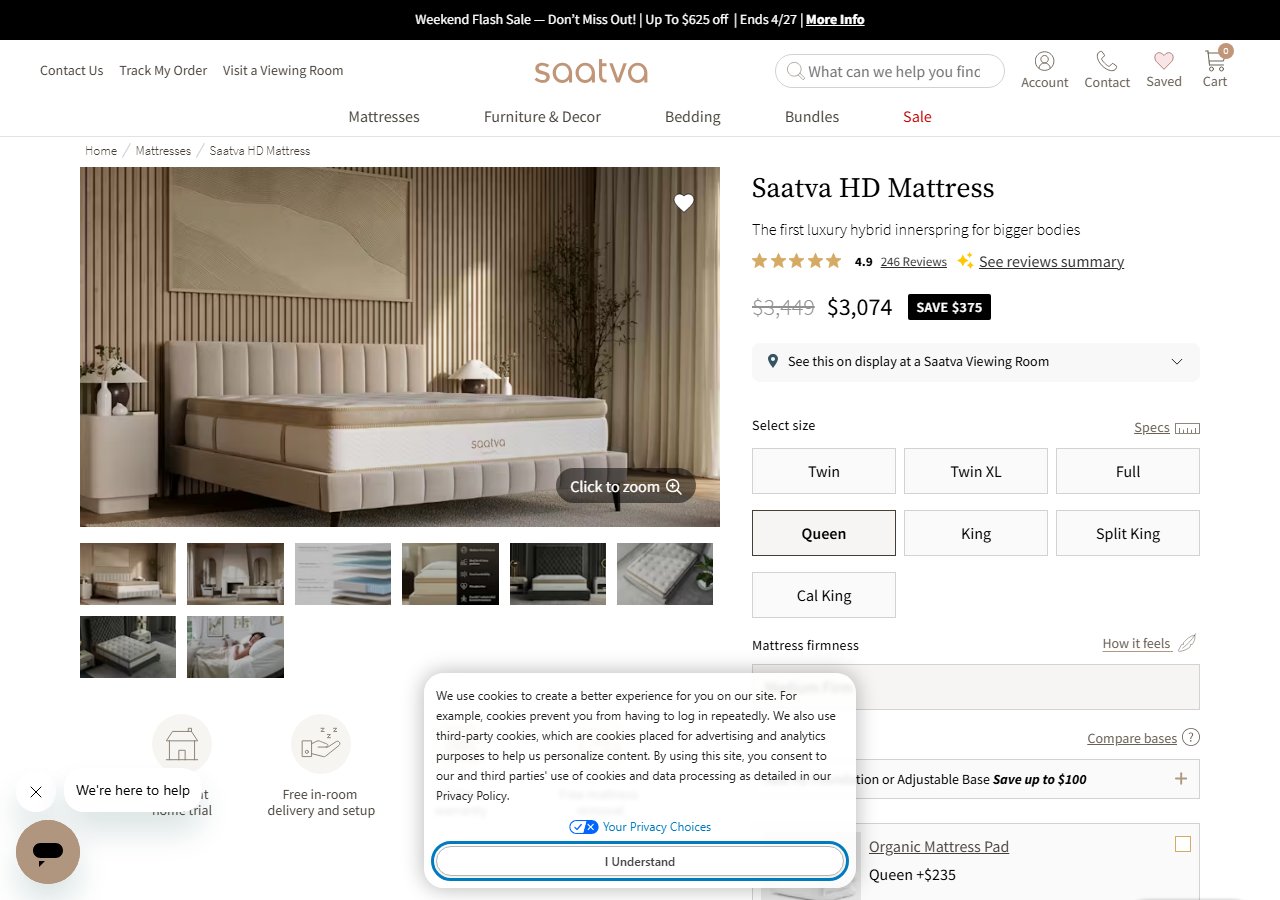
Saatva HD Mattress (Heavy-Duty)
$2,395-$3,995
See Price at Saatva →
Purple Hybrid Premier Mattress
$2,499-$4,799
See Price at Purple →Putting the Data Hierarchy Together
The federal evidence on construction-worker musculoskeletal injury tells a coherent story from job site to bedroom. Spinal loading at or above NIOSH Lifting Equation thresholds — daily, across a career — compresses discs, fatigues paraspinal musculature, and accelerates degenerative change. That loading requires an adequate overnight recovery window to partially reverse. An inadequate sleep surface interrupts that window every night, compounding the injury trajectory. The SSA and AHRQ data on MSDs as disability and cost drivers is the actuarial endpoint of this chain.
The intervention hierarchy is not complicated. Walk 30 minutes most days — NIH NCCIH evidence rates this as effective as most non-drug treatments. Correct your sleep position — NIH NIAMS guidance gives you two proven options that cost nothing. Replace your mattress if it has visible sag or is over a decade old — CDC sleep hygiene guidelines support this threshold. See a clinician if pain radiates below the knee, follows trauma, or comes with neurological symptoms — NIH NINDS guidance is unambiguous on these red flags.
If you have done all of that and are sleeping on a mattress that was not engineered for your body weight, your trade, and your spinal loading profile, then the Saatva HD, the Purple Hybrid Premier, and the Saatva Loom & Leaf represent three distinct engineering approaches to the same problem. None of them are magic. All of them are substantively different from the average-user-optimized mattress that most people buy because it was on sale. For a construction professional whose career depends on the structural integrity of their spine, that distinction is worth examining carefully.