The Federal Data Behind Your 5 a.m. Back Pain
You set the alarm for 5:15 a.m., swing your legs over the side of the bed, and spend the first ten minutes of the day just trying to straighten up. If you frame houses, pour concrete, hang drywall, or run heavy equipment, that ritual is so familiar it barely registers as abnormal anymore. It should. BLS Musculoskeletal Disorder tracking identifies the back as the most common body part injured across all U.S. occupations with days away from work — and construction consistently ranks among the highest-incidence industries in that dataset. Morning stiffness is not a personality quirk. It is a lagging indicator of cumulative spinal load that your body is trying, and failing, to shed overnight.
The financial stakes are enormous. AHRQ HCUP data identifies back pain as one of the most expensive conditions in U.S. healthcare by total inpatient and outpatient cost. AHRQ MEPS data shows that average annual personal healthcare expenditures for adults with chronic back conditions substantially exceed costs for adults without such conditions. And CMS drug spending data identifies opioid and non-opioid pain medication spending among the most expensive Medicare drug categories — a reflection of how badly the system is failing workers who never got upstream intervention. This article is upstream intervention.
Why Construction Work Destroys the Lumbar Spine — The Biomechanical Mechanism
Understanding why you wake up stiff requires a short detour into spinal biomechanics, because the injury pattern in construction is not random. It is predictable, documentable, and in many cases preventable — which is exactly why federal agencies have spent decades generating data on it.
The lumbar spine is engineered for load-bearing and rotational movement, but it has hard limits. The intervertebral discs that cushion the vertebrae behave like hydrophilic sponges: they absorb fluid during periods of low loading (primarily sleep) and express fluid under compressive load during the day. This diurnal cycle — loading and rehydration — is how discs maintain their height and shock-absorbing capacity. Construction work attacks this system from multiple angles simultaneously.
Compressive overload occurs every time a worker lifts a load that exceeds the disc's compressive tolerance. The NIOSH Lifting Equation — the federal standard for evaluating manual material-handling risk — documents that tasks across construction routinely exceed the Recommended Weight Limit that defines safe spinal loading. Concrete bags at 80 pounds. Bundles of roofing shingles at 60-plus pounds carried up an extension ladder. Rebar coils. Stacked drywall sheets. Each of these tasks, performed repeatedly across a 10- or 12-hour shift, generates cumulative compressive stress on the lumbar discs that the NIOSH equation classifies as high-risk.
Shear loading compounds compression. When a worker bends forward at the waist — not hinging at the hips as OSHA's ergonomics guidance instructs, but rounding the lumbar spine — the vertebrae slide relative to each other rather than compressing cleanly. Chronic shear loading is associated with disc herniation, facet joint irritation, and the kind of segmental instability that makes a worker's back feel "loose" and painful first thing in the morning.
Sustained awkward posture is a third mechanism. Framing carpenters work in crawl spaces. Plumbers contort under sinks and into pipe chases. Electricians spend hours with arms overhead or crouching in junction boxes. CDC NCHS data reports that approximately 20% of U.S. adults experience chronic pain, with lower back as the most common pain location — and the occupational clustering of that statistic is not subtle. The workers who carry loads, bend repeatedly, and sustain awkward postures make up a disproportionate share of that 20%.
Vibration transmission is the fourth and most underappreciated mechanism. Jackhammer operators, skid steer drivers, compactor operators, and anyone who spends hours on vibrating equipment is exposed to whole-body vibration that accelerates disc degeneration at rates documented in occupational medicine literature. Unlike acute lifting injuries, vibration damage is slow, cumulative, and by the time it produces morning stiffness, it has been building for years.
Now consider what happens when this worker goes to sleep. The lumbar discs, starved of compressive load for 6–8 hours, begin to rehydrate and swell slightly. If the sleep surface sags under the worker's body weight — especially if the worker is a larger-framed individual — the lumbar spine is not held in neutral alignment. It either sags into flexion (too-soft surface) or is pushed into extension (too-firm surface for a side sleeper). Either way, the muscles that spent the day protecting an already-stressed spine now have to work through the night to compensate for poor alignment. That is why you wake up stiff. The mattress is extending your workday by eight hours.
The stakes extend beyond discomfort. SSA Disability Insurance data identifies musculoskeletal disorders as the largest single category of new disability claims annually. For a construction worker in their 40s or 50s, a lumbar disc herniation or degenerative joint disease that might have been managed conservatively with good sleep hygiene, movement, and a supportive sleep surface instead becomes the on-ramp to long-term disability. BLS workers' compensation data shows industries with high MSD incidence carry workers' compensation insurance rates 3–5x higher than low-MSD industries — a cost that ultimately lands on workers through suppressed wages and reduced hiring.
The Arthritis Overlay That Most Construction Workers Don't Know They Have
For workers over 40, there is an additional variable that changes the sleep surface calculus: arthritis. CDC Arthritis Data reports that approximately 25% of U.S. adults report doctor-diagnosed arthritis, with prevalence concentrated in occupations involving sustained physical demand. That means one in four construction workers over a certain age is likely managing arthritis in addition to disc-related pathology — and the two conditions have partially different sleep surface requirements. Arthritic joints need pressure relief and warmth; disc pathology needs neutral alignment and support. A sleep surface that addresses only one of these simultaneously fails a significant fraction of the construction workforce.
Try These First — The Cheapest Interventions Cost Nothing
Before we discuss any equipment, it is worth being direct: the research base for non-product interventions in chronic low back pain is stronger than the research base for any specific mattress. Federal agencies do not recommend mattresses. They recommend movement, mechanical correction, sleep position, and timely clinical care. The product section of this article exists because some workers have genuinely worn out mattresses that are making their pain worse — but that is not the first question to answer.
The four interventions below are drawn from NIH, NIOSH, OSHA, and CDC sources. They are free or nearly free, and the evidence for each is more robust than the evidence for any premium sleep surface on the market.
Daily walking is the most evidence-supported free intervention for chronic low back pain. The NIH NCCIH evidence review documents that walking 30 minutes most days reduces chronic low back pain as effectively as most non-drug clinical treatments. For a construction worker who is already physically active on the job, this might seem redundant — but occupational physical activity and therapeutic walking are not the same thing. Job-site movement is loaded, asymmetric, and stress-generating. Therapeutic walking is rhythmic, low-load, and actively decompressing.
Lifting and bending mechanics matter even off the job site. OSHA's ergonomics guidance is explicit: hinge at the hips, not the lumbar spine; keep loads close to the body; avoid twisting under load. Most acute back episodes are mechanical and, crucially, rehearsable. Workers who carry poor mechanics into their home lives — picking up children, loading groceries, shoveling — are extending their injury exposure past the workday.
Sleep position is the biggest free variable in the sleep equation. NIH back pain guidance from NIAMS recommends side-sleeping with a pillow between the knees, or back-sleeping with a pillow under the knees, to keep the spine in neutral alignment. Stomach-sleeping torques the lumbar spine and worsens chronic pain. This single behavioral change costs nothing and can produce measurable improvement in morning pain within days.
Mattress replacement criteria are also worth making explicit before discussing specific products. CDC sleep hygiene guidance frames this correctly: replace a mattress when it has visible sag, when you consistently wake stiffer than you went to bed, or when it is older than 7–10 years. Even the most expensive mattress on the market does not undo poor sleep hygiene or sedentary days.
Some readers have already worked through those four interventions, replaced nothing, and still wake up every morning feeling like they slept on a job-site floor. For those workers, the sleep surface itself is a legitimate variable — and the federal data on body weight, spinal load, and recovery physiology does support the case for a surface that is engineered for high-load body types. What follows is an analysis grounded in that data.
When to See a Clinician Before Buying Anything
A new mattress is not a medical device. There are back pain presentations where buying a new sleep surface is not only insufficient but potentially dangerous, because it delays the clinical evaluation that the symptom pattern demands. NIH NINDS guidance on back pain identifies several red flags that warrant prompt clinical evaluation — imaging, specialist referral, or both — rather than a product purchase.
For construction workers specifically, the red flags are worth naming plainly. Nerve compression injuries from heavy lifting can masquerade as generalized back pain until they become emergencies. Compression fractures from cumulative vertebral loading can present as chronic stiffness until a sudden movement reveals the structural failure. And the CDC sleep data showing that approximately 35% of U.S. adults report sleeping less than 7 hours per night is a reminder that chronic sleep deprivation itself can amplify pain perception — meaning some workers experiencing severe morning pain may be dealing with a pain-amplification loop driven by sleep deprivation rather than a structural injury requiring imaging.
See a clinician promptly — before purchasing any sleep equipment — if your back pain presents with any of the red flags detailed in the clinical section below. These are not conservative recommendations. They are the federal standard.
Where Products Help — Sleep Surfaces for High-Load Body Types
For workers who have cleared the clinical threshold and have a genuine equipment problem — a sagging, aged, or inadequately supportive mattress — the selection criteria for a construction professional differ meaningfully from general consumer guidance. Three variables dominate: weight capacity and support core integrity, pressure relief at the shoulder and hip contact points (which are under enormous occupational stress all day), and edge support (because workers who sit on the edge of the bed to pull on boots need a surface that doesn't collapse under concentrated load).
The Saatva Loom & Leaf Memory Foam Mattress is the premium memory foam pick for construction professionals dealing with serious back pain. It uses a dual-layer gel memory foam system over a high-density support foam base, with an organic cotton cover. The key specification for this reader: the high-density base foam resists the body impression that causes soft mattresses to fail within 18–24 months under a 200-plus pound occupational worker. Memory foam's viscoelastic properties also mean it conforms to the lumbar curve and hip rotation of a side-sleeping construction worker without creating the pressure points that spring-based systems can. At $1,695–$3,295 depending on size, it is a significant purchase — but the AHRQ MEPS data is clear that untreated chronic back conditions generate substantially higher annual healthcare costs than treated ones, and a support surface that actually holds spinal alignment is a legitimate component of that treatment.
For workers who are larger-framed — over 230 pounds, or carrying the kind of muscle mass that heavy-trade physical labor produces over a career — the Saatva HD Mattress is specifically engineered for this load profile. The HD uses a lumbar zone support system with micro-coils above a high-gauge innerspring base, rated for higher continuous weight loads than standard consumer mattresses. The micro-coil layer provides the pressure relief at the shoulders and hips that arthritic joints require, while the reinforced support core delivers the spinal alignment that disc pathology demands. This dual-mechanism construction is exactly what the arthritis-plus-disc-pathology profile that CDC data identifies in high-physical-demand occupations actually requires. Priced at $2,395–$3,995, it is the most expensive option in this comparison, but it is also the only one in this list purpose-built for the body weight and load profiles common in the construction trades.
For workers whose primary complaint is pressure pain at the hips and shoulders — the kind of sharp contact-point pain that construction workers who sleep on their side know well — the Purple Hybrid Premier Mattress offers a genuinely differentiated pressure-relief mechanism. Purple's GelFlex Grid technology is not memory foam and not a traditional innerspring hybrid: it is a polymer grid structure that collapses under pressure points while remaining supportive under areas of lower pressure. For a worker whose hips and shoulders have been under occupational compression all day, this property provides a qualitatively different decompression experience than either foam or coil systems. The Hybrid Premier adds a pocketed coil support layer beneath the grid, addressing the spinal alignment requirement that the grid alone cannot fully satisfy. At $2,499–$4,799, it sits in the premium tier, but for workers with significant shoulder or hip arthritis overlaying their lumbar complaints, it is worth evaluating.
Sleep Surfaces Built for High-Load Construction Bodies
These three mattresses were selected for construction professionals specifically: evaluated for weight capacity, lumbar support integrity, pressure relief at occupationally stressed contact points, and long-term durability under body types shaped by heavy-trade physical labor.

Saatva Loom & Leaf Memory Foam Mattress
$1,695-$3,295
See Price at Saatva →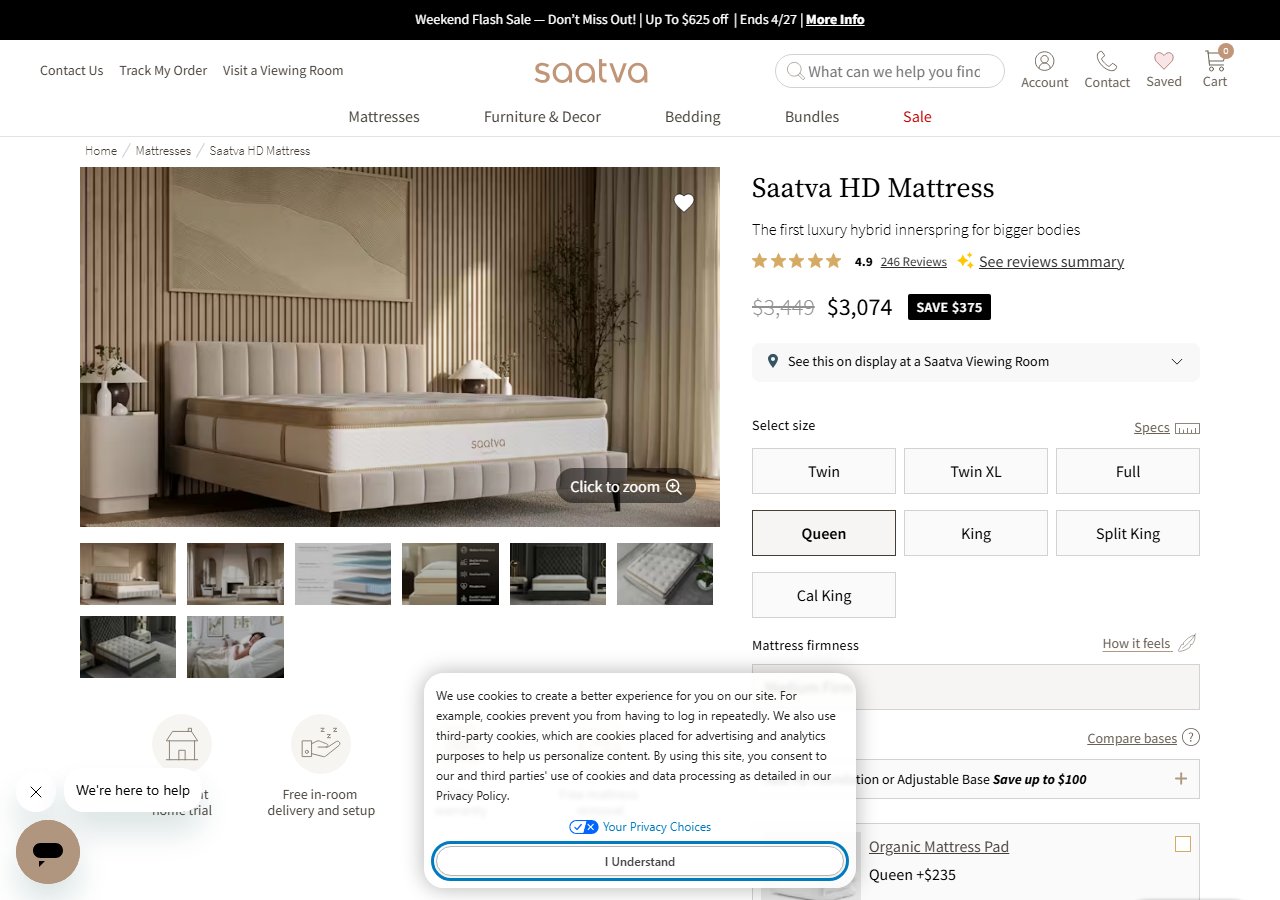
Saatva HD Mattress (Heavy-Duty)
$2,395-$3,995
See Price at Saatva →
Purple Hybrid Premier Mattress
$2,499-$4,799
See Price at Purple →The Sleep Deprivation Multiplier
One data point that tends to get lost in mattress discussions is the role of sleep quantity, not just sleep quality. CDC data shows approximately 35% of U.S. adults report sleeping less than 7 hours per night. Among construction workers, that number is likely higher: early job-site start times, long commutes, and the physical exhaustion that makes falling asleep easy but staying asleep — in pain — difficult, all compress sleep duration. The clinical literature is consistent: sleep deprivation amplifies pain perception. A worker getting 5.5 hours on a perfect mattress may experience more morning pain than a worker getting 8 hours on a mediocre one.
This is not an argument against investing in a better sleep surface. It is an argument for addressing sleep duration simultaneously. The NIOSH and CDC guidance on shift work and sleep recommends consistent sleep-wake schedules, dark and cool sleep environments, and avoidance of screens and alcohol in the two hours before bed — all of which are free and all of which interact with sleep surface quality to determine actual recovery outcomes.
The Financial Case for Getting This Right
For workers skeptical that a mattress in the $2,000–$4,000 range is a defensible purchase, the federal data provides a concrete frame of reference. AHRQ MEPS data shows that adults with chronic back conditions spend substantially more on annual personal healthcare than those without — the gap runs into thousands of dollars annually when you account for imaging, physical therapy, specialist visits, and medication. CMS drug spending data identifies pain medication — opioid and non-opioid — among the most expensive Medicare drug categories, which reflects how aggressively the healthcare system treats pain that has progressed past the point where conservative interventions can resolve it.
A sleep surface that holds spinal alignment for 8–10 years and costs $2,500 works out to roughly $250–$312 per year. Against the AHRQ data on chronic back pain treatment costs, that math is not difficult. The harder question is not whether a good mattress is worth the money. It is whether a specific mattress is actually a good mattress for a specific worker's body type, injury pattern, and sleep position — which is exactly what this analysis attempts to answer.
Summary: The Data-to-Intervention-to-Product Hierarchy
Construction professionals face a musculoskeletal injury burden that federal data has documented thoroughly and that the healthcare system has addressed expensively and often ineffectively. The BLS identifies backs as the most commonly injured body part. The NIOSH Lifting Equation documents that the loads construction workers carry routinely exceed safe spinal limits. The CDC reports 20% of Americans live with chronic pain, with the lower back leading — and occupational physical demand is a primary driver.
The intervention hierarchy is clear: movement first, mechanics second, sleep position third, mattress replacement when the mattress is genuinely the problem. For workers who have cleared those gates and need a sleep surface designed for high-load body types, the three products evaluated above represent the most purpose-built options currently on the market. Two are engineered specifically for body weight ranges and pressure-relief demands that standard consumer mattresses are not designed to address. One deploys a grid technology that provides genuinely differentiated decompression at arthritic contact points.
None of them replace the free interventions. All of them are better than a sagging 12-year-old mattress for a worker who is already doing the work of protecting their spine on the job site.