The federal data on back injury is already alarming — and body weight amplifies every variable
According to BLS Musculoskeletal Disorders by Occupation tracking, the back is the single most commonly injured body part across all U.S. occupations that result in days away from work. That is not a close race. The back outpaces shoulder, knee, and wrist injuries combined in industries ranging from warehousing and construction to healthcare and food service. If you work a physically demanding job and you carry 250 pounds or more on your frame, that federal benchmark was calculated for a population that does not include you — and the margin of safety it implies is materially thinner for your body.
The numbers compound quickly. AHRQ HCUP data identifies back pain as one of the most expensive conditions in all of U.S. healthcare measured by total inpatient and outpatient cost. SSA Disability Insurance reports confirm that musculoskeletal disorders are the largest single category of new disability claims filed annually in the United States. And CDC NCHS Data Brief 390 finds that approximately 20% of U.S. adults live with chronic pain, with the lower back identified as the most prevalent pain site. These are population-level averages. For high-bodyweight adults in physical occupations, each of those rates skews worse.
This article is not a product pitch. It is a structured walk through the mechanism that explains why your back hurts, the free interventions that federal health agencies recommend trying first, the clinical red flags that should send you to a clinician before you spend a dollar on equipment, and finally the sleep-surface considerations backed by biomechanical evidence — including specific products engineered for heavier sleepers.
Why this happens: the biomechanics of spinal loading at higher body weights
The spine is a load-bearing column. Every pound of body mass above the lumbar vertebrae transmits compressive force through the intervertebral discs, facet joints, and supporting musculature. This is not a moral statement about weight — it is structural engineering. A 250-pound adult standing upright places roughly 2.5 to 3 times their upper-body weight on the L4–L5 disc, the most commonly herniated segment in the lumbar spine. Increase body weight, increase compressive load. Increase the number of hours that load is sustained — through a warehouse shift, a construction day, a hospital floor rotation — and the cumulative mechanical stress on those discs and joints rises proportionally.
NIOSH's Lifting Equation establishes Recommended Weight Limits for manual material-handling tasks across warehousing, construction, and healthcare. NIOSH documents that workers in these industries routinely lift loads that exceed those limits — even when the worker themselves is of average weight. The equation accounts for load weight, horizontal distance from the body, vertical travel, asymmetrical twisting, and frequency of lift. What it does not fully model is the baseline spinal compression already present in a heavier body before the first box is picked up. For a 270-pound warehouse worker, the disc and joint structures begin each shift with a higher resting load than the Lifting Equation's reference population assumes.
Night is when the body is supposed to unload. The intervertebral discs are avascular — they receive nutrition through fluid exchange, a process that depends on the mechanical unloading that occurs during recumbent rest. Eight hours of horizontal sleep allows the discs to rehydrate and partially recover the height lost during the day's compressive loading. This is why people are measurably taller in the morning than in the evening. But the recovery window only works if the sleep surface actually allows the spine to decompress into a neutral alignment. A mattress that sags, bottoms out, or provides insufficient support for a heavier body creates a different problem: the spine spends those eight hours in a mechanically distorted position — flexed, laterally bent, or hyperextended depending on sleep position — compounding rather than relieving the day's damage.
CDC sleep data shows approximately 35% of U.S. adults report sleeping fewer than the 7 hours per night associated with reduced chronic disease risk. For back-pain sufferers, disrupted sleep creates a secondary cycle: pain interrupts sleep, sleep deprivation lowers pain tolerance, lowered pain tolerance makes the next day's physical work harder, and harder physical work intensifies the back pain that interrupted sleep in the first place. Breaking that cycle requires addressing both ends — what happens during the work day and what happens during the recovery window.
CDC Arthritis data adds another layer: approximately 25% of U.S. adults report doctor-diagnosed arthritis, with the highest prevalence concentrated in occupations involving sustained physical demand. Osteoarthritis of the facet joints is a common co-occurring condition with chronic lower back pain in heavy workers, and it responds particularly poorly to sleep surfaces that allow the pelvis to sink deeply, torquing the already-inflamed facet joints into end-range positions overnight.
The economic consequence is not abstract. BLS Employer Costs for Employee Compensation data shows that industries with high musculoskeletal disorder incidence carry workers' compensation insurance rates 3 to 5 times higher than low-MSD industries. AHRQ MEPS data shows average annual personal healthcare expenditures for adults with chronic back conditions substantially exceed costs for adults without such conditions. And CMS Drug Spending data identifies opioid and non-opioid pain medication spending among the most expensive Medicare drug categories — a downstream cost of undertreated chronic pain that begins, in many cases, with a preventable occupational injury or a recoverable acute episode that was never properly managed.
Try these first — the interventions that cost nothing
The cheapest intervention is the one that does not require buying anything. Federal health agencies are consistent on this point: most mechanical low back pain responds to behavioral, positional, and movement-based interventions before it requires medication, surgery, or expensive equipment. That sequence matters both for your health and your finances.
OSHA's ergonomics guidance on lifting and bending mechanics is the starting point for anyone in a physical occupation. The core principle: hinge at the hips, not the lumbar spine. Keep loads as close to the body as possible. Never twist under load — pivot the feet instead. Most acute back episodes in warehousing and construction are mechanical and the movement pattern that caused them is rehearsable and correctable. OSHA documents that proper lifting mechanics can substantially reduce peak spinal loading without any change in equipment or workflow.
NIH NCCIH evidence review on low back pain finds that walking 30 minutes most days reduces chronic low back pain as effectively as most non-drug clinical treatments. This is a finding that deserves more attention than it gets. The passive instinct when your back hurts is to rest. The evidence says movement — specifically low-impact, sustained aerobic movement — is the higher-value intervention for chronic presentations. A new mattress may help. A daily 30-minute walk is the higher-leverage tool.
Sleep position is the largest free variable in the overnight recovery equation. NIH back pain guidance from NIAMS is specific: side-sleeping with a pillow between the knees keeps the spine and pelvis in neutral alignment. Back-sleeping with a pillow under the knees reduces lumbar lordosis. Stomach-sleeping torques the lumbar spine and cervical spine simultaneously and is consistently associated with worsened chronic pain. Changing your sleep position costs nothing and can change your morning stiffness within days.
Finally, the mattress itself warrants an honest evaluation before replacement. CDC sleep hygiene guidance and clinical consensus suggest replacing a mattress if it shows visible sag, if you consistently wake stiffer than you went to bed, or if it is older than 7 to 10 years. But even a new, well-chosen mattress does not undo poor sleep hygiene, inadequate movement during the day, or sedentary recovery habits. The mattress is one variable in a system.
For readers who have already addressed position, movement, and lifting mechanics — and who are still waking up with stiffness and pain — the sleep surface becomes a legitimate equipment variable worth examining. This is especially true for adults over 250 pounds, where standard consumer mattresses are frequently not engineered for the load patterns your body creates during sleep.
When to see a clinician — red flags that need imaging or referral
NIH's National Institute of Neurological Disorders and Stroke back pain guidance is direct about the red flags that require prompt clinical evaluation rather than self-management. Do not buy a new mattress for any of the following symptoms. Get evaluated.
The clinical red flags for high-bodyweight adults with back pain are the same as the general population, but they can be easier to miss or attribute to body weight rather than a structural or systemic cause. Radicular pain that travels below the knee — particularly with numbness or tingling in the foot — suggests nerve root compression that imaging can characterize. Back pain following trauma (a fall, a vehicle accident, a sudden load incident at work) warrants imaging to rule out fracture. Pain accompanied by leg weakness, difficulty walking, or changes in bowel or bladder function suggests spinal cord or cauda equina involvement and is a medical emergency. Fever with back pain, or unexplained weight loss with back pain, can indicate infectious or oncologic causes. Night pain that is not relieved by position change is a red flag for non-mechanical causes.
For workers in physically demanding occupations, it is also worth noting that CDC data on arthritis shows high prevalence in exactly these populations — and inflammatory arthritis (rheumatoid, ankylosing spondylitis, psoriatic) can present as back pain that mimics mechanical low back pain. A clinician can distinguish between these presentations with a history, examination, and targeted labs. Self-treating inflammatory arthritis with a firmer mattress and better lifting mechanics delays a diagnosis that responds well to specific pharmacological management.
Where sleep surfaces fit into the evidence — and which ones are built for your body
Once you have cleared the clinical red flags, addressed lifting mechanics, sleep position, and daily movement, the sleep surface becomes a legitimate focus. For adults over 250 pounds, this is not a minor variable. Standard consumer mattresses — even expensive ones — are typically engineered for a reference body weight of roughly 130 to 180 pounds. The support cores, coil gauges, foam densities, and edge systems are calibrated for that load range. A 270-pound adult sleeping on a mattress designed for a 160-pound body is using equipment that is systematically underspecified for their biomechanical needs.
There are three specific engineering parameters that matter for high-bodyweight sleepers:
1. Support core depth and coil gauge. Heavier bodies compress comfort layers more deeply and reach the support core faster. A thin support core or a light-gauge coil system will allow the pelvis to sink past neutral, creating the same spinal distortion as a sagging mattress — even in a new product. Look for reinforced coil systems with gauge 13 or heavier, or high-density foam bases rated for the actual weight they will carry.
2. Foam density in comfort layers. Standard memory foam runs 3 to 4 pounds per cubic foot. At that density, a heavier sleeper will compress through the comfort layer and experience either poor pressure relief or accelerated material breakdown. High-density foam (5 pounds per cubic foot or higher) holds its shape longer and provides pressure relief without the hammocking effect that soft, low-density foams create under heavier loads.
3. Edge support. Heavier sleepers use more of the mattress surface — particularly the perimeter — when getting in and out of bed. Insufficient edge support contributes to falls, accelerated edge wear, and reduced usable sleep surface. Reinforced edge systems matter more at higher body weights than they do at average weights.
With those parameters as the frame, here are the three products we identified as engineered to address these specific variables for heavy-duty sleepers.
The Saatva HD Mattress is built from the ground up for adults over 250 pounds — it is not a standard mattress with a marketing claim bolted on. Saatva engineered it with a dual steel coil system (a micro-coil comfort layer over a heavy-gauge Bonnell innerspring base), high-density foam perimeter edges, and a 14.5-inch profile that gives heavier bodies significantly more compression range before reaching the support floor. For warehouse workers, construction laborers, and other high-demand physical occupations where the daily spinal load is already elevated, this is the mattress built for that specific pattern. It is priced at $2,395–$3,995 and is the most directly targeted product for this audience.
For readers whose primary complaint is pressure-point pain — hips, shoulders, and lower back hotspots that don't decompress overnight — the Saatva Loom & Leaf Memory Foam Mattress offers a premium memory foam construction with 5-pound-per-cubic-foot high-density foam that holds its structural integrity under heavier loads. This is not a mattress-in-a-box product: it is delivered white-glove and uses an organic cotton cover with a phase-change cooling treatment. At $1,695–$3,295, it is the premium memory foam pick for sleepers whose primary complaint is pressure rather than gross support — and who have already confirmed their pain is not a clinical emergency.
For sleepers who run hot, find traditional memory foam claustrophobic, or want an alternative pressure-relief mechanism that does not rely on foam conforming around the body, the Purple Hybrid Premier Mattress uses Purple's GelFlex Grid — a polymer grid that flexes under pressure points while staying firm under lower-pressure areas. This means the grid can simultaneously relieve hip and shoulder pressure without allowing the pelvis to sink into hammocking. The Premier version uses a 4-inch grid (thicker than the standard Purple), which extends the usable compression range for heavier sleepers before the coil base takes the primary load. At $2,499–$4,799, it is the premium pressure-relief alternative for heavy sleepers who have tried foam and found it unsatisfying.
Mattresses Engineered for Heavy-Duty Spinal Recovery (250+ lbs)
These three mattresses were selected because their coil gauge, foam density, and edge-support engineering specifically address the load patterns of adults over 250 pounds — not because they carry standard marketing claims about back pain support.

Saatva Loom & Leaf Memory Foam Mattress
$1,695-$3,295
See Price at Saatva →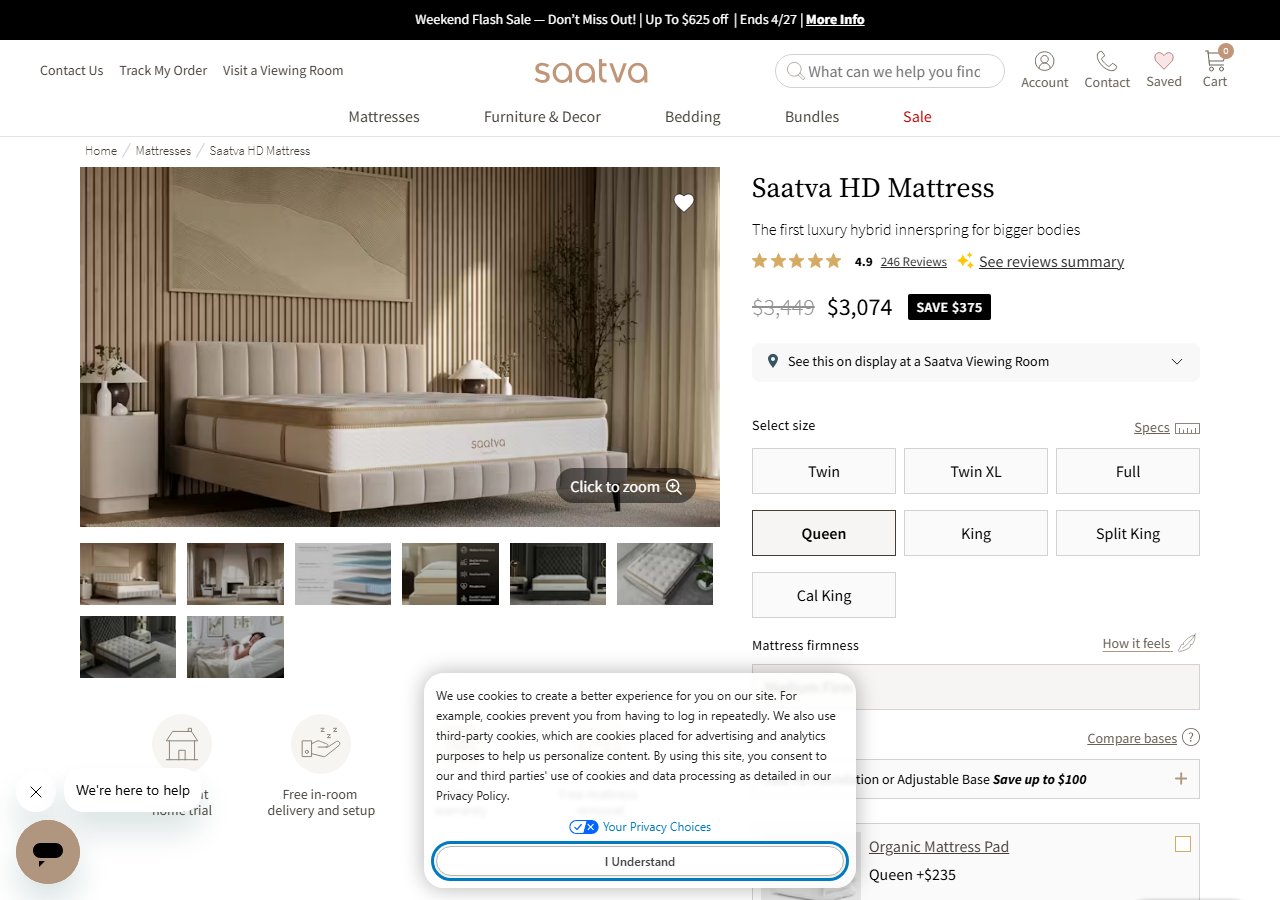
Saatva HD Mattress (Heavy-Duty)
$2,395-$3,995
See Price at Saatva →
Purple Hybrid Premier Mattress
$2,499-$4,799
See Price at Purple →The data-to-intervention-to-product hierarchy — a summary
The federal evidence is coherent and consistent: back pain is the leading occupational injury in the United States, it is disproportionately expensive to treat, and musculoskeletal disorders are already the largest category of new disability claims. High-bodyweight adults in physical occupations sit at the intersection of every risk factor that federal agencies have documented.
The intervention hierarchy that the evidence supports runs in a specific order. Movement first — NIH NCCIH research is unambiguous that walking and activity outperform passive interventions for chronic low back pain. Mechanics second — OSHA's lifting guidance exists specifically because most acute spinal loading events in physical work are preventable with technique changes that cost nothing. Sleep position third — NIH NIAMS guidance on neutral spinal alignment during sleep is evidence-based and free. Clinical evaluation fourth, for anything that meets NIH red-flag criteria. And equipment — including the sleep surface — fifth, as an adjunct to the other interventions, not a replacement for them.
For high-bodyweight adults who have worked through that hierarchy and are still waking stiff and in pain, a sleep surface engineered for their actual load patterns is a legitimate investment in the recovery window that their body depends on. The Saatva HD, Loom & Leaf, and Purple Hybrid Premier are three products built with the specific engineering parameters — coil gauge, foam density, edge support, compression range — that match what heavier bodies actually need from a mattress. None of them is a cure. All of them are meaningfully better specified for your body than the standard consumer mattress that was not designed with you in mind.