The Federal Data Behind a Problem Millions of Older Adults Quietly Endure
Every morning, millions of Americans over 60 do a version of the same slow ritual: swing their legs over the side of the bed, wait a moment, and then carefully test whether their joints will cooperate today. This is not dramatization. CDC arthritis surveillance data documents that approximately 25% of U.S. adults carry a doctor-diagnosed arthritis diagnosis — and that prevalence climbs steeply with age. Pair that with CDC sleep monitoring data showing that approximately 35% of U.S. adults report sleeping fewer than 7 hours per night — the threshold below which chronic disease risk measurably rises — and you begin to see the statistical shape of a crisis that primary care waiting rooms know well and that federal data has now confirmed at scale.
For adults under 40, a bad mattress is a nuisance. For adults over 60, a sleep surface that fails to manage pressure and spinal alignment is a genuine health infrastructure problem — one with downstream costs measurable in Medicare expenditures, opioid prescriptions, and functional independence. This article is not a product catalog. It is a translation of what federal agencies have documented about joint pain, sleep disruption, and musculoskeletal decline — and a structured framework for responding to that data.
Why Joint Pain Disrupts Sleep After 60: The Biomechanical and Physiological Mechanism
Understanding why this problem is age-specific requires looking at several converging biological changes — none of which are reversible, but all of which are manageable with the right environmental and behavioral inputs.
Cartilage thinning and reduced joint fluid. Articular cartilage — the shock-absorbing tissue inside joints — loses water content and structural integrity with age. By the sixth and seventh decade of life, this thinning is sufficient to make positions that were comfortable at 40 genuinely painful at 65. Lying on a surface that does not conform to the body's bony prominences — hips, shoulders, knees — creates sustained pressure on joints that no longer have the cushioning they once did. The result is pain-driven micro-arousals throughout the night, the kind that fragment sleep architecture without necessarily waking the sleeper fully. Cumulative sleep debt builds over weeks and months.
Reduced pain threshold and altered sleep architecture. CDC NHANES survey data documents that approximately 20% of U.S. adults experience chronic pain, with the lower back as the most common pain location. Research consistently shows that chronic pain lowers pain thresholds through central sensitization — the nervous system becomes progressively better at detecting pain signals. For older adults, this coincides with natural reductions in slow-wave sleep, the deepest and most restorative sleep stage, which itself has analgesic properties. Less deep sleep means less natural pain modulation, which means lighter, more fragmented sleep — a cycle that the right sleep environment can interrupt but not cure on its own.
Postural changes and spinal loading at rest. Decades of upright posture, occupational loading, and gravitational compression alter spinal geometry. Many adults over 60 have measurably increased thoracic kyphosis (forward curve of the upper back) and altered lumbar lordosis, meaning they no longer lie flat in a anatomically neutral position. A mattress that was engineered for a 35-year-old's spinal geometry may create pressure points or inadequate support for a 65-year-old's altered posture. BLS musculoskeletal disorder tracking confirms that the back is the most common body part injured across all U.S. occupations with days away from work — meaning most adults over 60 arrive at retirement already carrying an accumulated occupational spinal load history.
The medication and healthcare cost context. The downstream financial reality of undertreated joint pain is documented in detail across multiple federal datasets. AHRQ Medical Expenditure Panel Survey data shows that average annual personal healthcare expenditures for adults with chronic back conditions substantially exceed costs for adults without such conditions. CMS drug spending data identifies opioid and non-opioid pain medication spending among the most expensive Medicare drug categories — a direct reflection of how inadequately managed chronic pain cascades into pharmaceutical dependence. AHRQ HCUP data confirms that back pain is one of the most expensive conditions in U.S. healthcare by total inpatient and outpatient cost. And SSA Disability Insurance data identifies musculoskeletal disorders as the largest single category of new disability claims annually. These are not statistics about frailty — they are statistics about a system that has underinvested in prevention and sleep environment optimization for an aging population.
What Makes Sleep Specifically Worse for Arthritis Patients After 60
Arthritis is not a single disease — it is a family of over 100 conditions, with osteoarthritis (OA) and rheumatoid arthritis (RA) being the most prevalent in adults over 60. Their sleep disruption mechanisms differ in important ways that should inform how you think about sleep surface selection.
Osteoarthritis produces pain that is typically worse after periods of inactivity and improves somewhat with gentle movement. Morning stiffness lasting under 30 minutes is a classic OA signature. For OA patients, the sleep challenge is twofold: getting into a comfortable position at the start of the night, and then transitioning positions during the night without pain-triggered awakening. A surface that conforms well at initial contact — distributing pressure across a larger body surface area — reduces the peak pressure on individual joints and lowers the probability of pain-driven arousals when shifting position.
Rheumatoid arthritis involves inflammatory joint destruction that is often worst in the morning — morning stiffness lasting over an hour is a diagnostic criterion. For RA patients, the inflammatory process itself disrupts sleep independently of mechanical pressure, meaning surface management is a necessary but not sufficient intervention. RA patients are more likely to benefit from temperature-regulating sleep surfaces because systemic inflammation affects body temperature regulation.
Spinal stenosis — narrowing of the spinal canal, common after 60 — typically produces pain that worsens when lying flat and is relieved by flexing the spine forward. This is why many stenosis patients sleep in a fetal position or find that sleeping in a recliner provides more relief than a flat mattress. For these readers, surface firmness alone is less relevant than sleep position, and an adjustable base may be more impactful than mattress swap alone.
The Cheapest Intervention Is the One That Does Not Require Buying Anything
Before evaluating any sleep surface, federal clinical guidance identifies several interventions that cost nothing and have documented efficacy for chronic joint pain and sleep disruption. The evidence for behavior and movement is, in many cases, stronger than the evidence for any specific mattress. These should not be treated as disclaimers — they are the primary interventions.
Sleep position is the most powerful free variable you control every night. NIH guidance on back pain is specific: side-sleeping with a pillow between the knees, or back-sleeping with a pillow under the knees, keeps the spine in a neutral position that reduces mechanical stress on lumbar discs and facet joints. Stomach-sleeping creates cervical rotation and anterior pelvic tilt that directly aggravates lumbar pain. For arthritis patients specifically, pillow placement at the knees when side-sleeping reduces hip adduction stress that exacerbates hip OA. This intervention is free, evidence-backed, and should be implemented before any mattress is purchased.
Daily walking is more effective than most passive interventions. NIH NCCIH's evidence review on low back pain concludes that walking 30 minutes most days reduces chronic low back pain as effectively as most non-drug clinical treatments. For older adults, this is particularly meaningful because it addresses both the pain mechanism and the sleep disruption: physical activity improves sleep quality through adenosine-mediated sleep pressure buildup, and it reduces inflammatory markers associated with joint pain. A new mattress can improve sleep surface quality, but it cannot substitute for movement.
Evaluate your current mattress honestly. CDC sleep hygiene guidance supports replacing a mattress that shows visible sag, creates the sensation of rolling toward the center, or is older than 7 to 10 years. If you wake consistently stiffer than you went to bed — and that stiffness resolves after moving around for 30-45 minutes — your current sleep surface is a candidate for replacement. If stiffness persists all day regardless of sleep, the issue is clinical, not mechanical.
Understand lifting and movement mechanics during the day. OSHA ergonomic guidance emphasizes hinging at the hips rather than the lumbar spine, keeping loads close to the body, and avoiding twisting under load. For retired older adults, this applies not just to heavy lifting but to everyday tasks: loading a dishwasher, lifting a grandchild, pulling laundry from a front-loading machine. Many acute pain flares in older adults are mechanical and directly connected to habitual daily movement patterns that can be corrected.
For readers who have addressed sleep position, built a walking habit, and are sleeping on a mattress that is less than a decade old — and still wake with significant joint pain — a sleep surface upgrade is a reasonable next step. The research on mattress firmness and pressure distribution is not as robust as the research on movement and position, but it is not negligible. The key is matching surface characteristics to your specific joint anatomy and sleep position preference.
When to See a Clinician First — Before You Shop
Not all sleep-disrupting pain in older adults is benign musculoskeletal discomfort. NIH National Institute of Neurological Disorders and Stroke guidance identifies specific presentations that require clinical evaluation before any self-directed intervention. These are not situations where mattress selection is the appropriate response.
If your back or joint pain radiates below the knee — particularly if it follows a dermatomal pattern down one leg — that is a neurological red flag that warrants imaging to rule out disc herniation or spinal stenosis with nerve compression. If pain onset followed a fall, impact, or other trauma, fracture must be excluded before assuming the pain is mechanical, particularly in older adults where vertebral compression fractures from osteoporosis are common and frequently misattributed to muscle strain. Bowel or bladder dysfunction accompanying back pain is a cauda equina emergency. Unexplained weight loss with back pain in an older adult raises the index of suspicion for malignancy or serious systemic disease. Fever with back pain suggests infectious etiology.
For arthritis patients specifically: if morning stiffness consistently exceeds 60 minutes, if joints are warm and visibly swollen, or if fatigue is severe and systemic, rheumatologic evaluation for inflammatory arthritis rather than degenerative OA is warranted. The treatment trajectories are meaningfully different, and a sleep surface upgrade is far less relevant than disease-modifying therapy in that context.
Where Sleep Surface Technology Actually Helps — and What to Look For
With the mechanism understood, the free interventions addressed, and the clinical red flags acknowledged, we can now examine what evidence-based mattress selection looks like for adults over 60 with joint pain.
The core biomechanical goal for this population is pressure redistribution without sacrificing spinal support. These two objectives are in partial tension: a very soft surface maximizes pressure distribution but allows the spine to fall into a curved, unsupported position. A very firm surface supports the spine well but creates localized pressure at bony prominences — hips and shoulders most critically. The ideal surface for an older adult with arthritis threads this needle through zoned support and conforming materials.
Memory foam achieves this through viscoelastic response — it conforms to the body's contours under sustained pressure and temperature, distributing weight across a larger surface area and reducing peak pressure at joints. The limitation for older adults is that dense memory foam can trap body heat (thermally relevant given the temperature dysregulation common in older adults) and can create a motion-restriction effect that makes changing positions during the night physically effortful.
Hybrid constructions — foam comfort layers over individually wrapped coils — address the motion-restriction problem by adding spring and bounce from the coil core while maintaining foam's pressure-distributing surface. For older adults who need to reposition frequently during the night due to joint pain, hybrids often outperform all-foam options in practical use.
Grid polymer systems (the technology used by Purple) distribute pressure through a non-foam lattice that deflects under point loads while maintaining support at the surrounding matrix. This achieves pressure relief without the heat retention of foam — a meaningful distinction for older adults with inflammatory conditions.
The three products we analyzed against these criteria for adults over 60 with joint pain are positioned as follows:
The Saatva Loom & Leaf Memory Foam Mattress is the premium memory foam pick for older adults dealing with serious, chronic back and joint pain. It uses a multi-layer foam construction with a gel-infused cooling layer specifically designed to address the heat-retention problem common in dense memory foam. It is available in Relaxed Firm and Firm configurations — for most adults over 60 with arthritis, Relaxed Firm will provide better hip and shoulder pressure relief than Firm, while still maintaining adequate lumbar support. The white-glove in-home delivery and old mattress removal that Saatva includes is a practical consideration worth noting for older adults — no negotiating with a rolled mattress in a box.
The Saatva HD Mattress is engineered for heavier bodies (up to 500 lbs per side) and for sleepers whose body weight distribution creates challenges for standard mattress support systems. For older adults who are larger-framed or who have found that standard mattresses sag prematurely under their body weight, the HD addresses a real structural problem: when a mattress sags, the spine cannot maintain neutral alignment regardless of sleep position or pillow placement. The HD's reinforced support core prevents this sagging failure mode and is worth serious consideration for larger older adults who have gone through multiple mattresses prematurely.
The Purple Hybrid Premier Mattress brings the Grid pressure-relief technology in a hybrid format that combines the conforming pressure relief of Purple's grid polymer with coil-based support and responsiveness. For older adults with hip OA or shoulder pain who find memory foam's heat retention problematic, or who find all-foam surfaces too restrictive for nighttime repositioning, the Purple Hybrid Premier's grid-over-coil construction offers a meaningfully different pressure-relief mechanism. The grid deflects under bony prominences while supporting the surrounding tissue — a pressure map profile that is clinically relevant for arthritic joints.
Mattresses Engineered for Joint Pain and Pressure Relief After 60
These three mattresses were selected specifically for adults over 60 dealing with arthritis, chronic back pain, or significant joint pressure at night — each addressing a distinct biomechanical need documented in federal sleep and musculoskeletal research.

Saatva Loom & Leaf Memory Foam Mattress
$1,695-$3,295
See Price at Saatva →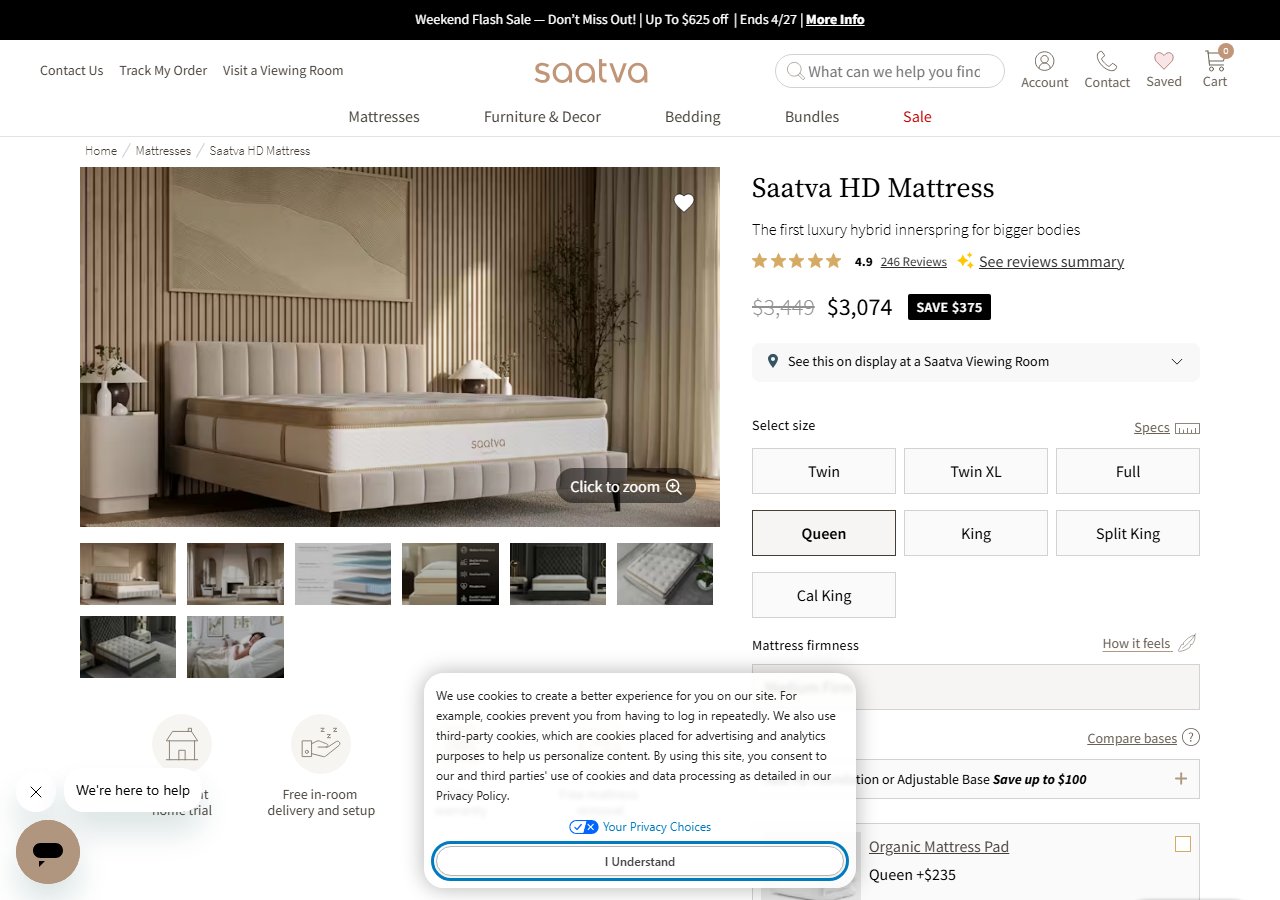
Saatva HD Mattress (Heavy-Duty)
$2,395-$3,995
See Price at Saatva →
Purple Hybrid Premier Mattress
$2,499-$4,799
See Price at Purple →What the Federal Data Tells Us About the Stakes of Getting This Right
The framing of mattress selection as a luxury consumer decision misses what the federal data is documenting. When SSA data identifies musculoskeletal disorders as the largest single category of new disability claims, and when AHRQ HCUP data confirms back pain as one of the most expensive conditions in U.S. healthcare by total cost, and when CMS drug spending data shows that pain medication is among the most expensive categories of Medicare drug spend — we are looking at a system where the upstream intervention (sleep surface quality, movement, position) is dramatically cheaper than the downstream consequence (surgery, opioids, disability).
For adults over 60 specifically, this calculus is particularly acute. The years between 60 and 75 are often the years when functional independence either compounds or deteriorates — where consistent restorative sleep and pain management set the trajectory for the following decade. The BLS data on back injury prevalence across occupations documents that most adults reaching 60 have already absorbed decades of occupational spinal loading. The question is not whether that history has effects — it does — but whether the sleep environment is structured to recover from that history or to compound it.
Summary: The Right Sequence
Federal data supports a clear hierarchy for older adults managing joint pain and sleep disruption. First: correct sleep position using NIH guidance — side-sleeping with a pillow between the knees or back-sleeping with a pillow under the knees is free and effective. Second: build or protect a walking habit; NIH NCCIH data puts daily walking on equal footing with most clinical interventions for chronic back pain. Third: rule out clinical red flags with a clinician before attributing all pain to a mattress problem. Fourth: evaluate your current sleep surface honestly — if it is over a decade old or visibly sagging, replacement is warranted. Fifth: when selecting a new surface, match the technology to your specific joint presentation — foam for conforming pressure relief, hybrid for repositioning ease, grid polymer for heat-neutral pressure relief.
The products in this article — the Saatva Loom & Leaf, Saatva HD, and Purple Hybrid Premier — were selected because they address specific biomechanical failure modes relevant to adults over 60 with arthritis. They are adjuncts to behavior and clinical care, not substitutes. The federal data is unambiguous on that point, and so are we.