You're Not Just Tired — You're Structurally Loaded
If you pour concrete, frame houses, run electrical conduit, or hang drywall for a living, your body is absorbing compressive and shear forces across an eight- to twelve-hour shift that most office workers will never approximate in a lifetime of workouts. According to BLS Musculoskeletal Disorders by Occupation tracking, the back is the single most commonly injured body part across all U.S. occupations involving days away from work — and construction is consistently among the industries driving that statistic. When you wake up at 5 a.m. stiff, sore, and moving like a man twice your age, that is not a mystery. It is physics with a paper trail.
This article is built around that paper trail. We are going to trace the federal data on construction MSD from the job site through your spine, into your sleep window, and out the other side. Along the way, you will find the free interventions that federal health agencies have ranked most effective, the clinical red flags that mean a mattress is the wrong purchase order right now, and the specific sleep surface engineering features that matter for workers carrying serious structural load. Products appear in this article because they are one legitimate tool — but they appear after everything else, which is the correct order.
Why Construction Work Breaks Your Lower Back: The Federal Data Trail
The mechanism is not complicated, but the scale of it is underappreciated. The NIOSH Lifting Equation — the federal standard for evaluating manual material-handling risk — documents that common construction tasks including carrying roofing material, lifting concrete blocks, hoisting HVAC components, and shoveling routinely exceed the equation's Recommended Weight Limit. When a lift exceeds that threshold, the compressive load on the L4–L5 and L5–S1 intervertebral discs surpasses what the National Institute for Occupational Safety and Health considers tolerable for repeated exposure. Do that for five days a week, forty weeks a year, for twenty years, and you are not experiencing bad luck. You are experiencing the predictable output of a cumulative loading model.
The financial signal in the BLS data confirms this is systemic, not individual. BLS Employer Costs for Employee Compensation data shows that industries with high MSD incidence — construction prominently among them — carry workers' compensation insurance rates 3 to 5 times higher than low-MSD industries. Insurers price risk actuarially. That premium differential is the insurance industry's quantitative assessment that construction bodies break at a categorically different rate than sedentary-work bodies. It is priced into every construction firm's overhead before the first nail is driven.
Disability data extends the picture further downstream. The SSA Disability Insurance program identifies musculoskeletal disorders as the largest single category of new disability claims filed annually in the United States. Construction workers don't file disability claims because they are fragile — they file them because their occupation deposits structural damage over time in a way that non-manual labor does not. The SSA data is a long-lag indicator of what the NIOSH lifting data predicts at the point of exposure.
The healthcare cost dimension is equally sobering. AHRQ HCUP data identifies back pain as one of the most expensive conditions in U.S. healthcare by combined inpatient and outpatient cost. AHRQ Medical Expenditure Panel Survey data shows that adults with chronic back conditions carry annual personal healthcare expenditures that substantially exceed those of adults without such conditions — meaning the financial impact lands on the worker as well as the insurer and the healthcare system. And CMS Drug Spending Dashboard data identifies opioid and non-opioid pain medication spending among the most expensive Medicare drug categories, a downstream signal of a chronic-pain population that was often physically working for a living twenty years before those prescriptions were written.
CDC NCHS Data Brief 390 places the population-level anchor: approximately 20% of U.S. adults live with chronic pain, with the lower back as the most common single pain location. Among construction workers, that prevalence is not uniformly distributed — it is concentrated. CDC Arthritis data shows that roughly 25% of U.S. adults report doctor-diagnosed arthritis, with prevalence skewed heavily toward occupations involving sustained physical demand. Arthritis and disc degeneration are not the same condition, but they share a driver: cumulative mechanical stress that outpaces the body's repair capacity.
The Sleep Window: Where Recovery Happens or Doesn't
Here is where the construction worker's situation diverges from the general chronic-pain population in a clinically relevant way. A sedentary worker with chronic back pain can theoretically reduce their daily spinal load by changing how they sit or move through an office. A construction worker cannot reduce their occupational load below NIOSH thresholds without changing occupations. The sleep window — six to nine hours per night — is functionally the only extended recovery period available. That makes the quality of spinal unloading during sleep disproportionately important for this population.
CDC sleep data shows that approximately 35% of U.S. adults already sleep fewer than 7 hours per night, the threshold associated with elevated chronic disease risk. Among shift workers and workers with physical pain that interrupts sleep onset or maintenance, that number is higher. A construction worker who spends six hours in inadequate spinal support is compounding the load they absorbed during the day rather than recovering from it.
The biomechanics of sleep surface inadequacy for high-load bodies are specific. A mattress that is too soft for a heavier-framed or more muscular worker allows the pelvis and hips to sink deeper than the lumbar spine, creating a hammocking posture that puts the lumbar discs under flexion stress throughout the night — the same disc positions that physical therapists and occupational therapists spend clinical hours teaching workers to avoid during the day. A mattress that is too firm for a side-sleeping worker creates high-pressure contact at the shoulder and hip, forcing compensatory scoliosis in the thoracic and lumbar spine to distribute the load. Neither scenario is neutral. Both scenarios add up across years.
Weight is a mechanical variable that most mattress marketing ignores or addresses only in product names. The average construction worker — particularly in heavy trades like ironwork, concrete, masonry, and framing — is not a 150-pound sedentary reference body. Physiologically, a 220-pound worker with significant muscle mass creates different peak-pressure distributions on a sleep surface than the standardized test bodies most mattress manufacturers use for comfort-layer engineering. Support-core density and coil gauge — not comfort-layer softness — are the variables that govern long-term spinal alignment for heavier workers. A mattress with an inadequate support core will feel fine for the first six months and begin sagging at the exact locations where the worker's load concentrates.
Try These First: Free and Low-Cost Interventions That Federal Health Agencies Rank Highly
Before we discuss any equipment, the honest accounting has to lead with what doesn't require a purchase. The research base for non-product interventions in chronic low back pain is, in several cases, stronger than the research base for any specific mattress brand. A worker who sleeps on an adequate surface but skips the interventions below will see less improvement than a worker who addresses the behavioral and mechanical variables first.
Sleep position alone is a free, evidence-backed variable. NIH National Institute of Arthritis and Musculoskeletal and Skin Diseases guidance is explicit: side-sleeping with a pillow between the knees, or back-sleeping with a pillow under the knees, maintains lumbar spine neutrality. Stomach-sleeping — which a significant fraction of physically fatigued workers default to because they pass out in whatever position they land — places the lumbar spine in extension and the cervical spine in rotation simultaneously. For a worker whose lumbar discs have already been loaded all day, this is not a neutral sleeping position. It is continued stress in a different posture.
Movement is the single most underrated intervention in this population. The NIH National Center for Complementary and Integrative Health's evidence review on low back pain finds that walking 30 minutes on most days reduces chronic low back pain as effectively as most non-drug clinical treatments. This is a remarkable finding given how simple the intervention is. Construction workers who are already physically exhausted often assume that rest is the treatment for back pain. The federal evidence base says the opposite: controlled low-impact movement — particularly walking — promotes disc nutrition, reduces inflammatory cytokine concentration in the paraspinal tissues, and maintains the muscle tone that protects the spine during loaded activities. The challenge for this population is distinguishing therapeutic movement from recreational recreation that exceeds recovery capacity.
On-the-job mechanics are modifiable even in construction. OSHA's ergonomics guidance teaches the hip-hinge pattern — loading the posterior chain rather than the lumbar spine — as the primary protective mechanism for manual material handling. Most acute back episodes in construction are mechanical: a twist under load, a lift from a compromised position, a moment of inattention at the end of a long day. OSHA's guidance is not about lifting lighter loads — it is about developing motor patterns that distribute load more safely under whatever weight the job demands. These patterns are learnable and, over a career, protective.
For workers who have already worked through the interventions above — or who have tried them and found that sleep quality remains poor due to surface issues — the conversation about sleep equipment becomes legitimate. The question is not "which mattress has the best marketing" but "which engineering specifications address the specific failure modes most common in high-load bodies."
When to See a Clinician Before Buying Anything
This section exists because a significant number of construction workers will read an article about back pain and mattresses when what they actually need is imaging and a referral. A mattress addresses chronic mechanical low back pain that has been evaluated and found non-pathological. It does not address the conditions below.
NIH National Institute of Neurological Disorders and Stroke back pain guidance specifies prompt clinical evaluation for back pain that radiates below the knee (suggesting nerve root compression or disc herniation with neurological involvement), back pain that follows a traumatic event (fall from height, vehicle accident — common in construction), back pain accompanied by leg weakness, foot drop, or changes in bladder or bowel function (possible cauda equina involvement, a surgical emergency), and back pain with fever or unexplained weight loss (possible infectious or malignant etiology). None of these presentations should lead to a mattress purchase. They require a clinician, imaging, and in some cases urgent surgical consultation.
Construction workers have elevated exposure to fall-related spinal trauma, compression fractures, and nerve impingement from repeated impact exposure — conditions that are not always acutely symptomatic. If your back pain has changed character recently, if it wakes you at night regardless of position, or if it is progressing despite rest, those are clinical referral criteria, not consumer purchase criteria. The sleep surface discussion that follows assumes you have ruled these out.
The Sleep Surface Engineering That Actually Matters for Construction Bodies
With the intervention and clinical context established, here is what the product specifications actually mean for the target reader.
Support-core density is the primary variable, not comfort-layer softness. For workers over 200 pounds — and many construction workers are — the support core (the innerspring system or high-density foam base) determines where the spine ends up, regardless of what the comfort layers feel like during a showroom test. A mattress that collapses under concentrated load in the hip zone will place the lumbar spine in flexion within the first few months of use, regardless of its initial firmness rating. This is the most common failure mode for heavy workers buying a standard-market mattress not engineered for their weight range.
Zoned firmness systems address the shoulder-hip asymmetry problem. A construction worker sleeping on their side presents a shoulder that needs to sink into the mattress (to keep the cervical spine neutral) and a hip that needs firm support (to prevent pelvic drop and lumbar sag). A uniform-firmness mattress cannot serve both requirements simultaneously. Zoned coil or zoned foam systems — which use different firmness levels under different anatomical zones — address this directly. This is not a marketing concept; it is a geometry problem with a mechanical solution.
Weight capacity is a published specification worth checking. Most standard mattresses are tested and warranted for a combined occupant weight of 500 to 600 pounds. Mattresses engineered for heavier bodies typically specify 500 to 1,000 pounds per individual side, which reflects a different coil gauge, coil count, and foundation design. For a 250-pound construction worker sharing a bed with a partner, the combined weight can easily exceed standard mattress engineering parameters.
For workers with serious, long-standing back pain who want a premium memory foam option, the Saatva Loom & Leaf is the first recommendation in this category. It uses high-density, temperature-regulating memory foam in a tiered construction — the top layer contours to the body's pressure points while the denser support layers beneath maintain lumbar alignment rather than allowing hammocking. The Relaxed Firm option is specifically relevant for heavier construction workers who want the pressure-relief properties of memory foam without the support-core collapse that cheaper memory foam mattresses exhibit at higher loads. Saatva also ships white-glove delivery and removes the old mattress, which matters for workers whose backs cannot safely handle a mattress installation.
For workers in the heavier trades — ironworkers, concrete finishers, masons, and anyone consistently over 250 pounds — the Saatva HD Mattress is the purpose-built option. The HD was engineered specifically for higher body weights, with a tempered steel coil system, a higher coil count than the standard Saatva Classic, and a support core architecture designed to maintain spinal alignment under load concentrations that standard mattresses are not tested for. The weight-capacity specs and coil gauge are published, not marketing language. For a construction worker who has gone through two or three standard mattresses that sagged prematurely, this is the specification explanation for why that kept happening.
For workers whose primary complaint is pressure point pain — shoulder pain from side sleeping, hip pain from contact pressure, or thoracic discomfort from high-density surfaces — the Purple Hybrid Premier takes a different engineering approach. Purple's GelFlex Grid is a polymer grid material that behaves differently from both foam and coil: it is simultaneously firm under flat distributed loads (maintaining spinal alignment) and yielding at high-pressure contact points (reducing shoulder and hip pressure). For construction workers who find that traditional firm mattresses produce pressure-point pain on the side where they sleep, the grid architecture addresses a failure mode that neither foam nor coil alone solves as effectively.
Mattresses Built for High-Load Construction Bodies
Each of these mattresses was selected for specific engineering features — support core density, zoned firmness, or pressure-point architecture — that address the structural recovery needs of construction workers carrying heavy occupational loads.

Saatva Loom & Leaf Memory Foam Mattress
$1,695-$3,295
See Price at Saatva →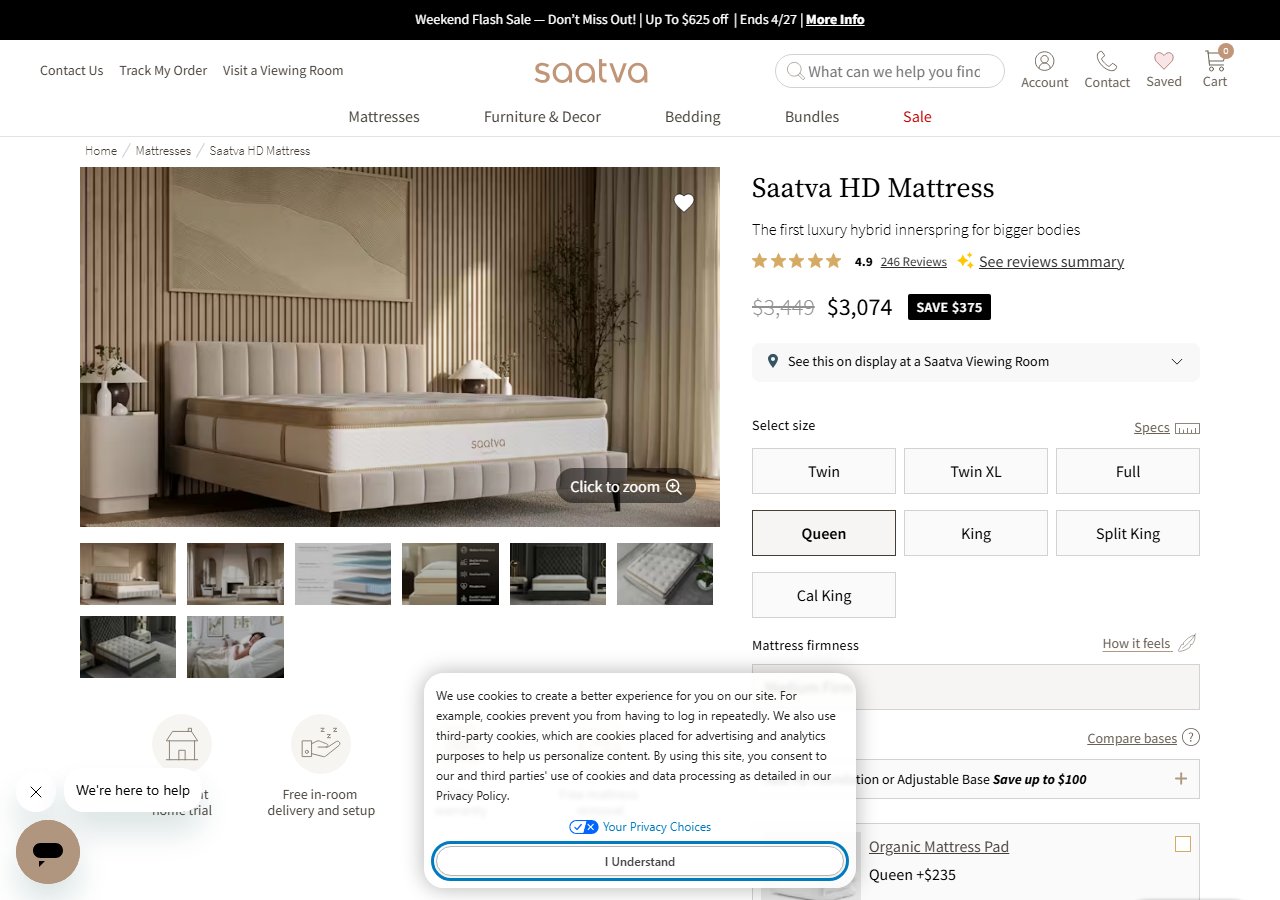
Saatva HD Mattress (Heavy-Duty)
$2,395-$3,995
See Price at Saatva →
Purple Hybrid Premier Mattress
$2,499-$4,799
See Price at Purple →Putting the Data Together: What a Construction Worker's Sleep Strategy Actually Looks Like
The BLS and NIOSH data establish a clear picture: construction work deposits spinal load at a rate that exceeds safe thresholds by federal standards, that load accumulates across a career in ways that become visible in SSA disability data and AHRQ healthcare cost data, and the sleep window is the primary unloading opportunity a physically active worker has. Sleep surface engineering is therefore not a luxury purchase for this population — it is a recovery infrastructure decision with a measurable impact on career longevity.
But the hierarchy matters. Sleeping position is free. Daily walking is free. OSHA lifting mechanics are taught at most union halls and safety training programs. Replacing a mattress with visible sag can sometimes be accomplished with a lower-cost option if the underlying support core is still adequate. The clinical red flags from NIH NINDS guidance are the gate through which every back-pain sufferer should pass before spending money on any passive intervention.
If you have worked through that hierarchy and your conclusion is that your sleep surface is the limiting variable — that you wake stiffer than you went to sleep, that your mattress shows body impressions, that it is more than seven years old and you are above 200 pounds — then the engineering specifications reviewed above are the relevant purchasing criteria. Support core density, zoned firmness architecture, and published weight capacity are not marketing features. They are the mechanical variables that determine whether a mattress serves as recovery infrastructure or as an additional load source.
For a career that BLS data tracks to the highest MSD rates in the U.S. workforce, getting the recovery window right is not a comfort preference. It is an occupational health decision with a twenty-year horizon.