Cold Plunges Are No Longer Fringe: Here's What Federal Data Shows
When Wim Hof dunked himself in ice ten years ago, cold-water immersion lived in biohacking forums and elite-athlete training rooms. Today, cold plunges are being installed in corporate wellness centers, recovery clinics, and the garages of longevity-focused professionals across America. That shift reflects something deeper than wellness marketing: a growing alignment between independent federal occupational health research and mainstream recovery science.
The question isn't whether cold plunges work—federal research agencies have already documented the mechanics. The question is: which cold plunge infrastructure makes sense for your recovery goals, budget, and daily schedule?
The Federal Data Foundation: What NIOSH and FDA Tell Us
Start with the physiology. NIOSH-cited recovery literature documents that cold-water immersion at 50–59°F (10–15°C) for 10–15 minutes post-exertion reduces delayed-onset muscle soreness and lowers serum creatine kinase markers—a protein released into the bloodstream when muscle tissue breaks down. This isn't opinion. It's measured biochemistry published in occupational health indexes.
Why does NIOSH, a federal occupational safety agency, track cold-water recovery data? Because workers in physically demanding fields—construction, agriculture, roadwork—need documented recovery protocols. NOAA-tracked workplace heat exposure data documents elevated injury and recovery demand for outdoor occupations during summer months, particularly in agriculture, construction, and roadwork. Cold exposure, when properly controlled, is part of how occupational health systems mitigate that demand.
Then there's the device landscape. The FDA 510(k) clearance database indexes thousands of cleared cryotherapy and recovery devices, distinguishing clinical-grade equipment from consumer wellness products. This is crucial: not all cold plunges are built to the same standard. Some pass federal medical device review. Others are marketed as "wellness" tools with no regulatory pathway at all. The difference matters for durability, temperature precision, and safety.
Why Cardiovascular Health Context Matters for Your Purchase
Here's a harder truth that contextualizes why recovery infrastructure has become a legitimate health investment: cardiovascular disease accounts for approximately 1 in 3 U.S. deaths annually per CDC tracking. For a significant portion of the U.S. population, cardiovascular resilience—the body's ability to handle physiological stress and recover—is not optional.
Cold-water immersion triggers acute cardiovascular stress: heart rate increases, blood vessels constrict, then dilate during recovery. Repeated, controlled cold exposure is theorized to enhance vascular plasticity and parasympathetic tone—the body's recovery nervous system. This is why cold plunges appear in longevity protocols alongside cardiovascular screening and VO₂ max training. They're not wellness theater; they're deliberate physiological stress applied in measured doses.
That said, cold plunges are not for everyone. People with uncontrolled hypertension, recent cardiac events, or cold-water immersion contraindications should consult their physician before adopting cold therapy. The federal data validates the mechanism, not a universal prescription.
What to Look for in a Cold Plunge: The Federal Device Perspective
When you're choosing a cold plunge, you're essentially choosing between three infrastructure categories:
1. Clinical-Grade Equipment (FDA 510(k) pathway)
These devices have undergone FDA review and meet Class II medical device standards. They typically feature precise temperature control (±1–2°F), automated filtration, and durability specs tested for consistent use. If you're buying for a recovery clinic, physical therapy practice, or high-frequency personal use, this is the relevant category.
2. Consumer-Grade Active Chilling Systems
These are marketed toward wellness and longevity audiences. They include active chillers, filtration, and app controls, but may not carry FDA 510(k) clearance. Temperature stability and long-term durability vary widely. They're designed for personal and small-group use, not clinical or occupational settings.
3. Passive Cold Containers (No Chiller)
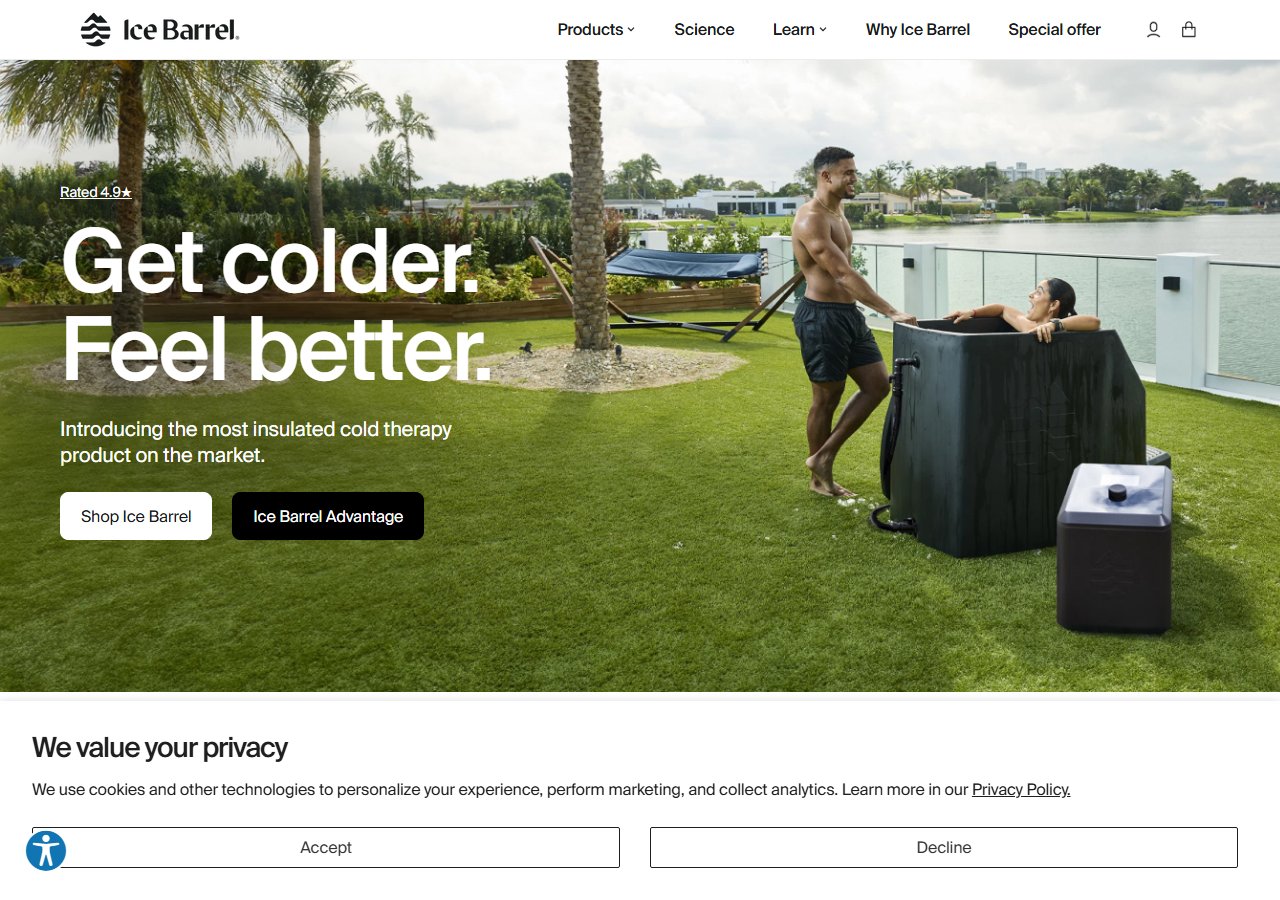
These are insulated barrels or tubs that you fill with ice and water. They have no mechanical components, no filtration, and no temperature precision. You manage water chemistry and temperature manually. They're the lowest-cost entry point and require the most labor to maintain.
[[mini-list]]
How to Apply Federal Data to Your Decision
If you're in an outdoor-facing occupation (construction, agriculture, landscaping), NOAA workplace heat exposure data documents peak injury risk during summer months. Cold plunges could be part of occupational recovery infrastructure—especially if your work site has limited cooling access. In this case, durability and water quality matter most. A passive system might suffice, but active chilling ensures you can hit the NIOSH-documented 50–59°F range reliably.
If you're investing in longevity and cardiovascular resilience, the NIOSH data on delayed-onset muscle soreness and creatine kinase reduction suggests cold plunges work best after high-exertion training (strength work, HIIT, distance running). You're looking for consistency and ease of use, so you actually complete the protocol. That typically means an active-chilling system with temperature precision and low maintenance overhead.
If you're evaluating claims, check whether the manufacturer references FDA 510(k) clearance. It's not a guarantee of superiority, but it is a signal that the device underwent federal regulatory scrutiny. Wellness-marketed products are not required to submit to FDA review, which is fine—but transparency about regulatory status matters.
Temperature, Duration, and the NIOSH Protocol
The federal occupational health data points to a specific window: 50–59°F (10–15°C) for 10–15 minutes post-exertion. This is not arbitrary. Lower temperatures accelerate vasoconstriction and activate the cold shock response more intensely. Longer durations increase hypothermia risk without additional recovery benefit. This protocol emerged from research in occupational settings where safety and efficacy had to be balanced.
When you're selecting a cold plunge, temperature precision matters. A system that can't maintain 55°F within ±2°F is essentially running an uncontrolled experiment. Your body will experience wild swings in cold exposure, which defeats the recovery protocol.
Frequency and Long-Term Use: What the Data Doesn't (Yet) Say
Federal occupational health literature documents acute cold-water immersion effects—what happens in the 24–48 hours after a single session. What happens to someone who uses a cold plunge 5 days a week for 10 years? That longitudinal data doesn't exist in the federal occupational health indexes yet.
This is important context for anyone building a "longevity stack" around cold plunges. You're extrapolating from short-term recovery science. That's reasonable—the acute mechanisms are real—but it's not the same as 30-year follow-up data from occupation health cohorts.
For now, follow the NIOSH guidance: cold-water immersion as a post-exertion recovery tool, not a daily standing practice. If you're using a cold plunge, integrate it into your training schedule, not your baseline routine.
Maintenance, Water Chemistry, and Infrastructure Durability
A cold plunge is not a bathtub. It's a system that cycles and filters water, maintains temperature, and runs regularly. Passive systems require you to change water, manage ice, and monitor for bacterial growth. Active systems require filtration media changes, occasional chemical balancing, and pump maintenance.
Before purchasing, calculate the operational cost: electricity for chilling, filter replacements, cleaning chemicals. A $1,200 barrel that requires weekly ice runs and monthly water changes might have a higher true cost than a $4,500 active system with automated filtration.
The Longevity Audience Consideration: Stack Integration
If cold plunges fit into your recovery and longevity protocol, they work best alongside:
- Structured training, not random exertion (the recovery has to follow a measured stimulus)
- Heat exposure, to leverage contrast-therapy benefits (sauna + cold plunge cycles)
- Sleep prioritization, since cold plunges can activate nervous system arousal
- Cardiovascular screening, since the mechanisms involve acute vascular stress
Federal data on occupational recovery doesn't endorse cold plunges as a standalone wellness intervention. It documents them as one tool in a structured recovery protocol. Anyone building a longevity stack should think in systems, not individual tools.
Making the Purchase Decision
Here's a honest framework based on federal data context:
Choose an active-chilling system if: You're planning to use the plunge 3+ times per week, you need precise temperature control, you want low maintenance overhead, and you can invest $1,500+. The NIOSH protocol assumes reliable 50–59°F access.
Choose a passive system if: You're treating cold plunges as occasional recovery (1–2 times per week), you live in a climate where winter temperatures naturally support cold plunges, you're willing to manage water and ice manually, and budget is primary.
Don't choose either if: You have cardiovascular contraindications, you're looking for a daily wellness ritual (the federal data doesn't support that use case), or you're hoping cold plunges will replace sleep or structured training. They won't.
Summary: Federal Data Meets Cold Plunge Reality
Cold plunges have moved from fringe to mainstream because federal occupational health research documented what actually happens in the 10–15 minutes after cold exposure. NIOSH data is real. FDA clearance databases distinguish clinical from consumer equipment. Cardiovascular health context makes recovery infrastructure worth taking seriously. Occupational heat exposure data proves recovery demand is increasing in real-world work settings.
If you're investing in recovery infrastructure, you're not guessing. You're building on documented physiological mechanisms. The cold plunge itself—active or passive, $1,200 or $7,490—is just the tool. What matters is integrating it into a coherent recovery protocol that matches your training, your schedule, and your actual cardiovascular health profile.
Choose the system that you'll actually use consistently. That consistency, matched to NIOSH-documented protocols, is where the federal data suggests the real benefit lives.