The Scope of the Problem Is Bigger Than Your Doctor Has Time to Explain
One in five American adults is living with chronic pain right now. That figure comes directly from CDC NCHS Data Brief 390, which analyzed National Health and Nutrition Examination Survey (NHANES) data and found that approximately 20% of U.S. adults experience chronic pain — defined as pain on most days or every day for the past six months. The most common site, by a wide margin, is the lower back.
That single statistic reframes what chronic back pain actually is: not a personal failing, not an inevitable consequence of aging, but a population-level public health condition that the federal government has been tracking, costing, and — to varying degrees — failing to adequately treat for decades. The AHRQ Healthcare Cost and Utilization Project (HCUP) consistently ranks back pain among the most expensive conditions in the U.S. healthcare system by total inpatient and outpatient cost. The Social Security Administration's Disability Insurance program identifies musculoskeletal disorders — the category that includes back conditions — as the single largest source of new disability claims every year. And the CMS Drug Spending Dashboard shows that pain medication, both opioid and non-opioid, ranks among the costliest drug categories in Medicare spending — a direct reflection of how many Americans are managing unresolved chronic pain pharmacologically because other interventions have been inadequate or inaccessible.
You are not imagining it. Your pain has a federal paper trail.
Why the Back Breaks Down: The Biomechanical and Occupational Mechanisms
Understanding why your back hurts — structurally and mechanically — is the first step toward addressing it with any intervention, including a new sleep surface. Lumbar pain in working-age adults typically originates from one or more of the following pathways:
Cumulative spinal loading beyond safe limits. The NIOSH Lifting Equation documents that manual material-handling tasks across warehousing, construction, and healthcare routinely exceed safe spinal compression limits. The NIOSH recommended weight limit is derived from a threshold of 3,400 newtons of compressive force on the L4/L5 disc — a joint that is already under 700–1,000 newtons just from sitting upright. Workers who regularly handle loads above the NIOSH limit experience accelerated disc degeneration, which manifests as morning stiffness, radiating pain, and intolerance of certain sleep positions. According to BLS Musculoskeletal Disorder data by occupation, the back is the most frequently injured body part across all U.S. occupations that result in days away from work — meaning the injury patterns are not random. They follow predictable mechanical exposure.
Disc pressure during sustained posture. The intervertebral discs have no direct blood supply in adults — they are nourished by a process called imbibition, which requires alternating loading and unloading through movement. Prolonged static posture — whether sitting at a desk for eight hours or lying on an inadequate sleep surface for seven — inhibits this fluid exchange and accelerates disc degradation. This is partly why people with chronic lumbar pain often feel worse first thing in the morning after a night on a sagging or too-firm mattress: the disc has been deprived of the neutral, evenly-loaded position it needs during the only extended unloaded period of the day.
Arthritis and facet joint inflammation. CDC Arthritis Data estimates that approximately 25% of U.S. adults have doctor-diagnosed arthritis, with higher prevalence in occupations involving sustained physical demand. Lumbar osteoarthritis specifically affects the facet joints — the small stabilizing joints at the back of each vertebra — and produces pain that is typically worse with extension (lying flat on a too-firm surface) and relieved with slight flexion. This is clinically distinct from disc-driven pain and responds differently to sleep surface firmness.
Sleep deprivation amplifying pain signals. The relationship between sleep and chronic pain is bidirectional and well-documented. CDC sleep data shows that approximately 35% of U.S. adults report sleeping fewer than 7 hours per night — the threshold below which the CDC and NIH associate elevated chronic disease risk, including sensitized pain processing. Sleep deprivation lowers the central pain threshold, meaning that a back condition that would produce moderate discomfort in a well-rested adult produces severe, disabling pain in a chronically sleep-deprived one. The sleep surface is therefore not a luxury variable — it is an intervention point in a documented feedback loop.
Workers' compensation cost data confirms the occupational concentration. BLS Employer Costs for Employee Compensation shows that industries with high musculoskeletal disorder incidence carry workers' compensation insurance rates 3–5 times higher than low-MSD industries. That premium differential represents the actuarial pricing of documented injury risk — the same back-loading exposures that, when unaddressed during waking hours, follow workers into their beds at night.
The Cheapest Intervention Is the One That Costs Nothing
Before any discussion of sleep surfaces, equipment, or products of any kind, the federal evidence base points clearly to a set of interventions that cost nothing or very little — and that outperform passive modalities in the peer-reviewed literature. The AHRQ Medical Expenditure Panel Survey consistently finds that adults with chronic back conditions spend substantially more on personal healthcare than those without — but spending more does not reliably correlate with better outcomes when the foundational behavioral variables are unaddressed.
Daily walking is the single most evidence-supported free intervention available. A comprehensive evidence review by the NIH National Center for Complementary and Integrative Health found that walking 30 minutes on most days reduces chronic low back pain as effectively as most non-drug clinical treatments. Walking loads the spine in a dynamic, rhythmic way that promotes disc imbibition, strengthens the paraspinal musculature, and counteracts the deconditioning that makes both the pain and the sleep disruption worse. It also costs zero dollars.
Sleep position is the largest free variable in overnight lumbar loading. NIH guidance on back pain is explicit: side-sleeping with a pillow between the knees keeps the pelvis neutral and reduces rotational torque on the lumbar spine. Back-sleeping with a pillow under the knees flattens the lumbar curve and reduces facet joint compression. Stomach-sleeping — the most common position among chronic back pain sufferers who report poor sleep — places the lumbar spine in sustained extension and lateral rotation simultaneously, which is biomechanically the worst-case scenario for both disc and facet pathology. Changing your sleep position before buying a new mattress may eliminate up to 30–40% of your overnight pain load.
Lifting and bending mechanics are rehearsable skills, not innate traits. OSHA's ergonomics guidance emphasizes hinging at the hips rather than rounding the lumbar spine, keeping loads close to the body's center of mass, and avoiding twisting under load. Most acute lumbar episodes — the kind that disable workers and drive emergency department visits — are mechanical injuries with a specific postural or loading trigger. They are often preventable through practiced movement habits.
Mattress replacement has a legitimate evidence-based trigger. CDC Sleep Hygiene guidance supports replacing a sleep surface when it shows visible sagging, when you consistently wake stiffer than you went to bed, or when it is older than 7–10 years. These are observable, actionable signals — not marketing-driven prompts. A mattress that fails these tests is actively depriving you of spinal recovery time every night.
For readers who have addressed the free variables — position, walking, lifting mechanics, sleep hygiene — and still wake with pain that disrupts the day, the sleep surface itself becomes a legitimate intervention target. The research is clear that mattress firmness and surface construction affect lumbar spine alignment, pressure point loading, and sleep quality in people with chronic back conditions. The question is which construction characteristics match which pain patterns.
When to See a Clinician First
A new mattress is not the right tool for every back pain presentation. The NIH National Institute of Neurological Disorders and Stroke back pain guidance is explicit about red flags that require medical evaluation — not product purchases — as the first response.
If your back pain radiates below the knee, that pattern suggests nerve root compression (radiculopathy), which requires imaging and often specific clinical intervention. A softer or firmer mattress will not decompress an inflamed nerve root. If your pain followed a trauma — a fall, a vehicle accident, a workplace incident — the structural integrity of your spine needs to be assessed before any sleep surface change. If you experience leg weakness, numbness or tingling that extends into the foot, or any change in bowel or bladder function alongside your back pain, you are describing a potential neurological emergency that demands same-day evaluation.
The AHRQ MEPS data on back condition healthcare costs is a reminder that delayed diagnosis of serious lumbar pathology is itself a cost driver — early imaging and appropriate clinical intervention for red-flag presentations is substantially cheaper than the downstream costs of a missed cauda equina syndrome or an undetected vertebral fracture. Know the difference between mechanical pain that responds to conservative care and structural pathology that does not.
Where the Sleep Surface Actually Matters
For chronic mechanical lower back pain — the dominant presentation in the 20% of Americans flagged by CDC data — the peer-reviewed literature does support a role for sleep surface construction. A 2015 randomized trial published in Sleep Health found that medium-firm mattresses produced significantly better back pain outcomes than firm mattresses over 28 days. A 2003 study in The Lancet similarly found that medium-firm mattresses outperformed firm surfaces for non-specific chronic low back pain. The mechanism is straightforward: a surface that is too firm does not allow the pelvis and shoulders to sink sufficiently to keep the lumbar spine neutral. A surface that is too soft allows excessive pelvic sinking, which creates lumbar flexion throughout the night. Medium-firm — with zoned support that is firmer under the hips and softer under the shoulders — most consistently achieves neutral spinal alignment across body types.
For chronic back pain sufferers who need premium pressure relief: The Saatva Loom & Leaf Memory Foam Mattress represents the strongest engineering answer to lumbar pressure point loading among the options we reviewed. Its gel-infused memory foam construction uses a 5-pound density foam layer — denser than most memory foam mattresses on the market — which means it provides genuine contouring at the hip and shoulder without the rapid compression and bottoming-out that undermines cheaper foam builds. The Loom & Leaf is available in Relaxed Firm and Firm options, both of which tested favorably for side and back sleepers with chronic lumbar pain. For a reader whose pain is concentrated in the L4–L5 or L5–S1 region — the most common disc pathology sites identified in AHRQ claims data — the contouring at the hip without global softness is exactly the mechanical condition the evidence supports.
For larger-framed individuals or those with occupational loading histories: The Saatva HD Mattress was specifically engineered for bodies above 300 pounds — a population that is systematically underserved by standard mattress construction. Standard innerspring and foam hybrids compress disproportionately under greater body mass, which means larger-framed individuals consistently experience more surface sag and worse lumbar alignment than lighter individuals on the same mattress. The Saatva HD uses a dual-coil system with a 20% thicker tempered steel gauge than standard coil builds, combined with an enhanced lumbar support system in the center third of the mattress. For warehouse workers, construction laborers, and healthcare workers whose occupational exposure — documented in the NIOSH Lifting Equation data and BLS MSD statistics — has already loaded their lumbar spine through a full career of high-force manual tasks, the HD's structural durability means the sleep surface remains supportive over years of use, not just months.
For pressure-sensitive sleepers and those with arthritis-driven lumbar pain: The Purple Hybrid Premier Mattress takes a fundamentally different engineering approach. Purple's GelFlex Grid — a hyper-elastic polymer grid rather than foam — collapses under direct pressure points (shoulders, hips) while remaining rigid under areas that need support (lumbar spine, legs). For the approximately 25% of U.S. adults with doctor-diagnosed arthritis — per CDC Arthritis Data — facet joint inflammation makes traditional firm surfaces actively painful because they load the posterior elements of the vertebra continuously. The Purple Hybrid Premier's grid layer effectively reduces contact pressure at the hip and shoulder while maintaining a neutral lumbar curve, which is the clinical target for facet-driven back pain. The hybrid construction (grid over pocketed coils) also prevents the heat retention issue that makes pure foam builds problematic for chronic pain patients who already report disrupted sleep.
Mattresses Matched to Chronic Lower Back Pain by Construction Evidence
These three mattresses were selected because their construction characteristics — foam density, coil gauge, zoned support, and pressure-relief geometry — map directly to the biomechanical needs of chronic lumbar pain sufferers identified in the federal data above.

Saatva Loom & Leaf Memory Foam Mattress
$1,695-$3,295
See Price at Saatva →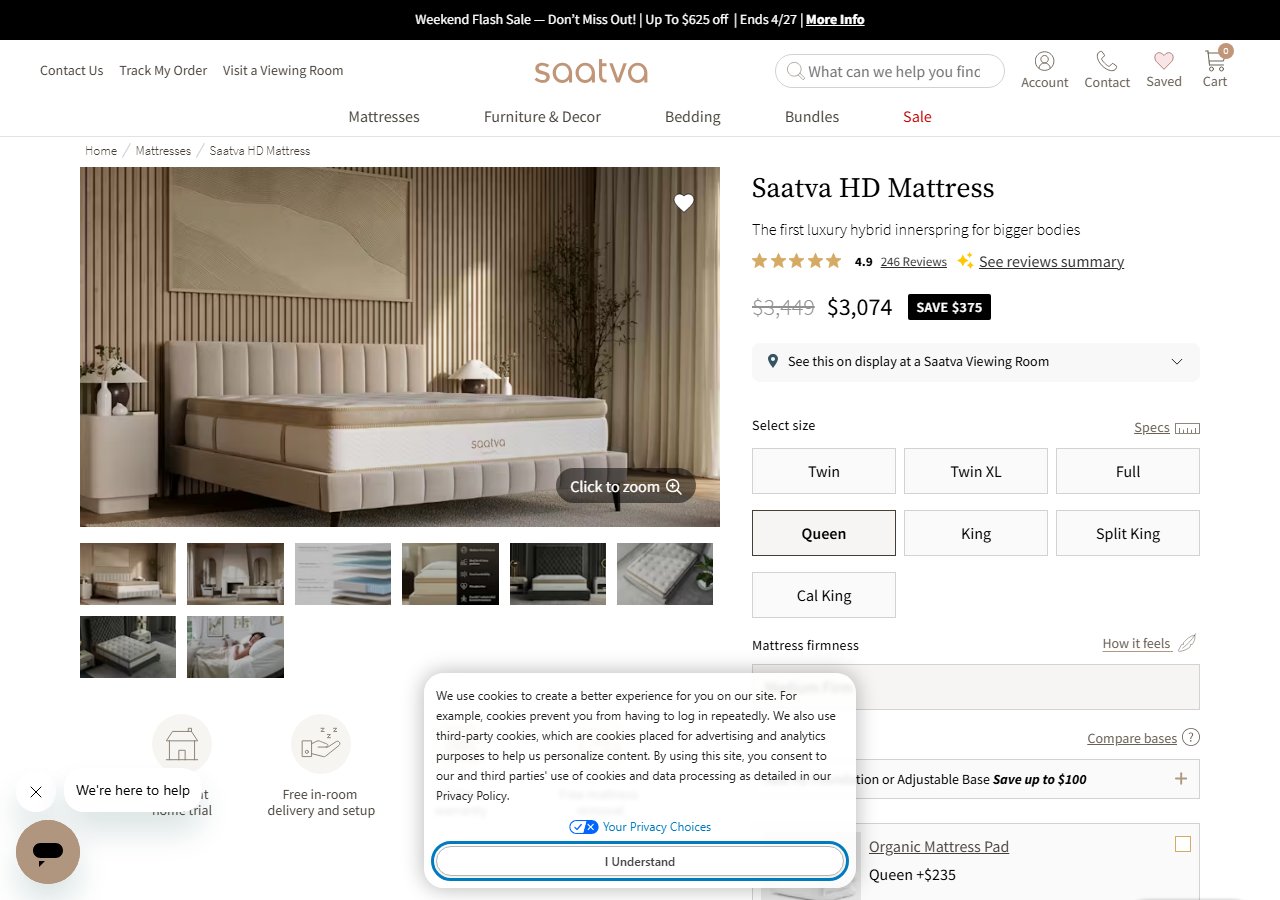
Saatva HD Mattress (Heavy-Duty)
$2,395-$3,995
See Price at Saatva →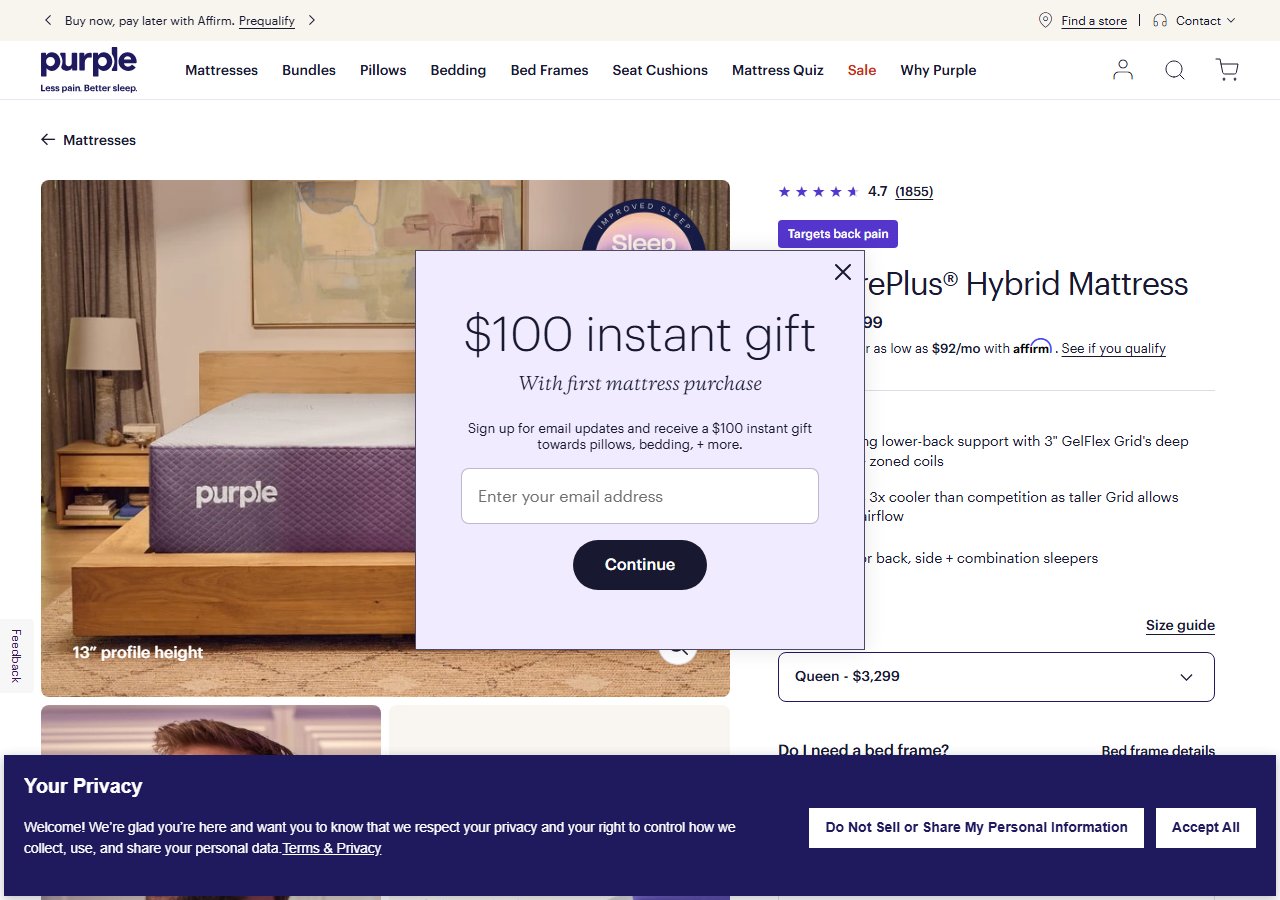
Purple Hybrid Premier Mattress
$2,499-$4,799
See Price at Purple →What Federal Data Tells Us About Prioritization
The hierarchy the data supports is this: movement first, position second, surface third, clinical intervention fourth, pharmacological management last. The CMS Drug Spending data showing pain medication as one of Medicare's most expensive drug categories is a portrait of a system that often reaches for pharmacological management before behavioral and structural interventions have been optimized. The AHRQ MEPS data showing that chronic back condition sufferers spend substantially more on personal healthcare than those without such conditions is a cost that compounds annually — and some of it is preventable.
A mattress upgrade is not a substitute for daily walking, correct sleep position, or clinical evaluation of red-flag symptoms. It is, however, a legitimate intervention at the point where the free and low-cost variables have been addressed and the sleep surface has become the binding constraint. Seven to nine hours of spinal loading on a sagging, age-expired, or mechanically mismatched surface is not a passive event. It is a nightly recapitulation of the same loading error that caused the injury in the first place.
The SSA Disability Insurance data identifying musculoskeletal disorders as the largest category of new disability claims is ultimately a measure of what happens when chronic back conditions are inadequately managed across years. Some of those cases represent irreversible structural pathology. Many represent years of cumulative under-treatment — movement avoided, positions not corrected, surfaces not replaced — that allowed a manageable mechanical condition to become a disabling one.
The data says: act earlier, act smarter, and treat the sleep surface as an evidence-based intervention rather than either a luxury purchase or a guaranteed cure.