One in Five Americans Wakes Up in Pain — and the System Is Not Fixing It
According to CDC NCHS Data Brief 390, approximately 20% of U.S. adults experience chronic pain, and lower back pain is the single most common pain location reported in that survey. That is roughly 50 million people. A substantial share of them are not sleeping well — CDC sleep data documents that 35% of U.S. adults report sleeping fewer than 7 hours per night, the threshold below which chronic disease risk rises measurably. The overlap of those two statistics is not a coincidence. Poor sleep accelerates pain sensitization. Chronic pain disrupts sleep architecture. The two conditions amplify each other in a feedback loop that no single product, prescription, or procedure reliably breaks.
The economic signal is equally unambiguous. AHRQ's Medical Expenditure Panel Survey (MEPS) shows that adults with chronic back conditions carry substantially higher annual personal healthcare costs than adults without such conditions. AHRQ's HCUP database identifies back pain as one of the most expensive conditions in U.S. healthcare by combined inpatient and outpatient spending — and that is before counting the indirect costs of missed workdays, reduced productivity, and disability claims. The Social Security Administration's Disability Insurance reports identify musculoskeletal disorders as the largest single category of new disability claims filed each year. Lower back conditions drive a substantial share of that total.
This is not a niche problem. It is the dominant physical health burden of the American working-age population. And yet the dominant response — more imaging, more medication, more passive intervention — has demonstrably failed to reduce the prevalence numbers. CMS drug spending data shows opioid and non-opioid pain medications among the most expensive Medicare drug categories, which tells you the system has been treating the symptom rather than the mechanism.
Why Chronic Back Pain Happens: The Biomechanical and Occupational Mechanism
Understanding why your back hurts requires separating two distinct mechanisms: acute mechanical injury and cumulative load failure. Most chronic lower back pain in working adults is the second type — not one dramatic event but the slow erosion of disc integrity, facet joint cartilage, and paraspinal muscle endurance under sustained, repetitive, or poorly-distributed spinal loading.
The NIOSH Lifting Equation documents that manual material-handling tasks across warehousing, construction, and healthcare routinely exceed safe spinal loading limits. The L4-L5 and L5-S1 disc levels — the two segments responsible for the vast majority of clinical lower back complaints — are subjected to compressive forces that can exceed 3,400 Newtons during common workplace tasks when performed incorrectly. Over years, that produces disc dehydration, height loss, and eventually annular tears that allow nucleus material to press against spinal nerve roots, producing the radiating pain and leg symptoms that characterize lumbar radiculopathy.
BLS Musculoskeletal Disorder data confirms that the back is the most commonly injured body part across all U.S. occupations that result in days away from work. This is not specific to physical trades — office workers, healthcare workers, and transportation workers all appear in the data. The industries with the highest musculoskeletal disorder incidence carry workers' compensation insurance rates 3-5 times higher than low-MSD industries. When your employer's insurance bill is triple the industry average, the mechanism is already well-established.
Approximately 25% of U.S. adults report doctor-diagnosed arthritis, with prevalence concentrated in occupations requiring sustained physical demand. Facet joint arthritis is a direct consequence of the cumulative loading mechanism described above — it is the skeleton's response to chronic overload at the posterior elements of the lumbar spine. Once facet arthritis is established, the pain is no longer purely positional or mechanical; it has an inflammatory component that responds differently to surface firmness, sleep position, and temperature than pure disc-origin pain does.
Nighttime is when the spine is supposed to recover. Intervertebral discs are largely avascular — they exchange nutrients and waste products through imbibition, a pressure-driven fluid exchange that works best during unloaded recumbency. In plain language: your discs re-hydrate while you sleep. If your sleep surface does not keep your spine in a neutral position during those 7-8 hours, you are compressing the discs asymmetrically, impairing that exchange, and waking up with less disc height and more stiffness than you would have had on a properly supportive surface. This is the biomechanical rationale for why the sleep surface matters — not marketing language, but spinal physiology.
The Cheapest Intervention Is the One That Costs Nothing
Before discussing any product, it is worth being direct: the sleep surface is one variable among several, and it is rarely the highest-leverage variable. The evidence base for free behavioral interventions is stronger than most people realize, and the interventions are available to anyone reading this article right now.
NIH NCCIH's evidence review on low-back pain is explicit: walking 30 minutes most days reduces chronic low back pain as effectively as most non-drug clinical treatments. This is not a minor footnote — it is a headline finding from a federal review of the comparative evidence. Paraspinal musculature that is regularly loaded through walking maintains the endurance capacity to stabilize the lumbar spine during the hours when you are upright. Deconditioning — the sedentary byproduct of pain avoidance — is one of the primary drivers of chronicity.
NIH guidance on back pain identifies sleep position as the single biggest free variable for people with chronic lumbar conditions. Side-sleeping with a pillow between the knees maintains the pelvis in a neutral position and prevents the hip from internally rotating, which would torque the lumbar spine. Back-sleeping with a pillow under the knees reduces lumbar lordosis and takes pressure off the facet joints. Stomach-sleeping — the worst position for chronic lower back pain — forces the lumbar spine into extension, compresses the posterior elements, and rotates the cervical spine to one side for hours at a time. OSHA ergonomics guidance reinforces the mechanical principle: the spine tolerates neutral alignment; it degrades under sustained asymmetric load.
And if your mattress is more than 7-10 years old, has visible sag, or you consistently wake stiffer than you went to bed, the CDC's sleep hygiene guidance is clear: the surface itself may be the problem. A sagging mattress creates a hammock effect that holds the lumbar spine in flexion for hours, precisely the opposite of what recovery requires.
For readers who have already corrected their sleep position, replaced a degraded mattress with a basic replacement, added a walking habit, and still wake up stiff and sore — equipment becomes a legitimate next step. The mattress recommendations below are positioned for people who have done the free work and need a sleep surface specifically engineered for lumbar support and pressure relief. They are not substitutes for behavioral change; they are amplifiers of it.
When to See a Clinician Before Buying Anything
Some back pain presentations should not be managed with a new mattress. They should be managed with a physician, a physiatrist, or an emergency department, depending on severity. NIH's National Institute of Neurological Disorders and Stroke provides explicit criteria for when back pain requires immediate clinical evaluation: pain that radiates below the knee (particularly with numbness or tingling), pain following trauma, pain accompanied by leg weakness, and pain associated with bowel or bladder changes are all neurological red flags that suggest nerve compression or spinal cord compromise. These are not situations where better lumbar support resolves the problem.
Fever with back pain suggests possible spinal infection (discitis, epidural abscess) — a rare but serious condition requiring urgent evaluation. Unexplained weight loss with back pain in adults over 50 is a flag for malignancy. Night pain that wakes you from sleep and is not positional in nature is different from the morning stiffness that characterizes mechanical and arthritic conditions — it merits clinical investigation.
The point is not to generate anxiety. Most chronic lower back pain is mechanical, modifiable, and manageable. But the diagnostic step matters: knowing whether your pain is from disc degeneration, facet arthritis, sacroiliac joint dysfunction, or muscle imbalance determines which interventions — including which mattress firmness and sleep position — are most likely to help. A physiatrist or orthopedic spine specialist can provide that answer in one visit.
How Sleep Surface Firmness Affects the Lumbar Spine: What the Research Actually Shows
The firmness debate in mattress marketing is badly misrepresented. "Firm is good for your back" is not what the research says. Neither is "soft cushions pressure points." What the evidence actually shows is more nuanced: spinal alignment during sleep depends on the interaction between body weight, body shape, sleep position, and surface compliance — and the optimal firmness is therefore individual, not universal.
The general framework: a surface that is too soft allows the pelvis to sink, creating lumbar hyperflexion. A surface that is too firm creates pressure point loading at the hips and shoulders (for side sleepers) that forces the body into compensatory positions — waking up with hip or shoulder pain is the signal. Medium-firm to medium surfaces tend to perform best across the broadest range of body types and sleep positions, which is why clinical guidance typically defaults to that range. But a 220-pound side sleeper and a 140-pound back sleeper do not have the same optimal firmness, and a mattress that works for one may be counterproductive for the other.
For people with lumbar disc conditions — herniation, degeneration, stenosis — the priority is maintaining lordotic curvature during sleep. This argues for surfaces with enough support at the lumbar zone to prevent the spine from flattening, combined with enough pressure relief at the hips and shoulders to allow the spine to remain in neutral without muscular compensation. Memory foam and hybrid constructions with zoned support layers are engineered specifically for this.
For people with facet arthritis or inflammatory back conditions, morning stiffness is the dominant symptom, and it is caused partly by inflammatory mediator accumulation in the joints during low-activity periods and partly by position-related joint compression. Pressure relief at the posterior elements — which a compliant comfort layer provides — reduces that compression and typically correlates with reduced morning stiffness.
For heavier-bodied users — particularly those in physically demanding occupations where cumulative spinal load is already high — standard consumer mattresses can bottom out, losing their supportive function and creating the hammock effect described earlier. This is a known engineering problem, and it requires a mattress specifically constructed to maintain support at higher weight loads.
The Products That Fit This Specific Problem
With mechanism, free interventions, and clinical criteria established, three mattresses address the specific biomechanical needs described above. Each is positioned for a distinct reader profile within the chronic back pain population.
The Saatva Loom & Leaf Memory Foam Mattress is the premium memory foam pick for people with serious chronic lumbar conditions who have found that innerspring or hybrid surfaces are too firm at the pressure points. Loom & Leaf uses a multi-layer American-made memory foam construction with a cooling gel layer and an organic cotton cover. The dual tempered steel coil support base prevents the bottoming-out problem common in all-foam mattresses. It is available in Relaxed Firm (5.5 on the firmness scale) and Firm (8 on the scale) — two options that correspond to the range most commonly recommended for lumbar disc and arthritis patients respectively. White-glove delivery with old mattress removal is included, which matters for people with active back conditions who should not be handling mattress logistics themselves.
The Saatva HD Mattress is specifically engineered for users up to 500 pounds — the "HD" designation is not marketing language but a structural specification. It uses a three-layer coil system (micro-coils, foam encasement, and a base coil layer with a higher gauge wire than standard Saatva models) that maintains lumbar support integrity at weight loads where standard mattresses deform. For warehouse workers, construction workers, and healthcare workers in the BLS datasets — people whose spines are already absorbing cumulative occupational load well above the NIOSH safe-limit thresholds — the mattress bottoming out during sleep is a serious issue that the Saatva HD directly addresses. The firmer support profile also tends to suit back sleepers in this weight range, the position NIH identifies as most protective for lumbar conditions.
The Purple Hybrid Premier Mattress takes a different engineering approach: its proprietary GelFlex Grid replaces traditional foam comfort layers with a hyper-elastic polymer grid that collapses under concentrated pressure (at bony prominences like hips and shoulders) while remaining rigid under distributed pressure (at the lumbar and thoracic spine). For readers whose back pain includes a significant inflammatory or arthritic component — where pressure sensitivity at the posterior elements is a primary driver of night pain — the Purple grid's ability to simultaneously relieve pressure and support spinal alignment is a meaningful functional distinction from standard foam or coil hybrids. The 3-inch and 4-inch grid variants in the Hybrid Premier provide progressively more pressure relief; the 4-inch option is typically recommended for side sleepers with hip or shoulder involvement alongside their lumbar condition.
Sleep Surfaces Engineered for Chronic Lumbar Conditions
These three mattresses were curated for adults managing chronic lower back pain across three distinct profiles: standard-build users with disc or arthritic conditions, heavier-bodied users in physically demanding occupations, and pressure-sensitive inflammatory presentations.

Saatva Loom & Leaf Memory Foam Mattress
$1,695-$3,295
See Price at Saatva →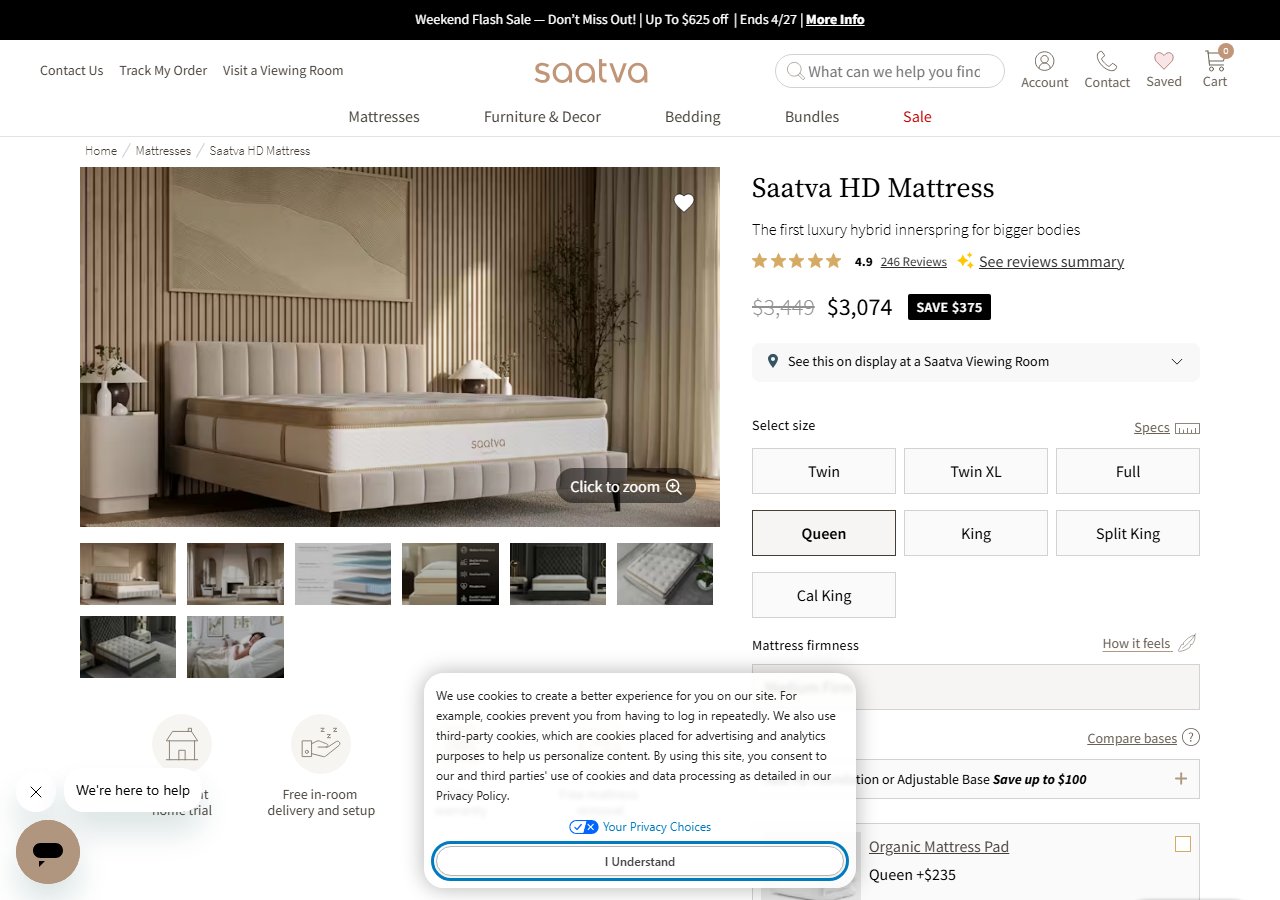
Saatva HD Mattress (Heavy-Duty)
$2,395-$3,995
See Price at Saatva →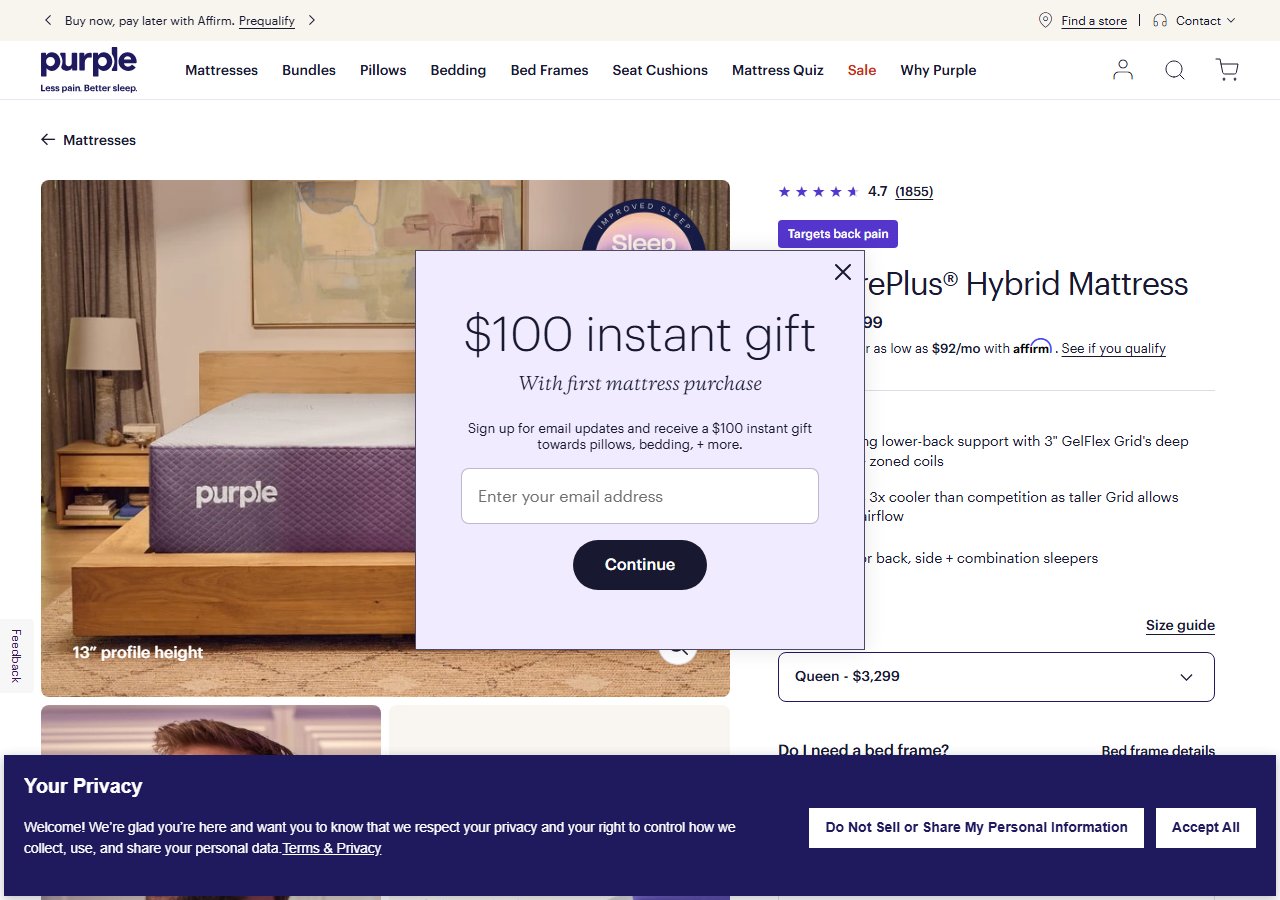
Purple Hybrid Premier Mattress
$2,499-$4,799
See Price at Purple →Putting It All Together: The Data-to-Intervention Hierarchy
The federal data tells a consistent story. CDC documents that 20% of American adults live with chronic pain, with lower back as the most common location. AHRQ confirms that those adults spend substantially more on healthcare — and HCUP data shows that back pain is among the most expensive conditions in the entire U.S. healthcare system. SSA disability data shows musculoskeletal disorders leading all other categories in new disability claims. This is not a problem that is going away, and the current treatment paradigm — heavy on medication and imaging, light on behavioral and ergonomic intervention — is not reducing prevalence.
The intervention hierarchy that emerges from the evidence is clear: correct sleep position first (it costs nothing and NIH guidance is specific about what works). Assess your current mattress — if it is sagging or more than a decade old, the surface itself may be the mechanism. Add daily walking — 30 minutes, most days, is the threshold NIH NCCIH identifies as matching most non-drug clinical interventions for chronic low back pain. Learn proper lifting mechanics from OSHA's ergonomics guidance if your occupation involves manual material handling. And see a clinician if your pain includes any of the neurological flags described above.
If you have done that work and are still searching for the sleep surface that keeps your spine in the best position for recovery during the 7-8 hours when your discs are supposed to re-hydrate and your paraspinal muscles are supposed to be resting — the three products above represent the clearest fit for the three most common chronic back pain profiles: serious disc or arthritic conditions in standard weight ranges (Loom & Leaf), heavy-bodied users whose spines are already carrying occupational overload (Saatva HD), and inflammatory or pressure-sensitive presentations (Purple Hybrid Premier).
A new mattress will not fix chronic back pain. Nothing will fix it quickly — the epidemiology of chronicity is unambiguous on that point. But sleeping on a surface that actively worsens your spinal alignment for a third of your life is a solvable problem, and solving it is a legitimate part of a comprehensive management plan.