One in Five Americans Wakes Up with This Problem Every Day
Start with the number: approximately 20% of U.S. adults experience chronic pain, with the lower back as the most common pain location, according to CDC NCHS Data Brief 390. That is roughly 66 million people who carry lumbar pain into every workday, every commute, and — critically — every night of sleep. For many of them, the eight hours they are supposed to spend recovering are the hours that make the pain worse.
This is not a niche problem. It is the single most common injury site across all U.S. occupations. BLS Musculoskeletal Disorders by Occupation tracking identifies the back as the number-one body part injured in cases involving days away from work, across every major industry sector. Warehouse workers, construction laborers, nurses, delivery drivers, retail workers — the through-line is spinal load.
The financial consequences of that load are enormous. AHRQ's Medical Expenditure Panel Survey documents that adults living with chronic back conditions carry substantially higher annual personal healthcare costs than adults without those conditions. AHRQ's HCUP database goes further, identifying back pain as one of the most expensive conditions in U.S. healthcare by total inpatient and outpatient spending. CMS drug spending data shows that opioid and non-opioid pain medication spending ranks among the most expensive Medicare drug categories — a direct downstream consequence of undertreated and poorly managed musculoskeletal pain. And SSA Disability Insurance data identifies musculoskeletal disorders as the single largest category of new disability claims filed each year. The back, in other words, is not just the most injured body part — it is the one most likely to end a career.
Why Chronic Back Pain and Poor Sleep Form a Feedback Loop
Understanding why this matters at night requires a brief detour into the biomechanics of what sleep does — and what a poor sleep surface undoes.
During sleep, intervertebral discs partially rehydrate. The discs are avascular, meaning they do not receive blood supply directly. They absorb fluid through a pressure-differential process that works best when the spine is in a neutral, decompressed position. When a sleep surface sags — either from age, low-quality foam, or inadequate support for body weight — the lumbar spine is held in sustained lateral flexion or extension through the night. Instead of rehydrating, discs stay compressed in a mechanically disadvantaged position. The sleeper wakes stiffer than they went to bed. They interpret this as their back pain simply being bad. Often, what it actually is, is their mattress making it worse.
The compounding factor is sleep duration. CDC sleep data shows that approximately 35% of U.S. adults report sleeping fewer than 7 hours per night, the threshold below which chronic disease risk rises sharply. For chronic back pain sufferers, shortened sleep does double damage: it reduces disc rehydration time, and it lowers the body's pain threshold through sleep-deprivation-mediated central sensitization. Chronic pain and chronic sleep deprivation are a self-reinforcing cycle. You hurt, so you sleep poorly. You sleep poorly, so you hurt more.
The occupational context makes this worse. The NIOSH Lifting Equation documents that manual material-handling tasks across warehousing, construction, and healthcare routinely exceed safe spinal loading limits during the workday. Workers in these sectors arrive at bedtime with spines that have already absorbed cumulative compressive and shear forces beyond recommended limits. For these workers, the night is not a luxury — it is the only physiological window available for spinal recovery. A mattress that fails to facilitate that recovery is not a comfort problem; it is an occupational health problem.
BLS Employer Costs for Employee Compensation data shows that industries with high MSD incidence carry workers' compensation insurance rates 3 to 5 times higher than low-MSD industries. The workplace injury and the sleep surface are not separate conversations. They are the same conversation.
It is also worth noting that approximately 25% of U.S. adults report doctor-diagnosed arthritis, with prevalence concentrated in occupations involving sustained physical demand. Arthritis in the lumbar facet joints — a direct consequence of years of compressive loading — produces a specific type of nighttime pain: stiffness that peaks in the early morning hours after sustained stillness, and that improves slightly with movement. For this subgroup, the pressure-relief characteristics of a sleep surface are particularly important. A surface that is too firm creates point loading on inflamed facet joints; a surface that is too soft fails to support lumbar lordosis and allows the spine to sag into flexion.
The Cheapest Intervention Is the One That Costs Nothing
Before we get to sleep surfaces, the data is clear: behavioral and movement interventions have stronger evidence bases than most passive treatments, including new mattresses. The following are the interventions you should try first — or layer alongside any product purchase.
Sleep position is the single largest free variable available to a chronic back pain sufferer. NIH guidance from the National Institute of Arthritis and Musculoskeletal and Skin Diseases recommends side-sleeping with a pillow between the knees, or back-sleeping with a pillow under the knees, as positions that maintain lumbar neutrality. Stomach-sleeping torques the lumbar spine into sustained extension and rotation — a posture that is mechanically identical to what a physical therapist would identify as a provocation position. If you are a stomach sleeper with chronic lumbar pain, this is the first thing to address. It costs nothing and the mechanism is well understood.
Daily walking has a stronger evidence base than most people expect. NIH's National Center for Complementary and Integrative Health evidence review finds that walking 30 minutes most days reduces chronic low back pain as effectively as most non-drug clinical treatments. Walking works through several mechanisms: it promotes disc nutrition through cyclic loading and unloading, it reduces lumbar muscle spasm through rhythmic movement, and it reduces the central sensitization that amplifies pain signals. A new mattress will not do any of these things.
Lifting and bending mechanics matter beyond the workday. OSHA's ergonomics guidance is explicit: hinge at the hips, not the lumbar spine; keep loads close to the body; avoid twisting under load. Most acute back episodes are mechanical and repeatable — meaning the same movement pattern that caused the first injury will cause the recurrence. Learning the hip-hinge pattern is a one-time investment that pays forward indefinitely.
Mattress replacement criteria: CDC sleep hygiene guidance and orthopedic consensus suggest replacing a mattress when it shows visible sag, when you consistently wake stiffer than you went to bed, or when the surface is older than 7 to 10 years. These are the operative criteria for deciding whether a product purchase is warranted. Even the most expensive mattress on the market does not compensate for poor sleep hygiene, sedentary days, or unaddressed workplace ergonomics.
For readers who have already addressed sleep position, are walking regularly, and are sleeping on a surface that meets basic quality criteria — and who still wake with significant lumbar pain — the sleep surface itself may genuinely be a limiting factor. In that case, the biomechanical characteristics of the mattress become a meaningful clinical variable, not a marketing one. Here is how to think about what the data supports.
When to See a Clinician Before You Buy Anything
A new mattress is not appropriate as a first response to every type of back pain. NIH's National Institute of Neurological Disorders and Stroke identifies several presentations that require imaging or clinician referral before any passive intervention — including a new sleep surface.
Do not self-treat with a mattress purchase if your back pain radiates below the knee (a pattern consistent with nerve root compression or disc herniation), if it followed a significant trauma, if it comes with lower extremity weakness or changes in reflexes, if you have experienced any bowel or bladder dysfunction, or if the pain is accompanied by fever or unexplained weight loss. These are red flags for serious pathology — including cauda equina syndrome, spinal infection, or malignancy — that require urgent medical evaluation. The clinical red flags section below lists these with source citations.
For the majority of chronic low back pain sufferers — those with nonspecific lumbar pain, axial pain that does not radiate below the knee, morning stiffness that improves with movement, or occupational loading histories — a systematic approach to sleep surface selection is appropriate and evidence-informed.
What the Research Actually Says About Firmness
The "firmer is better" orthodoxy that dominated orthopedic advice for decades has been substantially revised. The current evidence base, including studies reviewed by NCCIH and summarized in clinical guidelines, supports a medium-firm sleep surface for most nonspecific chronic low back pain sufferers. The mechanism is intuitive once you understand disc biomechanics: a surface that is too firm creates point loading at the bony prominences of the pelvis and shoulders, forcing the lumbar spine into a laterally flexed position; a surface that is too soft allows the spine to sag into flexion without support. Medium-firm allows the shoulders and hips to sink slightly — conforming to body contour — while maintaining lumbar support.
For back sleepers, this means the lumbar region should not feel bridged or unsupported. For side sleepers, the shoulder should sink enough that the cervical and thoracic spine remain in line with the lumbar spine. The pillow-between-the-knees recommendation from NIH exists precisely because even a well-designed medium-firm surface cannot fully prevent hip drop in side-lying without mechanical assistance at the knee.
Body weight is the confounding variable that most generic firmness advice ignores. A 130-pound side sleeper and a 300-pound side sleeper experience fundamentally different pressure distributions on the same surface. Heavier individuals require mattresses with higher-density core support layers to prevent premature sag and maintain the neutrality that disc rehydration requires. This is not a marketing distinction — it is a physics distinction.
Sleep Surfaces That Address the Biomechanical Load Patterns in the Data
With the mechanism, interventions, and clinical boundaries established, the following sleep surfaces address the specific patterns documented in the federal data above. These are adjuncts to the behavioral and movement interventions described earlier — not replacements for them.
For chronic back pain sufferers whose primary complaint is lumbar pressure and morning stiffness — the most common presentation in the CDC NCHS data — the Saatva Loom & Leaf Memory Foam Mattress is the premium pick. Loom & Leaf uses a multi-layer memory foam construction with a gel-infused comfort layer over a high-density support foam core, specifically engineered to provide the shoulder and hip contouring that prevents lateral spinal flexion in side sleepers while maintaining lumbar support in back sleepers. It is available in Relaxed Firm and Firm configurations — the Relaxed Firm (roughly medium-firm by industry standards) aligns with the evidence base for nonspecific chronic low back pain. At $1,695 to $3,295 depending on size, it is a significant purchase, but when set against the AHRQ MEPS data showing substantially elevated annual healthcare costs for chronic back pain sufferers, it is a different category of expenditure than a comfort upgrade.
For workers in the occupational categories most heavily represented in BLS injury data — warehousing, construction, healthcare, and logistics — body weight and cumulative spinal loading create specific requirements that standard consumer mattresses are not designed to meet. The Saatva HD Mattress was engineered specifically for this population. Its heavy-duty innerspring architecture uses a higher coil gauge and a reinforced perimeter support system designed to maintain structural integrity under loads that would accelerate sag in conventional mattresses. For workers whose spines have absorbed repeated loads beyond NIOSH-recommended limits during the day, a mattress that maintains its support geometry year over year is not a luxury specification — it is the primary criterion. The Saatva HD is priced at $2,395 to $3,995 and carries a higher weight capacity than standard models.
For back pain sufferers whose primary complaint is pressure sensitivity — including those with diagnosed lumbar arthritis, facet joint degeneration, or nerve root irritation that has not crossed the clinical red flag threshold — pressure relief at bony prominences is the primary biomechanical need. The Purple Hybrid Premier Mattress uses Purple's proprietary GelFlex Grid in place of conventional foam comfort layers. The grid is engineered to collapse under direct pressure points (shoulders, hips, sacrum) while remaining firm in unsupported regions — a characteristic that conventional foam cannot replicate because foam responds to both point load and distributed load similarly. For sleepers with arthritis-related pain, the distinction matters: the grid reduces sacral and hip pressure while maintaining lumbar support in a way that medium-firm foam approximates but does not fully achieve. Priced at $2,499 to $4,799, it is the highest-priced option in this list and most appropriate for sleepers who have specifically identified pressure sensitivity as their primary pain driver.
Sleep Surfaces Matched to the Biomechanics of Chronic Back Pain
Each of the following mattresses was selected to address a specific biomechanical load pattern documented in federal occupational and health data — not as a generic comfort upgrade.

Saatva Loom & Leaf Memory Foam Mattress
$1,695-$3,295
See Price at Saatva →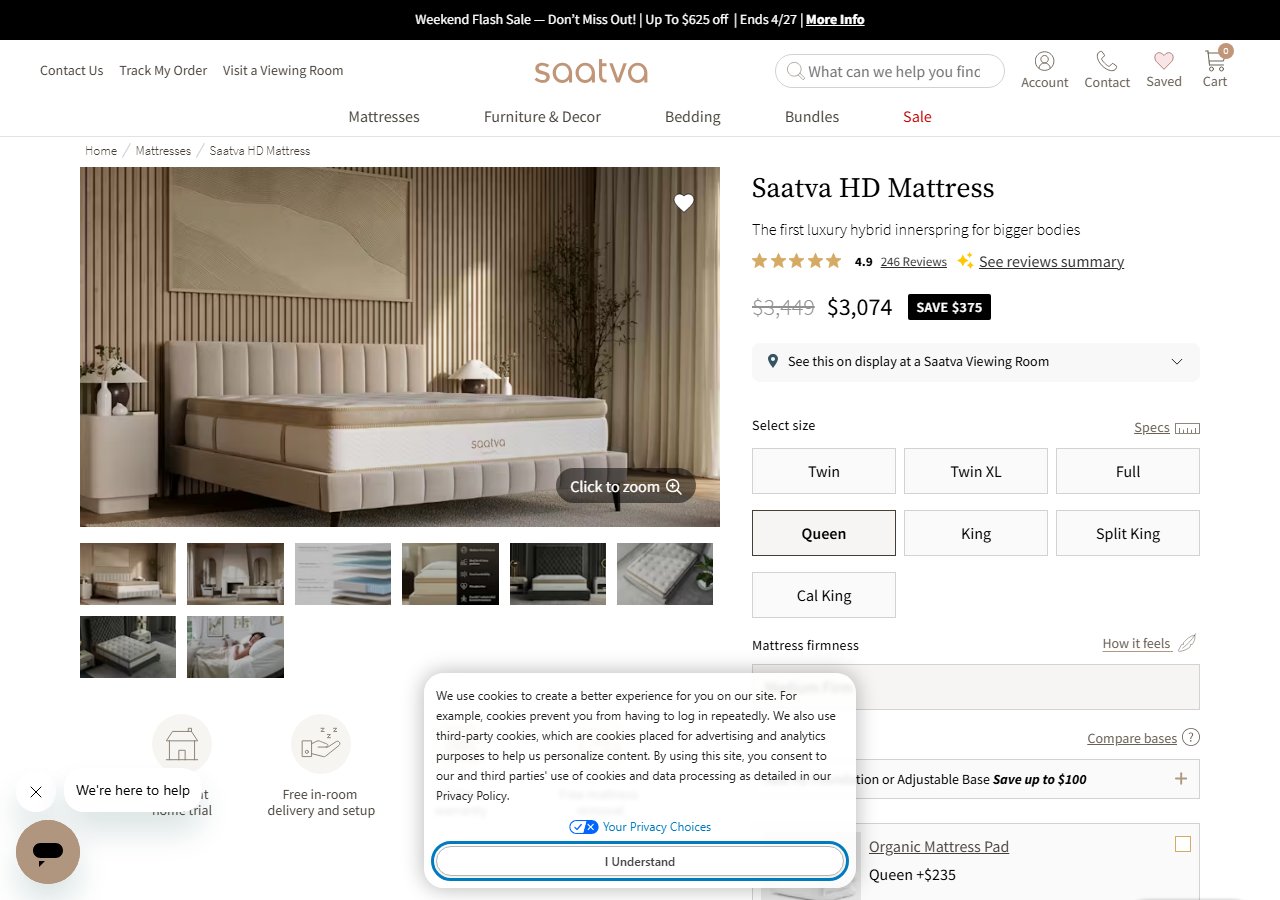
Saatva HD Mattress (Heavy-Duty)
$2,395-$3,995
See Price at Saatva →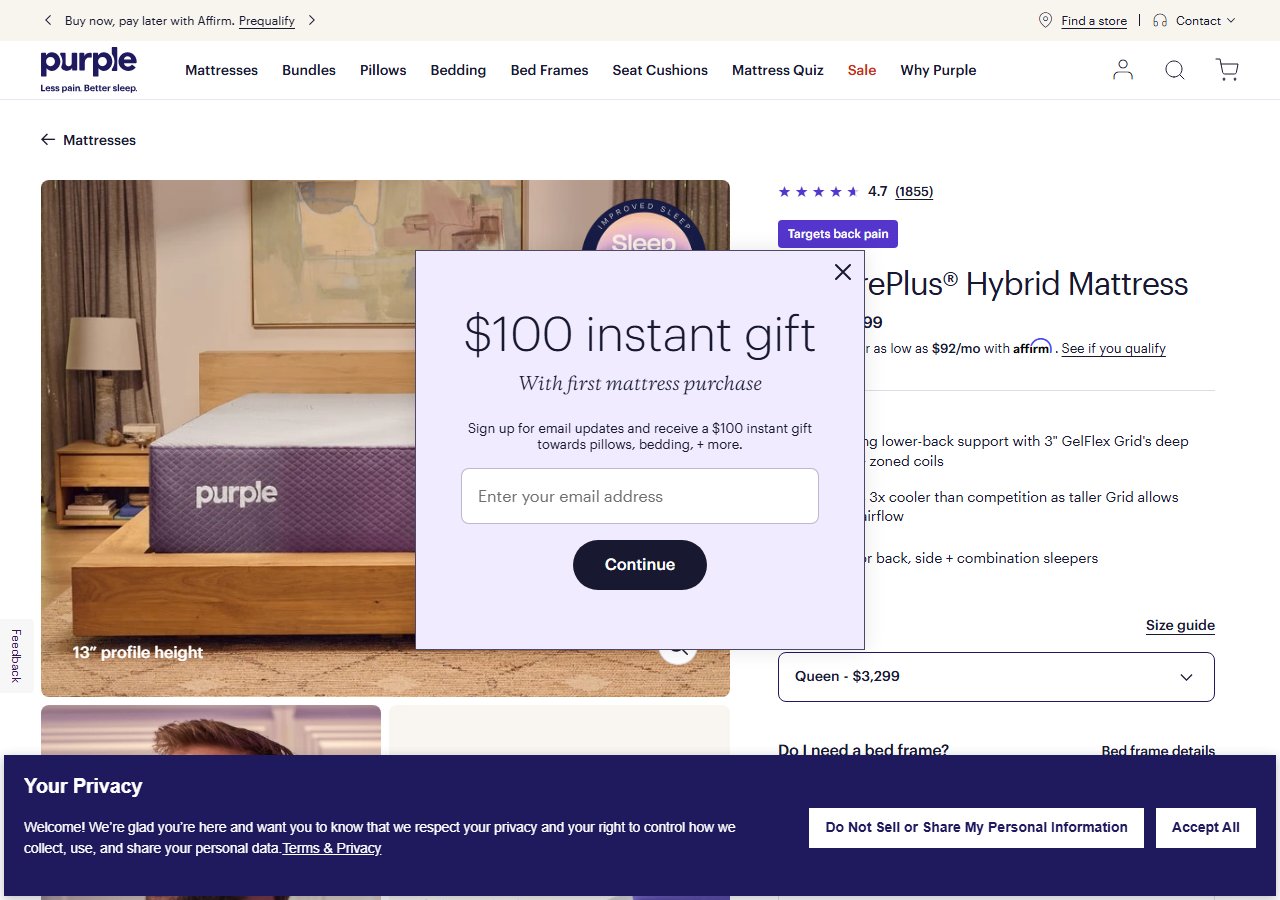
Purple Hybrid Premier Mattress
$2,499-$4,799
See Price at Purple →The Data-to-Intervention-to-Product Hierarchy, Summarized
The federal data on chronic back pain is unambiguous in its scope: 20% of U.S. adults, the most expensive condition category in AHRQ's hospital data, the largest category of new SSA disability claims, the most common injury site across every major U.S. occupation. This is a population-level problem, not an individual bad-luck event.
The hierarchy of response that the data supports is equally clear. Movement comes first — walking 30 minutes most days has clinical trial evidence behind it that most passive interventions do not. Sleep position comes second — free, immediately implementable, and mechanically sound. Lifting mechanics come third — a behavioral change that reduces the cumulative spinal loading that makes nighttime recovery harder. Mattress replacement is warranted when the sleep surface itself is objectively failing: visible sag, consistent morning stiffness, or age beyond 7 to 10 years.
When a new sleep surface is warranted, the choice should be driven by the biomechanical characteristics that match the specific presentation — lumbar pressure and morning stiffness, high body weight and occupational loading, or pressure sensitivity from arthritis and nerve root irritation. The Loom & Leaf, Saatva HD, and Purple Hybrid Premier address those three presentations specifically. None of them replace walking, sleep position discipline, or a clinician's evaluation when red flags are present.
The 66 million Americans living with chronic pain deserve a clear hierarchy, not a product push. The federal data provides it. Use it.