One in Five American Adults Wakes Up in Pain — and the Back Is Ground Zero
Start with the scale of the problem: according to CDC NCHS Data Brief 390, approximately 20% of U.S. adults live with chronic pain, and the lower back is the single most common pain site reported in that population. That is roughly 50 million people. If you add in the workers who sustain acute back injuries on the job — the Bureau of Labor Statistics confirms the back is the most frequently injured body part across all U.S. occupations resulting in days away from work — the picture becomes even starker. This is not a niche health complaint. It is the dominant physical burden carried by the American workforce.
For many of those 50 million people, the question of whether their mattress is making things worse is entirely reasonable. Sleep is when the spine is supposed to decompress, when intervertebral discs rehydrate, and when the paraspinal muscles finally stop contracting. A mattress that fails to support spinal alignment during those 6-8 hours does not merely leave you uncomfortable — it imposes a cumulative mechanical load on structures that are already inflamed or compressed during waking hours. But before we reach for a credit card, the federal data on this topic demands a more disciplined sequence: understand why back pain develops, try the free interventions first, recognize when a clinician is the right call, and only then invest in sleep equipment.
Why Chronic Low Back Pain Happens: The Biomechanical and Occupational Mechanism
Chronic low back pain is not a single diagnosis — it is a syndrome with several overlapping drivers. Understanding those drivers is essential for choosing interventions, whether free or purchased.
Mechanical compression from occupational loading. The NIOSH Lifting Equation documents that manual material-handling tasks across warehousing, construction, and healthcare routinely exceed safe spinal loading limits. Warehouse workers, construction laborers, and nursing aides spend entire shifts lifting, bending, and twisting in ways that compress lumbar discs beyond their design tolerance. Over years, this produces disc degeneration, facet joint arthritis, and a sensitized pain system that remains active even during rest. The CDC Arthritis Data shows approximately 25% of U.S. adults carry a doctor-diagnosed arthritis diagnosis, with that prevalence clustering in exactly these high-demand occupations. Arthritis of the facet joints is one of the most underappreciated contributors to night-time back pain.
Sleep deprivation amplifies pain sensitivity. CDC sleep data reveals that approximately 35% of U.S. adults sleep fewer than 7 hours per night, the threshold below which chronic disease risk escalates. Sleep deprivation is not merely a consequence of back pain — it is a cause of worsened pain perception. The descending pain-inhibition pathways that the brain uses to modulate spinal nociception require adequate slow-wave sleep to function. Chronic back pain sufferers who sleep poorly enter a feedback loop: pain disrupts sleep, and disrupted sleep lowers pain tolerance, making the next night worse.
The financial and systemic burden. This is not just a personal health issue. AHRQ HCUP data shows back pain ranks among the most expensive conditions in U.S. healthcare by total inpatient and outpatient cost. AHRQ MEPS data shows that adults with chronic back conditions spend substantially more on personal healthcare annually than those without. At the system level, SSA Disability Insurance data identifies musculoskeletal disorders as the largest single category of new disability claims filed annually. And CMS drug spending data shows opioid and non-opioid pain medications among the most expensive categories in Medicare — a downstream cost of undertreated, chronic mechanical pain. The person lying awake at 3 a.m. with a stiff lumbar spine is part of a multi-hundred-billion-dollar problem that the healthcare system has not solved with drugs, surgery, or passive treatment alone.
What happens at the mattress. When you lie down on a mattress that is too soft, the pelvis sinks below the shoulders, creating a lateral lumbar curve (scoliotic position) that stretches the ligaments and facet joint capsules on the concave side all night. When a mattress is too firm, there is insufficient pressure relief at the shoulder and greater trochanter for side-sleepers, forcing the spine into lateral flexion from the other direction. The clinical sweet spot — consistently supported in physical therapy research — is a medium-firm mattress that maintains a neutral lumbar curve regardless of sleep position. The spine should be in roughly the same alignment it would be in if you were standing with good posture, only horizontal.
Try These Free Interventions Before You Spend a Dollar
The cheapest intervention is the one that does not require buying anything. Federal evidence is unambiguous that several behavioral and positional changes produce measurable reductions in chronic low back pain — reductions that rival or exceed what any mattress can offer. The sequence matters: exhaust the free interventions first, and you will buy more selectively if you buy at all.
Sleep position is your most immediately adjustable variable. NIH guidance from the National Institute of Arthritis and Musculoskeletal and Skin Diseases is explicit: side-sleeping with a pillow between the knees keeps the pelvis level and the lumbar spine neutral. Back-sleeping with a pillow under the knees flattens the lumbar lordosis slightly and reduces facet joint compression. Stomach-sleeping creates forced lumbar extension and cervical rotation that worsens chronic pain for almost everyone with a lumbar condition. This one positional adjustment — costing only a spare pillow — can produce noticeable improvement within a week for mechanical low back pain sufferers.
Daily walking is a peer-reviewed back pain treatment. An NIH NCCIH evidence review on low back pain finds that walking 30 minutes most days reduces chronic low back pain as effectively as most non-drug clinical treatments. The mechanism is multifactorial: walking loads the lumbar discs rhythmically (promoting disc nutrition through fluid exchange), activates the multifidus and transversus abdominis without compressive peak loads, and reduces systemic inflammation. The evidence for walking is stronger than the evidence for any mattress brand.
Lifting mechanics prevent re-injury. OSHA's ergonomics guidance recommends hinging at the hips rather than the lumbar spine, keeping loads close to the body, and avoiding axial twisting under load. Most acute back episodes in working adults are mechanical and directly traceable to a single lifting or bending event. Learning and rehearsing proper hip-hinge mechanics — essentially, deadlift form — is documented to reduce acute-on-chronic flare frequency.
When the mattress actually is the problem. CDC sleep hygiene guidance supports replacing a mattress when it shows visible sag, when you consistently wake stiffer than you went to bed, or when the mattress is older than 7-10 years. Mattress foams and coil systems mechanically degrade over this period in ways that are not always visible to the eye. If your mattress passes none of these tests — no sag, you sleep fine, it is two years old — a new mattress is unlikely to resolve your pain.
For readers who have already corrected sleep position, started walking regularly, optimized their lifting mechanics, and still wake with significant lumbar stiffness or pain — or whose mattress is visibly degraded — the equipment question becomes legitimate. The products below were selected based on the specific biomechanical demands documented in federal occupational health data for adults with chronic back conditions. Each addresses a distinct failure mode in standard mattress design.
When to See a Clinician First
A mattress purchase is never the right response to certain back pain presentations. NIH National Institute of Neurological Disorders and Stroke guidance on back pain identifies specific red flags that require prompt clinical evaluation — not sleep equipment. These are covered in detail in the red-flags section below, but the core principle is: if your back pain is accompanied by neurological symptoms, followed trauma, or is worsening despite rest, you need imaging and a clinician, not a new mattress.
The financial stakes reinforce this. AHRQ MEPS data documents that adults with unmanaged chronic back conditions accumulate healthcare costs that dwarf the price of any mattress on this list. Early clinical intervention for red-flag presentations — disc herniation with nerve root compression, spinal stenosis, vertebral fracture — prevents the surgical and pharmacological costs that accumulate when these conditions are managed passively. Buying a mattress when you need an MRI is not just clinically irresponsible; it is financially irrational.
Where a Mattress Actually Helps: The Biomechanical Case for Targeted Investment
Once you have cleared the clinical threshold and confirmed that your pain is mechanical in nature — aggravated by position, better with movement, not accompanied by neurological symptoms — the mattress becomes a meaningful variable. Here is how the science and the products align.
The medium-firm evidence base. Research published in clinical sleep medicine and physical therapy journals consistently supports medium-firm mattresses for non-specific chronic low back pain. The mechanism is straightforward: a mattress that is too soft allows the lumbar spine to sag into flexion during back-sleeping and lateral flexion during side-sleeping. A mattress that is too firm creates pressure points at bony prominences (greater trochanter, shoulder, lateral knee in side-sleepers) that cause the sleeper to shift position repeatedly, interrupting slow-wave sleep — which, as noted above, directly worsens pain sensitivity.
Memory foam's specific advantage for back pain sufferers. Viscoelastic (memory) foam distributes pressure across a larger surface area than traditional innerspring systems, reducing peak pressure at bony prominences. For adults with facet joint arthritis, hip bursitis, or sensitized paraspinal tissues — populations well-represented in the CDC Arthritis data showing 25% prevalence — this pressure redistribution has direct analgesic relevance. The question is foam density and ILD (Indentation Load Deflection). High-density, high-ILD foam supports the lumbar curve; low-density foam bottoms out under body weight and fails.
The Saatva Loom & Leaf: The Premium Memory Foam Pick
For adults with serious chronic back pain who need the pressure redistribution of memory foam combined with genuine lumbar support, the Saatva Loom & Leaf Memory Foam Mattress is the most coherently engineered option in this analysis. It uses a multi-layer design: a cooling spinal zone gel layer at the top, a contouring layer of 4-pound density memory foam (high enough to avoid the "sinking" failure mode of budget foams), and a high-density base layer that maintains long-term structural integrity. The Relaxed Firm option (the recommended firmness for most chronic back pain presentations) is specifically designed to maintain lumbar lordosis in back-sleepers while providing enough give for shoulder pressure relief in side-sleepers. Saatva's white-glove delivery and old-mattress removal is practically relevant here: you are not dragging a 100-pound foam roll up three flights of stairs.
The Loom & Leaf's price range ($1,695-$3,295 depending on size) positions it as a genuine healthcare infrastructure investment rather than a commodity purchase — which is the correct framing when you consider AHRQ MEPS data on the annual cost differential of managed versus unmanaged back conditions.
The Saatva HD: Built for the Mechanically Loaded Spine
The population most directly implicated in the BLS and NIOSH data — warehouse workers, construction laborers, healthcare workers who lift patients — often carries additional body weight from years of high-output physical labor. Standard mattresses, even premium ones, are designed for bodies in the 130-200-pound range. For larger-framed adults (250+ lbs), standard coil gauges and foam densities bottom out, eliminating the supportive properties entirely.
The Saatva HD Mattress was specifically engineered for this load pattern. It uses a dual-coil architecture — individually wrapped micro-coils over a heavy-gauge tempered steel coil base — that maintains its firmness profile under sustained weight loads that would permanently compress a standard mattress within 2-3 years. The lumbar zone reinforcement in the center third of the mattress directly addresses the sagging failure mode that occurs when heavier sleepers spend years on undersized support systems. If you are a warehouse worker, construction professional, or healthcare worker with chronic back pain and a larger frame, the HD ($2,395-$3,995) is the product most directly calibrated to your biomechanical profile.
Purple Hybrid Premier: The Pressure-Relief Architecture Alternative
For back pain sufferers whose primary complaint is pressure-point pain — the hip, shoulder, or sacrum pain that drives position-switching and interrupts sleep — the Purple Hybrid Premier Mattress offers a fundamentally different engineering approach. Purple's proprietary GelFlex Grid is a hyper-elastic polymer grid that collapses under pressure points (distributing load across the surface) while remaining firm under the torso and lumbar region (maintaining spinal alignment). This is the inverse of what traditional foam does: foam softens everywhere under load, while the grid softens selectively.
For side-sleepers with hip bursitis, shoulder pain, or IT band issues secondary to their chronic back condition — a common comorbidity pattern — this selective pressure relief is clinically relevant. The Hybrid Premier adds a pocketed coil layer beneath the grid for responsive support and edge stability. At $2,499-$4,799 depending on size, it is the most expensive option in this analysis, and the right pick for a narrow but significant subset: chronic back pain patients who have tried memory foam and found it creates pressure-point discomfort at the hip or shoulder.
Mattresses Engineered for Chronic Back Pain: Three Picks Anchored to Federal Data
Each mattress below was selected based on specific biomechanical failure modes documented in federal occupational health research — not marketing claims — and is matched to distinct back pain profiles by sleep position, body size, and primary pain mechanism.

Saatva Loom & Leaf Memory Foam Mattress
$1,695-$3,295
See Price at Saatva →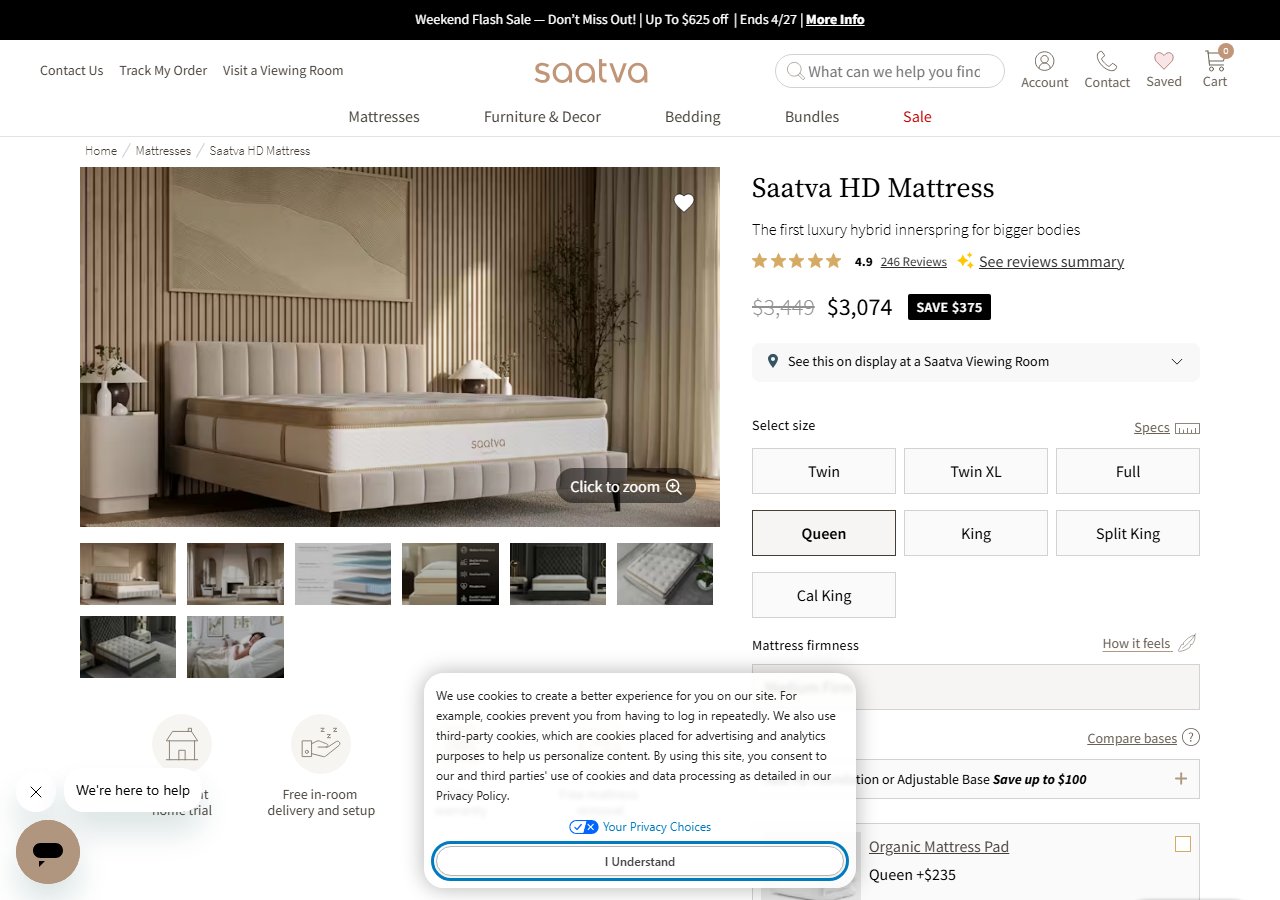
Saatva HD Mattress (Heavy-Duty)
$2,395-$3,995
See Price at Saatva →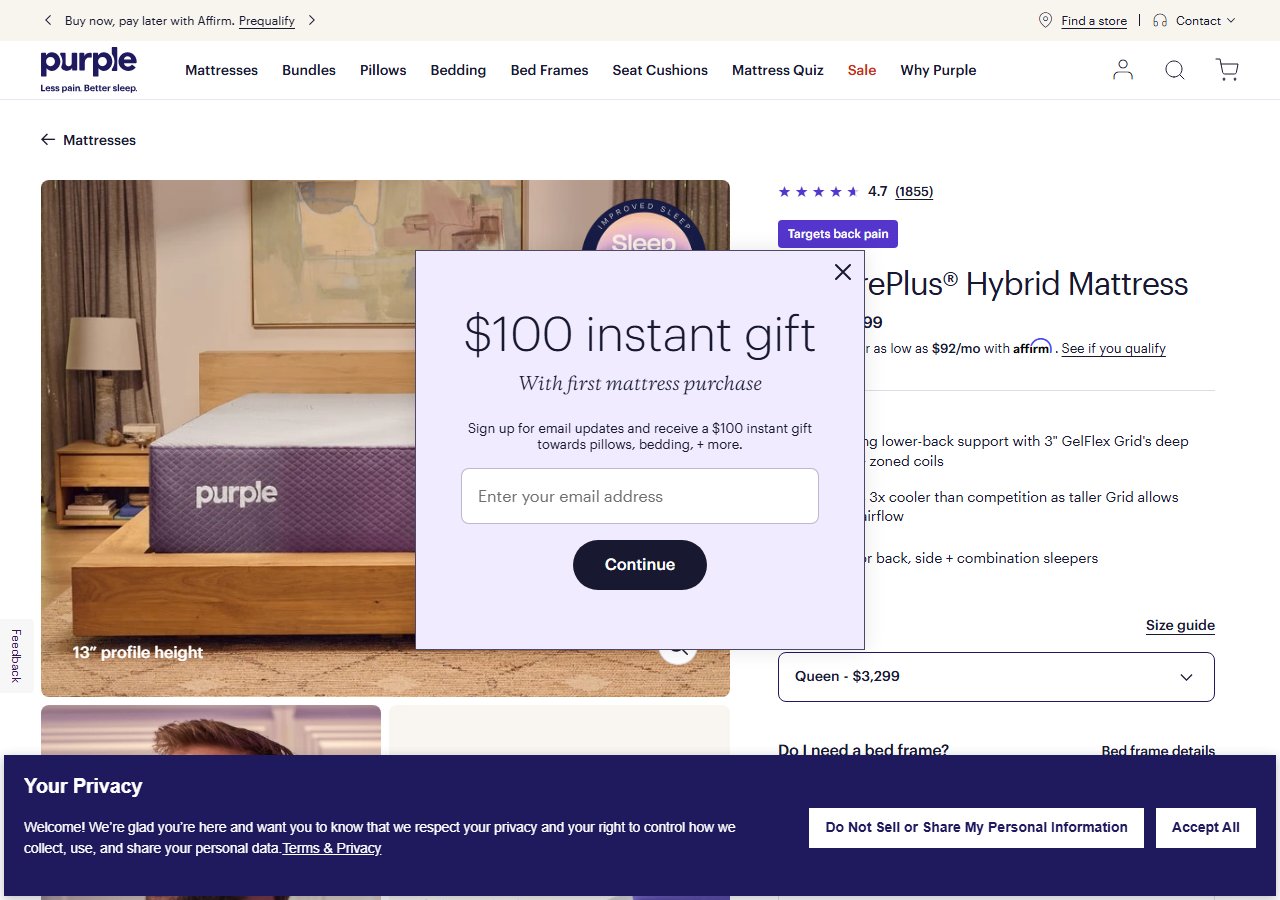
Purple Hybrid Premier Mattress
$2,499-$4,799
See Price at Purple →The Right Mattress Is the Last Line of Defense, Not the First
The federal data assembled in this analysis tells a coherent story that cuts against how mattresses are typically marketed. Back pain is fundamentally an occupational and behavioral problem before it is a sleep product problem. BLS data documents the back as the most injured body part across all occupations. NIOSH Lifting Equation data shows that the loading events causing those injuries routinely exceed safe biomechanical limits. CDC chronic pain data places 50 million Americans in the chronic pain population. And BLS workers' compensation data shows that industries with high MSD incidence carry workers' compensation costs 3-5 times higher than low-MSD industries — a system-level cost that individual sleep equipment cannot address.
What a well-chosen mattress can do: provide 6-8 hours of mechanical unloading that does not actively worsen a spine already stressed by occupational demands. It cannot undo poor movement patterns, inadequate walking, or a job that involves repetitive lifting. But when the free interventions are in place and the mattress is genuinely failing — sagging, older than a decade, leaving you consistently stiffer than you went to sleep — replacing it with a medium-firm, high-density support system is a defensible and cost-effective investment compared to the downstream healthcare expenditure documented by AHRQ.
The hierarchy is non-negotiable: sleep position first, daily movement second, lifting mechanics third, clinical evaluation for red flags when indicated, and then — if all of those are in order — an evidence-aligned mattress chosen for your specific body weight, sleep position, and pain pattern. That sequence, not any single product, is what the federal data actually recommends.