One in Five Americans Wakes Up in Pain — and the Numbers Get Worse From There
According to CDC NHANES survey data published in NCHS Data Brief 390, approximately 20% of U.S. adults live with chronic pain, and the lower back is the single most common pain location reported. That is roughly 50 million people managing a condition every single day — including the roughly eight hours most of them spend horizontal on a sleep surface that may be either helping or hurting their recovery.
The scale of the downstream cost is staggering. AHRQ HCUP data identifies back pain as one of the most expensive conditions in U.S. healthcare measured by total inpatient and outpatient spending. SSA Disability Insurance reports show musculoskeletal disorders — of which chronic back conditions are the dominant subtype — represent the largest single category of new disability claims filed annually. And CMS drug spending dashboard data shows opioid and non-opioid pain medications among the most expensive Medicare drug categories, reflecting the enormous pharmacological burden the U.S. has taken on trying to manage this one body part.
None of that spending is primarily directed at what happens during sleep. That is a significant gap, because the biomechanical case for the sleep surface as a clinical variable is stronger than most patients — and many clinicians — appreciate.
Why Back Pain and Sleep Are Biochemically Linked
The lumbar spine carries compressive load all day. Intervertebral discs, which have no direct blood supply in adults, rely on the cyclical compression-and-decompression of daily activity and overnight rest to exchange nutrients and waste products. When you lie down, intradiscal pressure drops dramatically — that is part of why you are fractionally taller in the morning than at night. But that pressure drop only serves disc health if the spine is in neutral alignment during sleep. When the lumbar curve is unsupported — either because a mattress is too soft and lets the pelvis sink into spinal flexion, or because it is too firm and fails to accommodate the natural lumbar lordosis — the discs and surrounding musculature spend eight hours under asymmetric load rather than recovering from the day's compression.
This matters more for the chronic back pain population than for average sleepers because inflamed, degenerative, or post-surgical lumbar tissue has reduced tolerance for positional stress. A healthy spine can tolerate a mediocre mattress for years without measurable harm. A spine with disc disease, facet arthropathy, or stenosis is far less forgiving of sustained misalignment, and the morning stiffness and pain flares that many chronic back pain patients report are often directly attributable to overnight positional loading rather than daytime activity.
CDC sleep data shows that approximately 35% of U.S. adults already sleep fewer than 7 hours per night — the threshold CDC associates with elevated chronic disease risk. Among chronic pain patients, sleep disruption is even more prevalent: pain wakes people, and sleep deprivation amplifies pain sensitivity through well-documented neurological pathways. The sleep-pain feedback loop is not metaphorical; it is measurable.
Layer in occupational exposure. BLS Musculoskeletal Disorder tracking documents the back as the most common body part injured across all U.S. occupations with days away from work. The NIOSH Lifting Equation finds that manual material-handling tasks in warehousing, construction, and healthcare routinely exceed safe spinal loading thresholds. CDC arthritis data shows roughly 25% of U.S. adults carry a doctor-diagnosed arthritis diagnosis, with prevalence highest in the physically demanding occupations that also produce the most cumulative spinal compression. These workers are not just sleeping on potentially inadequate surfaces — they are arriving at those surfaces pre-loaded with mechanical stress and inflammatory burden that compounds overnight if alignment is poor.
BLS employer compensation data shows industries with high musculoskeletal disorder incidence carry workers' compensation insurance rates 3–5 times higher than low-MSD industries. That is an actuarial acknowledgment of what the biomechanical literature has documented for decades: back injuries are expensive, recurring, and strongly tied to cumulative mechanical exposure.
And AHRQ MEPS data quantifies the individual financial toll: adults with chronic back conditions spend substantially more on personal healthcare annually than adults without such conditions. The people reading this article are not just in pain — they are paying for it in multiple currencies simultaneously.
The Mechanism Specific to Your Condition
Chronic lumbar pain is not one diagnosis — it is a heterogeneous category that includes disc degeneration, herniation, facet joint arthropathy, spinal stenosis, sacroiliac joint dysfunction, and nonspecific mechanical low back pain. Each has a slightly different biomechanical fingerprint, but they share a common vulnerability: sustained positional stress during sleep amplifies inflammatory signaling and delays the tissue recovery that should occur during slow-wave sleep.
For disc-predominant pathology (herniation, DDD), the critical variable is lumbar flexion under load. A mattress that is too soft allows the heavy pelvis to sink, rounding the lumbar spine into flexion and placing posterior disc material under sustained stress — precisely the loading pattern that worsens posterior herniations and exacerbates morning radiculopathy. For facet-predominant pathology (arthropathy, stenosis), the critical variable is lumbar extension, which closes the facet joints and narrows the neural foramina. These patients often find firm, flat surfaces uncomfortable and tolerate slight flexion better. The clinical implication: there is no single firmness that is universally correct for all back pain. The evidence points toward medium-firm as the best average for nonspecific chronic low back pain, but individual anatomy and diagnosis matter.
Sleep position interacts with all of this. Stomach-sleeping forces the lumbar spine into extension and rotates the cervical spine, compounding stress at both ends of the axial skeleton. Side-sleeping in a fetal position exaggerates lumbar flexion. The evidence-supported positions are back-sleeping with a pillow under the knees to preserve the natural lumbar curve, or side-sleeping with a pillow between the knees to prevent hip drop and pelvic tilt. Changing sleep position is free. It is also genuinely effective, and it comes before any discussion of what surface you are sleeping on.
Try These First: Free Interventions With Strong Evidence Bases
The cheapest intervention is the one that requires no purchase. Before any back pain patient with sleep complaints moves into mattress shopping, the evidence supports addressing modifiable behavioral variables first. A $3,000 mattress does not undo poor sleep positioning, sedentary days, or a lifting pattern that reinjures the lumbar spine every morning at work.
NIH NCCIH's evidence review on low back pain found that walking 30 minutes most days reduces chronic low back pain as effectively as most non-drug clinical treatments. That is a remarkable finding: a free, accessible, zero-equipment activity matching the efficacy of interventions that cost hundreds of dollars per session. Walking promotes disc hydration, reduces inflammatory cytokine levels, and maintains the muscular endurance of the paraspinal stabilizers that protect the lumbar spine during both activity and rest. Movement is the primary lever for chronic low back pain. Products are secondary.
NIH NIAMS guidance on back pain is explicit about sleep position: side-sleeping with a pillow between the knees and back-sleeping with a pillow under the knees both keep the lumbar spine in neutral and reduce overnight compressive stress. Stomach-sleeping torques the lumbar spine and should be actively avoided by anyone with chronic lumbar pathology. This adjustment costs nothing and works immediately.
OSHA's ergonomics guidance documents the mechanics of safe lifting: hinge at the hips rather than the lumbar spine, keep loads close to the body, avoid twisting under load. Most acute back episodes in working adults are mechanical and reproducible — the same motor pattern, repeatedly. Correcting it is behavioral, not pharmaceutical, and not a product.
CDC sleep hygiene guidance is unambiguous on mattress replacement: if a mattress has visible sag, if you consistently wake stiffer than you went to bed, or if it is older than 7–10 years, replacement becomes a legitimate clinical variable. But replacement is the response to an objectively degraded surface — not a default upgrade motivated by marketing. Even the most expensive mattress on the market does not undo poor sleep hygiene or sedentary days.
For readers who have already addressed sleep positioning, added daily walks, corrected their lifting mechanics, and still wake with significant lumbar stiffness and pain — especially on a mattress that is visibly sagging or more than a decade old — the sleep surface itself becomes a legitimate variable to address. The following section deals with that scenario: when equipment is a genuine adjunct to a behavioral foundation, not a replacement for it.
When to See a Clinician First
Back pain is common. Most of it is mechanical and resolves within weeks. But a subset of back pain presentations are red flags that indicate serious pathology — and buying a mattress is the wrong response to those presentations. NIH NINDS guidance on back pain is explicit: seek prompt clinical evaluation before pursuing any passive treatment if you experience the following:
- Pain that radiates below the knee, particularly with numbness or tingling in the foot or toes, may indicate significant nerve root compression requiring imaging
- Back pain following trauma (a fall, motor vehicle collision, or heavy impact) should be evaluated to rule out fracture before any positional or equipment adjustments are made
- Leg weakness or difficulty walking in conjunction with back pain suggests possible spinal cord or cauda equina involvement — an emergency
- Bowel or bladder dysfunction (incontinence or retention) with concurrent back pain is a surgical emergency; do not wait
- Back pain with fever, unexplained weight loss, or a history of cancer requires imaging to rule out infectious or malignant etiologies
None of these presentations are addressed by sleep surface changes. They require clinical workup. For the much larger group of chronic mechanical back pain patients who have already been evaluated and are managing a stable, diagnosed condition — disc disease, arthropathy, stenosis — the sleep surface discussion that follows is appropriate and evidence-supported.
Where the Right Sleep Surface Actually Helps
Once behavioral foundations are in place and clinical red flags have been ruled out, the mattress becomes a legitimate tool in the management of chronic lumbar pain. The evidence base is clearest on medium-firm support for nonspecific chronic low back pain, with the caveat that individual anatomy, body weight distribution, and specific diagnosis all affect the optimal firmness. The key engineering variables are: zoned support (firmer under the lumbar region, softer under shoulders and hips), pressure relief at bony prominences, and motion isolation for people who share a bed and are sensitive to partner movement.
For serious chronic back pain patients who want a premium memory foam option, the Saatva Loom & Leaf Memory Foam Mattress is the first recommendation in this tier. Priced from $1,695 to $3,295, it is built on a high-density support foam base with a layered memory foam system that provides the deep conforming response that distributes pressure away from the lumbar region and bony prominences — without the excessive sinkage that would force the spine into flexion. Saatva builds it in two firmness options (Relaxed Firm and Firm), both of which sit in the evidence-supported medium-to-firm range for chronic back pain. The Loom & Leaf is a direct-to-consumer product with white-glove delivery and a 365-night trial — a meaningful consideration when you are choosing a surface for a medical condition that requires a long adjustment period to evaluate accurately.
For workers whose back pain is compounded by occupational loading — warehouse associates, construction workers, healthcare workers who transfer patients — or for larger-framed individuals whose body weight places higher compressive demands on the sleep surface, the Saatva HD Mattress is the more mechanically appropriate choice. Priced from $2,395 to $3,995, it is engineered specifically for higher weight ranges and the chronic mechanical stress patterns that the NIOSH Lifting Equation and BLS MSD data document in detail. Its individually wrapped coil system features a reinforced lumbar zone and heavy-gauge support coils designed to maintain consistent spinal alignment under loads that standard mattresses progressively fail to support over time. For the occupationally exposed back pain patient — the demographic that BLS shows is most likely to have a chronic back condition with day-away-from-work documentation — this is the engineering match.
For patients whose primary complaint is pressure-point pain — hip pain in side-sleepers, shoulder pain that compounds lumbar complaints, or broad inflammatory sensitivity — the Purple Hybrid Premier Mattress takes a different engineering approach. Priced from $2,499 to $4,799, it uses Purple's proprietary GelFlex Grid in place of traditional foam comfort layers. The Grid is a hyper-elastic polymer matrix that collapses under concentrated pressure points while remaining firm under distributed body weight — the functional result is simultaneous pressure relief and lumbar support that is biomechanically difficult to achieve with foam alone. For back pain patients who have tried memory foam and found it either too conforming (sinkage) or too slow to respond (heat retention and foam delay), the Grid represents a genuinely different material science approach worth evaluating.
Mattresses Built for Chronic Back Pain — Supported by Sleep Science
These three mattresses were selected for their documented support architecture, firmness options in the evidence-supported range for chronic lumbar conditions, and construction approaches matched to the specific biomechanical needs of back pain patients — from standard chronic sufferers to occupationally exposed workers.

Saatva Loom & Leaf Memory Foam Mattress
$1,695-$3,295
See Price at Saatva →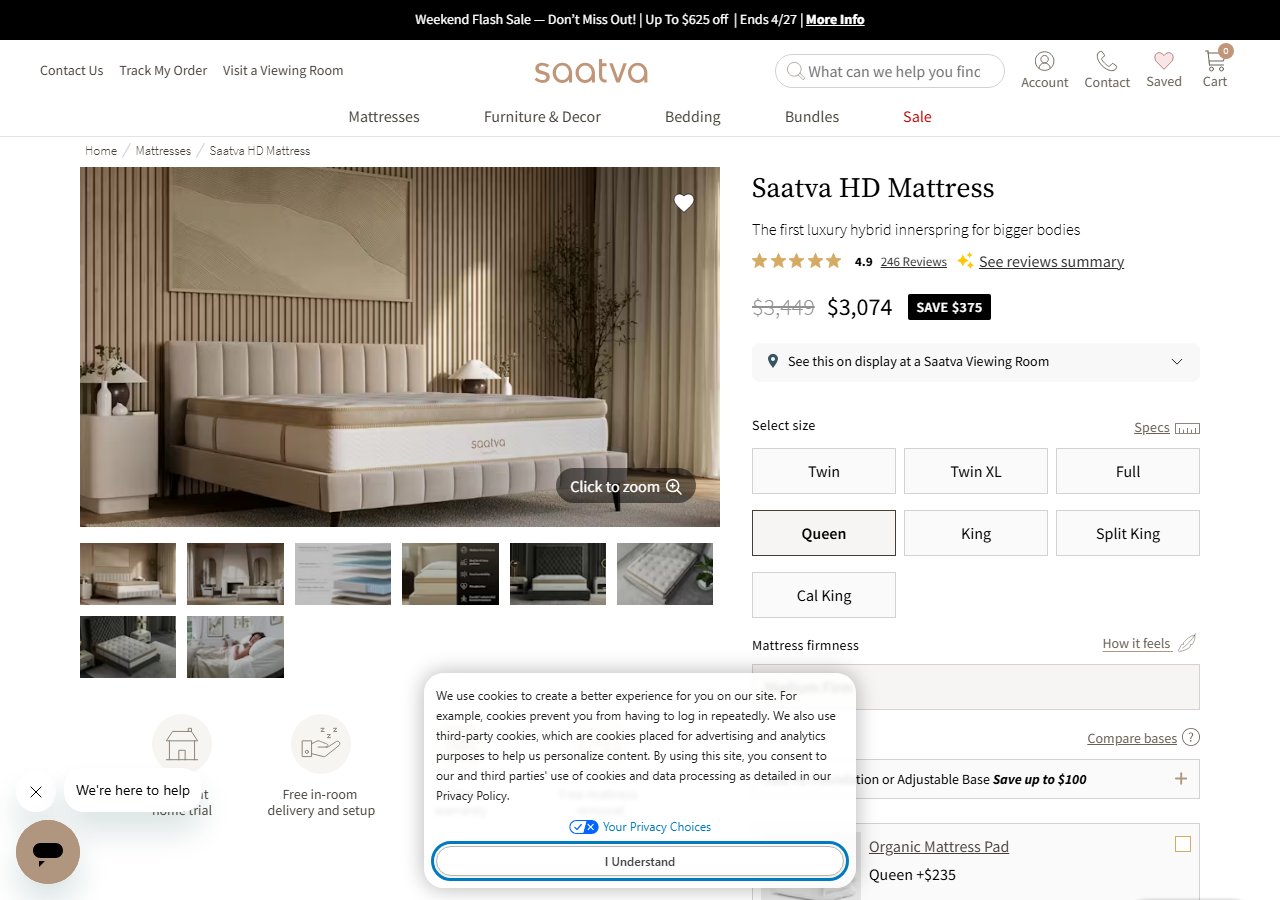
Saatva HD Mattress (Heavy-Duty)
$2,395-$3,995
See Price at Saatva →
Purple Hybrid Premier Mattress
$2,499-$4,799
See Price at Purple →What the Data Actually Tells You to Do
The federal data on back pain is not subtle. CDC NHANES data puts 20% of U.S. adults in chronic pain with the back as the most common site. AHRQ HCUP and MEPS data quantify the staggering healthcare costs that follow. SSA disability data shows this condition driving more disability claims than any other category. These are not marginal statistics — they describe one of the most prevalent and economically consequential health conditions in the United States.
And yet the intervention hierarchy that the evidence supports is remarkably unglamorous: walk daily, correct your sleep position tonight with a pillow, fix your lifting mechanics at work, replace a mattress only when it is objectively degraded or has outlasted its useful life. When you have done those things and the pain persists, a well-engineered mattress — medium-firm, zoned for lumbar support, with appropriate pressure relief at bony prominences — is a legitimate adjunct. The products above represent three different engineering approaches to that problem, at different price points and for different body types and pain presentations.
The most important number in this article is not a price point. It is 20% — one in five American adults managing chronic pain every day, many of them in occupations that the BLS and NIOSH have documented as systematically damaging to the lumbar spine. For that population, every controllable variable matters. Sleep surface is one of them. It is not the most powerful lever, but it is an eight-hours-per-night variable that adds up to roughly 2,900 hours per year of either therapeutic or detrimental spinal loading. Getting it right is worth the research.